Story 44 of 52
By M. Snarky
In 1974, the California Supreme Court ruled that pinball was more a game of skill than chance and overturned its prohibition in Los Angeles, prompting a pinball arcade renaissance in the city.
Our local pinball arcade which practically popped up overnight was on the east side of Lankershim Blvd near the corner of Weddington Street, in North Hollywood, California, or NoHo as it is now called. It was almost directly across the street from the old El Portal theater and was located in an old single-level brick building. I don’t remember the official business name of the pinball arcade, but it was definitely not the Funky Flipper which closed in 1973 and was further south on Lankershim near Otsego Street, famous for its proximity to Bill Elkins’ The Basement recording studio where people could catch a glimpse of Linda Ronstadt, or Tom Petty, or Jackson Browne.
The prices were one game for a dime and three games for a quarter and if I added up all of the money that I spent at that pinball arcade, it would have been about $26 over a one-year period. Adjusted for inflation, it would be $163.57. Wowzah—it seemed like cheap entertainment at the time. There was, however, a certain level of social status if you held the high score on one of the machines. It was also a gathering place for locals. My brother Scott, cousin Chris, and I would often walk together to meet up at the arcade with other friends in the neighborhood. We would often play against each other, but it was ultimately about getting the highest score and getting your name on the board.
There were also some older boys and men hanging around who smoked cigarettes while they played pinball (there were ashtrays on many of the pinball machines) and it seemed to be very tense when a few of them would be standing around a single-player machine while someone else was playing with intent, indicating, perhaps, that the gambling rumors were not a myth.
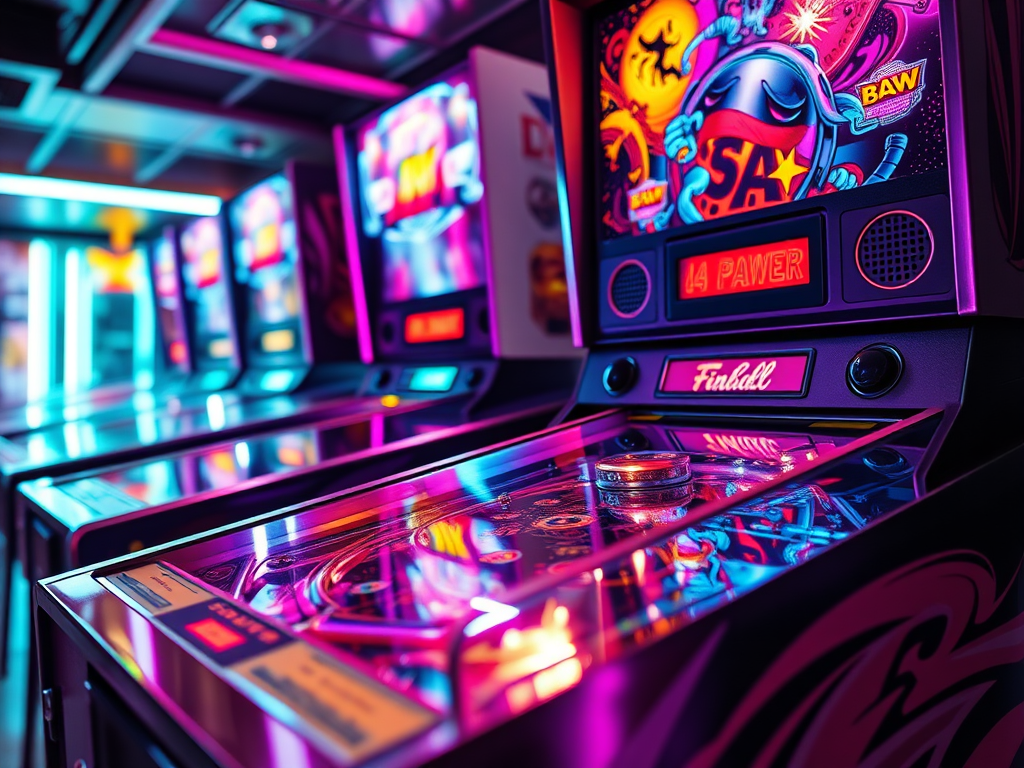
The pinball machines of that era were all analog electromechanical devices and did not have any solid-state components. They were built with incandescent lights, switches, transformers, relays, and solenoids and they were always warm to the touch.
In the summer of 1974, I was thirteen years old and I held the high score of 74,800 points on the Bally’s Fireball pinball machine for two weeks. Fireball was a challenging game. It had a spinning disc in the center, a kickback kicker on the left, two captive/kickout holes (Odin and Wotan), a Flipper Zipper feature that would bring the flipper tips close together allowing you to hold a ball captive, and the usual scoring bumpers. If you were good, you could play three balls at a time and quickly rack up the points. The tilt on this machine wasn’t too touchy, so you could get away with some relatively aggressive table shaking.
I learned all of the nuances of the pinball machine, for example, the exact pullback length of the plunger to give the pinball just enough momentum to drop into the 3,000-point chute. I knew where the dead zones were, and the exact point on the flippers to launch the pinball exactly in the direction where I wanted it to go on the board, and precisely how much shaking I could get away with. I always scored enough points for at least one Replay (a free game!), which were signified by a loud knock emanating from inside the machine, the replay point thresholds of which were 52,000, 72,000, and 96,000. I could play Fireball for about half an hour at a stretch on one thin dime. Indeed, I was the temporary Pinball Wizard of Fireball.
The male arcade manager, a thin, bearded, middle-aged hippie type with long stringy black hair that he parted on the side for a world-class comb-over to hide the top of his balding head kept a blackboard behind the change counter where he tracked the names, dates, and pinball machine scores, and it looked something like this:

It didn’t take long before the pinball arcade manager determined that he was probably losing money with kids playing for such a long time on one dime, so he adjusted the tilt setting on all of the pinball machines to ridiculously low, hyper-sensitive levels that essentially tilted out with the slightest nudge. This made it much harder to get a high score or a replay. Subsequently, the high scores listed on the chalkboard were impossible to surpass and as time went on, the dates were never updated. This may have also been part of the calculus of the arcade manager in that people would spend more money to try and beat the old high scores.
One fall day, as I was walking home from Walter Reed Junior High School, I wandered over to the pinball arcade with two dimes rattling in my pocket with the intent of setting the high score on Fireball once again, but when I got to the building there was a large sign on the door that said, “Business Closed.” I peered into the dusty window and saw that all of the pinball machines had vanished, but the high score blackboard was still hanging on the back wall without my name on it, mocking me.
There were rumors floating around about the arcade closure; it was a front for a gambling operation; it was a front for a drug dealing operation; there was an armed robbery, and the owner/manager was shot and killed; a jealous woman caught her man with another woman and shot him dead.
Rumors aside, I never found out what truly happened there, but it never reopened as a pinball arcade.
It’s all gone now. All of the nineteenth century brick buildings have been replaced with trendy new movie theaters, shiny office buildings, and fast-food restaurant chains.
Links
Funky Flipper https://www.facebook.com/groups/losangelesnostalgia/posts/462213053236535/
Bill Elkins’ The Basement (renamed The Alley) https://nohoartsdistrict.com/the-legendary-alley-studios/
Bally’s Fireball pinball machine https://pinside.com/pinball/machine/fireball-bally
That Time America Outlawed Pinball https://www.history.com/articles/that-time-america-outlawed-pinball
Instagram: @m.snarky
Blog: https://msnarky.com
©2025. All rights reserved.
 msnarky