
Future Former L.A. Resident

Story 50 of 52

By M. Snarky

Our written plan to exit from Van Nuys (gentrified in 2007 as Lake Balboa), located in the San Fernando Valley, a suburb north of Los Angeles proper, stemmed from an encounter with a person I dubbed Dirtman.

In and of itself, taking the effort to write out an exit plan makes it a serious affair by default. It makes it tangible. It makes it actionable. It moves it from a nebulous idea to reality.

How we met Dirtman was something out of a dark comedy. You see, my wife Kim and I walk with our Aussie-Doodle dog named Sydney almost every night around our neighborhood. We arguably know it better than any of our neighbors. I wrote about Walking in My Neighborhood in detail in July of 2024. It hasn’t changed much.

We know which houses have the dogs that start barking a block away, and which houses have the dogs that start barking when you are two doors down, and which houses have the lying-in-wait assassins that postpone barking until you are directly in front of them before they release their fury…and subsequently makes you release your adrenaline. These furry fuckers are almost exclusively the mean little dog breeds. I recently wrote about my firsthand experience with Mean Little Dogs too. You can hear some of these dogs continue to bark long after you are gone and onto the next block…or two.

On a recent July evening as we were walking our usual three-mile route around the neighborhood, we turned the corner into the second cul-de-sac south of our house and this is where we first encountered Dirtman. There he was, standing on top of a large pile of dirt that was dumped in the street, stomping his feet on it, and raising a huge cloud of dust. Apparently, this dirt was originally to be used for someone’s backyard landscaping project, but since it was on a public street, Dirtman appropriated it and then proceeded to flatten it out in his apparent rage against dirt.

Next, Dirtman took off his backpack and his heavy canvas jacket­­—which was already completely out of place for a hot July evening—and then he started dragging the jacket back and forth through the loose dirt very deliberately (as if he were dredging a piece of chicken through a pan of flour), and then he threw the jacket down and started throwing huge handfuls of dirt all over the entire garment. Dirtman then proceeded to carefully pick up his jacket by the collar and gently shake the dirt off—emulating the character Pigpen from the Peanuts comic strip the entire time—and then he folded it up carefully and angrily threw it back down on the pile of dirt again. Then he proceeded to roll his body around in the dirt pile like he was a human steamroller, or as if he were practicing the Stop, Drop, and Roll fire safety technique that he learned in elementary school, assuming of course that he did attend an elementary school of some sort.

He didn’t say one single word, but he did sneeze uncontrollably a few times. By now, his perspiration was turning the layer of dirt that was stuck to his face, neck, and arms into a thin layer of dark mud, looking like something you’d get in a fancy day spa for $500. Maybe he was just trying to channel an Aboriginal man living in the outback.

It was next to impossible to tell how old he was with the coating of dirt and mud, but I would guess he was thirty-something. His dark eyes had a glazed, wild look in them indicating that he was probably very high on something, and I did my best not to make direct eye contact as we passed him at a distance. I once read in some psychology article somewhere that direct eye contact with a person who is having an obvious mental breakdown can trigger a violent reaction. This no-direct-eye-contact technique comes in handy here in the suburbs of Los Angeles where the crazies now rule the streets.

As we walked past Dirtman, I noticed that the gate at the end of the street that leads to the infernally busy Balboa Blvd was wide open. The only thing missing was a flashing neon sign that said, “Open.” This was unusual because everyone who lives on any of the six cul-de-sacs that dead-end at Balboa know to keep the gates closed and locked to prevent the encroaching homeless population from entering the neighborhood, or at least offer a minor deterrent for the lazy ones. I believed keeping the gates locked was common knowledge around here, but someone apparently didn’t get the memo. It was probably a preoccupied teenager staring at the screen of their smartphone.

As I walked past the gate, I closed it and made sure that it locked. Kim said (in the sweetest, most sarcastic voice one could ever hear), “Great; now he’s trapped in our neighborhood.” It made me chuckle at first, but in the next moment I realized my folly: By not knowing the true state of mind of this Dirtman fellow, closing that gate may have seemed to him like I was locking him in and now my mind was racing with all sorts of wild what-if scenarios of nasty in-your-face verbal altercations and unrelenting physical violence. Then I remembered that I had my pepper spray with me and felt a sense of relief, but I kept him in the corner of my eye anyway.

As we turned the corner out of the cul-de-sac to continue our walk, Kim uttered the words that no husband ever wants to hear: “I don’t feel safe in our neighborhood anymore.” This sent a chill down my spine. We have lived in this neighborhood for 26-years. This statement meant—in no uncertain terms—that we were going to need to start planning our exit NOW. Our hand was forced not by a job change, or by a bad economic situation, nor by any other internal, familial, or personal issues; it was forced by externalities that we have no control over.

Granted, this homeless population has been slowly yet perpetually closing in from all of the major boulevards and streets around our neighborhood: Roscoe Blvd to the north, Saticoy Street to the south, Balboa Blvd to the east, and Louise Ave to the west. We found ourselves living on an island surrounded by a sea of homelessness and lawlessness.

Street takeovers, street gang graffiti, deadly assaults on public transportation, homeless encampments, wildfires started by people living in homeless encampments, robberies, burglaries, RVs in various states of decay parked on the streets, abandoned cars, piles of trash, fires, squatters, open drug deals and open drug use in the middle of the day, and people sleeping on the sidewalks have been pervasive for years, but it has mostly stayed in the periphery of our neighborhood. I’m sorry to say that we had become mostly desensitized to it because you see it everywhere, every single day!

The city and county of Los Angeles are abject failures on so many levels that it truly was only a matter of time before we would be forced to leave in order to preserve what waning sanity, patience, and hope that we have left. Mind you, this is not a trivial decision. I was born in Los Angeles, and I’ve lived here for most of my life. I met Kim (who was born in Burbank) and we got married and raised our children here. Our eldest son Travis died here. It makes me so sad that this formerly fantastic city—a city of the world—is now entirely crestfallen and has become so incredibly untenable that it repels its own native sons and daughters.

Los Angeles has completely lost its soul and there is zero sense of community anymore. It is now mostly populated by cliques who are only looking out for themselves. The harsh reality is that tribalism rules the day here as the corrupt cabal in city hall continues to circle the drain.

What was once a shining city on a hill, Los Angeles is now an imploding, burning city poised at the gates of hell. The City of Angels has completely ceased to exist—nowadays it more closely resembles Gotham City.

The reasons most people moved into the Valley in the first place was that it was not like living in Los Angeles: The Valley was less congested with traffic and less crowded, it was cleaner, it had better schools, it had newer malls, it was suburbia on steroids for all of the right reasons. But now the Valley has simply become an extension of Los Angeles for all of the wrong reasons, and it is hard to tell the difference between the two anymore.

Fortunately, our little 73-year-old post war tract house sold quickly, and we close escrow soon. We bought a place in another county as far away from Los Angeles as our jobs and careers would allow. I hope the new neighbors will forgive us for being from L.A. On second thought, maybe we should downplay that little fact

Best of luck with the 2028 Olympics, Los Angeles, but I’m sure that the city will put on a lovely façade as only phony Tinseltown can do, and then it will be back to business as usual: broke, broken, corrupt, dysfunctional, and crime ridden. I wonder where they’ll hide all of the homeless people and their derelict RVs and travel trailers for the television coverage of the games. Maybe the city will give them an EBT card and directions to Slab City.

Perhaps Dirtman was simply a metaphor for this insane, dirty, scummy, out of control city.

Vaya con Dios, Los Angeles.
Instagram: @m.snarky

Blog: https://msnarky.com

©2025. All rights reserved.

Bluffside Park

Story 45 of 52

By M. Snarky

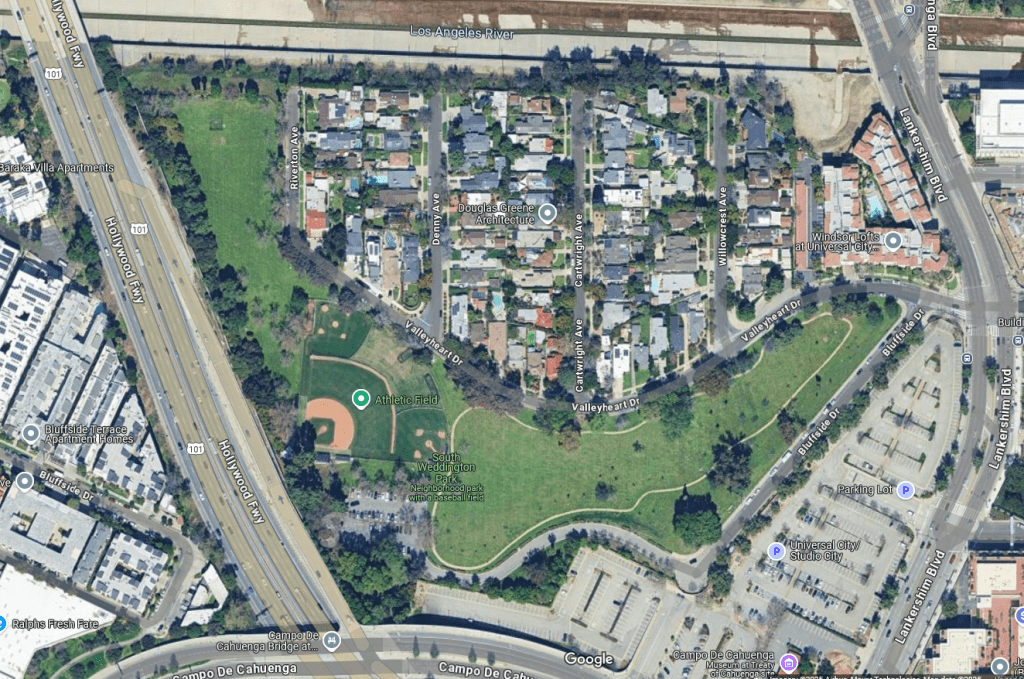
Between 1979 and 1984, Bluffside Park was the unofficial local name for South Weddington Park in Studio City, and it was the “secret” place where all of the hip cool young people from Studio City, North Hollywood, and the Hollywood Hills would meet up to find out the answers to the many important questions of the day:

  • Was there any good weed to score?
  • Does anyone know where to score some cocaine?
  • Where were the weekend house parties?
  • Were there any good bands playing at the Starwood, Gazzarri’s, or Phases?
  • Does anybody have any clove cigarettes?

Good weed was relatively easy to obtain around Los Angeles most of the time and some strains were vastly better than others—some of which would knock you on your ass—but getting your hands on some decent cocaine required knowing a guy who knew a dealer and trusting that the blow wasn’t cut with too much lactose or mannitol. Ultimately, you just had to trust the system and weren’t going to get ripped off.

The curious thing about cocaine is that while it impresses people as a classy drug used by sophisticated individuals such as artists, musicians, poets, actors, and writers—ergo, sophistication by association—it simultaneously drains your bank account at $100 per gram. That was a lot of money back then, especially for a low roller like me making only $5 per hour as an electricians apprentice. Indeed, a spare Benjamin was hard to come by but all too easy to spend foolishly in an attempt to impress friends and love interests. Although I did enjoy getting high on cocaine, I could only indulge in it occasionally because I needed to make rent on a regular basis, which was unlike some of the young adults in the neighborhood who were still living with their wealthy parents and always seemed to have a vial or two of cocaine in their pocket.

As it was, Bluffside was one of those local impromptu gathering places where sometimes only a handful of people would show up and at other times the small dirt parking lot was completely full of cars and anticipation. There was always a good chance that you would run into someone that you hadn’t seen in a while which would give you the opportunity to catch up on things, exchange phone numbers, and maybe get high together.

Unfortunately, the locals living in the Bluffside enclave hated the sometimes-noisy crowds that occasionally blasted the KROQ soundtrack of the day on the Blaupunkt radio installed in their parents BMW’s or Mercedes-Benz’s. Apparently, music by The Clash, The Dead Kennedys, The Police, the B-52’s, and Iggy Pop violated the collective sensibilities of the well-heeled neighborhood and so they would call the L.A.P.D. regularly.

The cops arrival would disburse the crowd remarkably fast when they rolled up because they were easily spotted due to the park being accessible only by two streets: Bluffside Drive to the east and Valleyheart Drive to the north. The park boundary was wedged between CA 101 to the west and the concrete L.A. River (a.k.a. “the wash”) to the north, and it was easy to ditch the cops along the verge of the 101 or the verge between the wash and the residential houses in the tony little neighborhood.

The unofficial yet generally accepted schedule at Bluffside was to meet on Friday night after work, disseminate and absorb all of the critical information, chose your adventure, and then meet again on Saturday night and repeat the process. By Sunday night, the talk was mostly about the disasters, misadventures, and the highlights of the previous 48-hours. There were also plenty of casual conversations revolving around music and food and books and movies and sometimes a bit of juicy gossip would creep into the conversation about who started dating, who broke up, and who was having sex with whom.

The legendary house parties were absolutely wild. There were many wealthy families living in the area who worked in the automotive, aerospace, music, television, or film industries, and some of them lived in these fabulous hillside houses that had large swimming pools some of which included detached cabanas or pool houses. Often, the parents would go on a lengthy vacation and leave their eighteen-year-old or so offspring at home by themselves because there is nothing more tedious and troublesome than traveling with adult children, the term of which appears to be an oxymoron.

Leaving an unsupervised eighteen-year-old “adult” at home was analogous to leaving an arsonist with a five-gallon jerrycan of gasoline and a match: At some point combustion was going to happen. One phone call to one friend would start a chain-reaction of other phone calls to other friends, and exponentially, the news got around quickly. Soon, hundreds of random people—some known, others being perfect strangers (if there is such a thing)— start showing up on a Saturday night to party their asses off like there was no tomorrow because, frankly, at that age most of us were living in the moment which was all that truly mattered.

The age span between eighteen and twenty-one is like purgatory because you are considered an adult and are of legal age to vote and engage in contracts or join the military or buy a car or borrow money from the bank to buy a house, but you can’t buy alcohol, one of the great privileges and pleasures of true adulthood. When you are stuck in this underage limbo, the only way to get alcohol was to know somebody who was old enough to buy it for you, or you had to resort to “pigeon” for it. To pigeon was to hang out in a liquor store parking lot out of sight of the store clerk and ask someone who was going inside the liquor store to purchase your alcohol for you. At best, the odds were 50/50. Circus Liquor in North Hollywood was my liquor store parking lot of preference because it was close to where I lived. Indeed, the only way to get your fifth of Cuervo Gold or a six-pack of Bud tall boys was by proxy. There were other, more nefarious ways like shoplifting, but I always considered theft one of the lowest forms of human conduct and refrained from engaging in such a lowly act.

This was a pre-GPS era, so unless you had a Thomas Guide in your car and knew the street address of the house party (of at least the general vicinity), you would often pile into the car of a guy who said that he knew where the party was, and along with your plain brown paper bag of beer or tequila, you drove off to parts unknown. We would often get lost and missed out on many house parties with this method. The surest way to find the house party was to convoy with a bunch of other cars that were following the guy in front who did have a Thomas Guide and snake your way up into the narrow streets of the Hollywood Hills.

One of these house parties was near Laurel Canyon Blvd and Mulholland Drive, overlooking Hollywood. The house was stylishly furnished, replete with leather couches, crystal chandeliers, marble, and all manner of artwork. There was a better than average live rock band playing under a cabana on the pool deck. There were several kegs of beer on ice in plastic trash cans that were lined up along the back wall of the house. Drinking Heineken from a keg is not the same as drinking Heineken from a bottle—it was considerably better, and so it flowed endlessly into my bottomless red cup. The house was jam-packed with partygoers and marijuana and clove cigarette smoke permeated the air. People were smashing out their cigarette butts on the hardwood floors and spilling their beers all over the house. Some people were snorting cocaine from the marble countertops in the kitchen.

As I was bumping my way through the crowd toward the band, Tom Armstrong, an old hooligan friend that I hadn’t seen in a while, spotted me from the opposite side of the pool and yelled out my name. We acknowledged each other. He was there with his friend Duke. Tom said something in Duke’s ear, and then they started walking briskly in opposite directions around the pool toward me. This could only mean one thing: They had conspired to throw me into the pool. Not tonight, boys! I spotted some Italian cypress trees at the far edge of the pool deck and decided that I was going to hide behind them. The thick crowd of people slowed them down considerably and I bent down as low as I could while winding my way through the thicket of people toward the trees hoping that Tom and Duke would lose sight of me.

When I got to the edge of the slate pool deck, I briefly glanced back to see Tom and Duke closing in on me. I took a step beyond the deck thinking that it was a planter bed where the Italian cypress trees were located, but it wasn’t…it was the ledge of a concrete retaining wall. I stepped off the ledge and fell down about twelve feet into the darkness and almost landed on a couple who were making out on a bench in the planter below. I hit the dirt hard on my right side. It knocked the wind out of me, and I was sure that I broke my right arm and maybe some ribs. The guy on the bench jumped up and said, “Dude—are you okay?” I couldn’t talk yet because I was still struggling to catch my breath, so I just nodded my head, slowly stood up, and limped away holding my arm and headed back toward my car to drive myself to the emergency room. On the way to my car which was parked way up the road, I ran into my friend Mark Flaata who had just arrived. By then I had recovered considerably in the miraculous way that one recovers quickly when one is young. My arm and ribs were definitely not broken, but my confidence definitely took a major hit. We went back into the party and stayed until the cops showed up around midnight and shut it down.

Meeting back at Bluffside the next night, we heard many other stories about the same wild party. It’s funny how people can be at the same place at the same time yet not run into each other while also having a completely different experience. Drama, comedy, run-ins with law enforcement, breakups, hookups, philosophical conversations, religious conversations, swearing off drinking alcohol or doing drugs, passing out on the front lawn, and musings about the meaning of life were all part of the various storylines that were told. In those moments, we represented our fleeting wasted youth in the truest form possible.

This was all part of an earnest—although ultimately futile—effort to stave off the requirement to get serious about life because no young person wanted to end up like their parents working long hours in jobs that they hated and being stuck with all of those serious adult responsibilities like insurance and mortgages and car payments and the multitudes of problems that seem to accompany them.

No matter our purest intentions, time marches forward mercilessly regardless of how tenaciously we try to hold it back, and most of the once fierce, invincible, carefree teenagers eventually become another cog in a massive, indifferent, mindless system that strips them of their soul and spits out their bones when it is done with them, repeating the infinite cycle of modern society.

Luckily, some of them survive with their souls intact. These are my kind of people.

Instagram: @m.snarky

Blog: https://msnarky.com

©2025. All rights reserved.

Lifeguard Queen

This is an AI generated image that looks remarkably like the Lifeguard Queen of my youth.

Story 42 of 52

By M. Snarky

Late summer, 1974, North Hollywood, Calif. The walk from our apartment at 5342 Cahuenga Blvd to the North Hollywood Pool was about a mile, and for 25¢ you could swim all day. With only our towels in hand and one quarter each in our pockets (Grandma Opal Hess would say, “two-bits”), we walked directly west down the dry and dusty Union Pacific Railroad tracks that paralleled Chandler Blvd to North Hollywood Park, and then turn left at Tujunga Ave where the pool was located on the west side of the street just beyond the public parking lot. When the temperature rose above 100-degrees, it was like walking through the sweltering heat of a desert, but it was always worthwhile because I knew she would be there.

I had just turned 13, my younger brother Scott was 11-1/2, and our younger cousin Chris was 10-1/2. The three of us were accidentally representing the poor white boys of North Hollywood with our holey T-shirts, cut-off jeans, knee-high tube socks with holes in the heels and the toes and our worn out Keds and Converse sneakers. We had no food, no water, no sunscreen, and usually no extra money – not even a nickel for some bubble gum. Our parents were so broke that we would often have to resort to scouring the neighborhood for returnable soda bottles to collect enough money for the pool entry fee.

Whenever we did have any extra change, we would stop by the Winchell’s Donut House near the corner of Lankershim Blvd and Chandler because it was on the way to the pool, and we would have been foolish not to pick up a few 5¢ donuts.

At the front counter of the pool house, you handed over your hard-earned quarter to the attendant for a ticket, then you took the ticket over to the men’s side of the pool house where there was another counter. There was a hand painted sign above that counter that said, “No Cut-Off Jeans!” and, “No Swimming in Underwear!” and “No Urinating in the Pool!” There was another hand painted sign above the door that exited to the pool deck that said, “Rinse Off Before Entering Pool.” Being the ignorant youth that I was, I would have argued that the no cut-off jean policy was dumb and that the no swimming in underwear and no urinating in the pool rules were obvious, but why do I need to rinse off? But rules are rules, and in a public space they must be posted…and obeyed, that is, if you want to avoid getting kicked out.

There was this persistent rumor going around that there was a chemical in the pool water that turned bright red if you peed in it, which signals to everyone in the water around you AND the lifeguard staff that, a) you are a rule breaking savage, and b) you will be promptly removed from the pool, Pissboy will be tattooed onto your forehead, and you will be escorted off of the premises by two burly lifeguards, and banned for life from entering any of the Los Angeles County Parks & Recreation managed public pools. I will tell you unequivocally (although not without some level of embarrassment) that this was indeed just a persistent rumor that I believe was likely propagated by the lifeguard union.

Anyway, you gave the male attendant your ticket and they would hand you a mesh bag with what I can only describe as a large diaper pin that had a number stamped on the end of it which matched the stamped metal number tag attached to the bag. The first time we went to the pool I had no idea what I was supposed to do with the mesh bag or with the pin. After observing what the other men and boys did with them, I quickly figured out what to do, so I put my beat-up shoes, tube socks, T-shirt, and cut-off jeans in the bag, attached the pin to my swim shorts, and handed the bag over to the young man behind the counter who promptly hung the bag on a rack in numerical order.

Scott, Chris, and I, after rinsing off in the remarkably cold water (why was there never a hot water valve?), walked out onto the pool deck like we owned the place. Around the entire pool deck, about every ten feet or so, painted in fire engine red, was “NO RUNNING!” in huge, stenciled letters. More rules. So, with our towels draped around our necks, we briskly walked over to our favorite spot on the deck near the far southeast corner of the deep end where I could observe the high lifeguard chair from afar, which was the throne upon which my Lifeguard Queen sat.

She was a tan, brunette beauty with hazel eyes, wearing Ray Ban Aviator sunglasses, a white sun visor, and the iconic red one-piece Los Angeles County Lifeguard issued bathing suit. Being an official lifeguard, she also had the shiny metal whistle on a lanyard around her neck and a large megaphone by her side. She was a magnificent, powerful sight to behold, and I was crushing hard.

Mind you, I was not creeping on her or staring or ogling – I would simply glance over at her every now and then, hoping that one day she would notice me and smile and maybe wave at me. I had no idea what I was going to do if she ever did acknowledge me like that, but I probably would have suffered a heart attack.

I was comfortable in the water and thought that I knew how to swim, but I truly didn’t know how to swim well. You could say that I only knew how not to drown, just like most other recreational swimmers, I suppose. It wasn’t until I took professional swimming lessons decades later at Los Angeles Valley College for Ironman training with my wife Kim, that I realized how bad I was at swimming. How bad? It went something like this: On the first day of training, coach Stuart directed us (about three-dozen people) to self-seed ourselves along the pool coping thusly, “Advanced swimmers in the right-hand lanes, intermediate swimmers in the middle lanes, and beginning swimmers in the left-hand lanes.” I considered myself an intermediate swimmer and lined up in the middle lane.

Then coach Stuart said, “Okay swimmers, we’re going to split lanes for this drill in a clockwise direction, so we don’t swim into each other. Tom, Frank, Lisa, and Caroline will demonstrate this for you.” The four of them jumped into the middle lane and with a “Yip!” command from the coach, they started swimming in single file along the left-side next to the pool lane divider and when they got to the far end of the lane they turned around and came back along the right-side pool lane divider, passing each other without crashing as they swam in opposite directions.

Coach Stuart continued, “Does everyone understand this?” and we all nodded our heads in acknowledgement. “Now I want everyone to swim a few laps to warm up – Yip!” And with that, we jumped into the water and began swimming as directed. When I got back to the coaches side of the pool after a couple of laps, coach Stuart signaled me to the coping and asked me my name. “Okay, Kent, move down a lane to the left.” I moved down as directed. After a couple more laps, coach Stuart signaled me again and said, “Brad, move down another lane to the left.” I complied. By the time the warmup was over, my name was Norman, and I was standing in the wading pool.

But back in 1974 at North Hollywood Pool, I felt like I was channeling Olympic Gold Medalist Mark Spitz, and I was positive that I caught the queen’s eye once or twice as I swam by her elevated throne.

On the opposite side of the pool from the lifeguard chair were the two glorious springboards – one set at 1-meter, and the other set at 2-meters. These were our favorite activity to do at the pool. We got pretty good at doing jackknifes and swan dives (or so we thought), but big fat cannonball and cherry bomb splashes were our favorites. We mostly just goofed around doing boyish things like belly flops, lazy forward flips, mostly out-of-control back flips, and “Change-your-minds” where you acted like you were going to dive straight into the water but tucked into a cannonball at the last second.

On the last August day of the summer pool season – which was coincidentally also an extremely hot day – a Speedo wearing whale of a man swam right into the diving lane impact zone as I launched myself off of the springboard. I was in midair when I heard the whistle blow, but I didn’t see him until it was too late because I was looking across the pool to the Lifeguard Queen of all my dreams who was blowing said whistle. I collided with him upon entry of my almost perfect starfish belly flop, the impact of which knocked the wind out of me. I involuntarily inhaled a lungful of water which burned my lungs like fire. I began gasping uncontrollably for air under the surface of the water as I started sinking. The last thing I remembered was hearing a muffled splash next to me as I was looking up at the blazing, shimmering sun through the rippled surface of the water.

When I came back to my senses, there she was, smelling like Coppertone coconut tanning oil, leaning over me with the bleach scented chlorinated pool water dripping off of her face and hair and red swimsuit, giving me mouth-to-mouth resuscitation on the warm concrete pool deck. Her lips tasted like cherry flavored ChapStick. She was even more beautiful close up. Was I in heaven? I looked into her stunning hazel eyes and smiled. She pulled back and asked, “Kent, are you okay?” She knew my name! THE LIFEGUARD QUEEN KNEW MY NAME! Wait! How did she know my name? What happened? Never mind – let it happen! I started to say, “I love you, Lifeguard Queen!” but before I could say anything, I was rudely awakened by a big splash of pool water. Alas, it was all just a very vivid dream, probably intensified by the heat, hunger, and dehydration. But it seemed so real.

On the way out through the pool house that day she was working the front counter. We made eye contact, and I bashfully looked away. She said, “Cool Tee-shirt!” I was wearing a classic white Coca-Cola Tee-shirt with the red arm and neck ringer bands. I blushed. Then she said, “Have a nice day – see you next summer.” My heart skipped a beat. In an awkward, broken voice, I barely got, “See you next summer,” out of my mouth. At that age, “next summer” always seemed such a long way off and it would never come soon enough.

Summer, 1975, North Hollywood, Calif. This year we had secondhand BMX bicycles that we pieced together to get to the pool faster! On opening day, we raced each other down the railroad tracks from the apartment to the pool. All along the way we kept trying to one-up each other to see who could bunny-hop the highest or ride a wheelie the longest – this turned into a serious competition! Breathless, we locked our bikes to the rack at the pool and rushed to the front counter to get our tickets. The three of us; Scott, Chris, and myself, breathing heavily and dripping with sweat, didn’t even register with the attendant who just smiled at us as he took our quarters and handed us our tickets.

The singular thing that was occupying my mind was the Lifeguard Queen.

This time, the cold shower before entering the pool area was appreciated after riding our bikes so hard in the summer heat. We speed-walked toward our regular corner when we heard “Slow down!” coming over the staticky public address system, clearly directed at the three of us. We complied and slowed down – barely. As we briskly walked behind the queens throne I glanced up to get a brief look of her highness without being too obvious, but this time, the occupant of the throne was not the queen, instead, there was an imposter in her place: the throne was being occupied by one of the male lifeguards. Noooo! Where in the world was my Lifeguard Queen? Wahhhh! Sadly, I never saw her again. The pool days were never the same afterward. I felt an emptiness in her absence and became less enthusiastic about going to the pool.

Although I didn’t learn what her real name was, I imagined that it was something regal like Elizabeth, Genevieve, Catherine, or Margaret.

The summertime always reminds me of those carefree days at that pool with my brother and cousin, but mostly, I wonder about the Lifeguard Queen.

Old crushes die hard.

Instagram: @m.snarky

Blog: https://msnarky.com

©2025. All rights reserved.

It’s Everybody’s Fault

Story 40 of 52

By M. Snarky

Another controversy and another peaceful protest that morphed into a riot in Los Angeles which looks remarkably similar to a Dodgers World Series championship celebration. Some things will never change.

This time, it’s about federal Immigration and Customs Enforcement (ICE) agents in the sanctuary city of Los Angeles within the sanctuary state of California enforcing federal immigration law, the media narrative of which is labeled as “ICE Raids.”  When the citizens of L.A. got news of this, the peaceful protests began. Not soon afterward, the wolves amongst the peaceful protesters started vandalizing public and private property and then they started flying foreign flags and started burning American flags amongst many other things and then they started looting businesses and hurting people. This is the point at which the protesters completely lost my support for their cause, however noble it may have been.

President Trump, in his usual fascist bullying manner deployed the National Guard to support ICE allegedly without notifying Mayor Karen Bass or Governor Gavin Newsom. Mayor Bass blames Trump for the rioting yet resists cooperating with ICE. Governor Newsom blames Trump for the rioting yet resists cooperating with ICE. And then in Governor Newsom’s perpetual effort to both appear on national television and not let a crisis go to waste (right out of the Rahm Emanual playbook), thumbs his nose at Trump and promises to sue but does nothing to actually deescalate the violence. The idiocy of this is breathtaking.

Thomas Jefferson once said, “The government you elect is the government you deserve.” Well, here we are. Great job everyone.

For the record, I completely reject Trump dispatching military resources to my city – this is not 1930’s fascist Germany or Italy. People are going to get hurt and killed, and this blood will be on the hands of Trump, Newsom, and Bass, the trifecta of disastrous political leadership.

That being said, I don’t see this immigration issue as black-and-white at all; I see this as the culmination of failure of leadership at the federal, state, and city government levels for decades which has brought this city to another boiling point. The only black-and-white that I can discern from all of this chaos is that you have the open border advocates (typically Democrats) on the one side, and you have the law-and-order advocates (typically Republicans) on the other side, and on this illegal immigration issue, the two of these are mutually exclusive.

I am a U.S. citizen that was born right here in Los Angeles. I’m also a migrant every time I travel internationally, and not only do I have to prove who I am with my U.S. government issued passport, I also have to fill out a visa form, letting the foreign government know whether I’m there for business or leisure, where I’m going to, and where and for how long will I be staying. Sometimes they also want to know what my profession is and my annual income, whether I’m married or single, and so on and so forth. My face is scanned. My thumbprint is taken. This is all in an effort to validate that I am who I say I am. In the background, I’m sure that my information is checked with INTERPOL and FBI databases to assure that I am not a terrorist threat, or a criminal, or a person of interest. Only after getting clearance, will I be allowed into their country. Fair enough.

It’s a slight inconvenience, but not insanely difficult. I have no idea what actually happens to someone who is red flagged other than they are taken to a secure area, but it is probably very inconvenient and very likely to include incarceration and deportation, and maybe a strip search and a body cavity check and a beating or two, none of which I want to experience.

But here at the southern border of the U.S. we are not so vigorous as out international counterparts, and this is where things really start falling apart with our immigration policy and law enforcement, and I think that there is plenty of blame to go around.

I believe that the federal government is complicit (dare I say derelict?) when they elected to not vigorously enforce existing federal immigration laws at the porous southern border for decades, under both Democratic and Republican administrations.

The state of California is complicit in its effort to ignore federal immigration laws by allowing undocumented migrants to work in the state without proper federal authority or approval, essentially ignoring appropriate lawful identification and immigrant status verification.

The Los Angeles City Council are complicit in their sanctuary city policy prohibiting city resources from being used to assist federal immigration enforcement. Was this actually approved by the voters in the city, or is this just a flex?

The California Democratic party is complicit for allowing undocumented immigrants to obtain driver’s licenses and for providing public services at the expense of the state taxpayers like in-state tuition discounts for universities, Medi-Cal (California’s Medicaid program) coverage, financial aid like Cash Assistance for Program for Immigrants (CAPI), food and nutrition assistance like California Food Assistance Program (CFAP), and not requiring voters to present photo identification at the polls. This, I think, smacks of pandering to a group of vulnerable people for a voting bloc that will keep Democrats in power. These programs and services also make the state of California a magnet for illegal immigration.

The Republican party is complicit due to their “pro-business” platform (which really isn’t) and wanting cheap labor for their business constituency, so they turn a blind eye to the illegal immigration issue, allowing undocumented migrants to work in the U.S. without proper identification or authority, again, taking advantage of a group of vulnerable people.

The corruptible Mexican government is complicit for not enforcing international immigration law but being that remittances from the U.S. are a significant part of the Mexican economy (around 4%, or $64.75B), they have zero incentive to do so. By the way, this money is not spent stateside stimulating local economies; it is exported U.S. dollars. They are complicit for allowing the drug cartels to cross the U.S. border virtually unabated, providing access for them to sell their deadly drugs inside the U.S. Moreover, having an economy that is so terrible that its poorest citizens choose to leave for better opportunities in the U.S. speaks volumes about Mexico’s domestic economic problems that have been ongoing for generations.

The undocumented immigrants are complicit themselves in that many of them have been here in the U.S. for decades and either let their visitor or work visa expire or crossed the border illegally yet have not applied for a visa renewal or citizenship or a green card or amnesty. To me, this means that they want to remain a foreign national and have no desire to become a legal U.S. citizen or obtain legal permanent U.S. residency – which is fine – but that does not give them a pass to not have their legal documents in order. I’m not going to buy the media narrative that this is because they are afraid of deportation, or that they are poor, or illiterate, or ignorant – it’s paperwork, not rocket science. There are also plenty of free or low-cost public resources available to help them navigate the process, so there really aren’t any excuses not to do it, which begs the question; why haven’t they already done so?

The media are also complicit in changing the language of the narrative from “illegal alien” (a common term used in law) to “undocumented alien” then to “undocumented migrants” or “undocumented immigrants” and then to just using “immigrants” or “migrants,” intentionally blurring the line between legal and illegal status and conflating the significant differences between them and also downplaying the possibility of any criminals crossing the border into the U.S. illegally which may be a low number, like maybe, I don’t know, let’s say a few cartel members here or a few street gang members there or a few murderers and rapists trickling in across the border here and there, but it is definitely not zero. But the fact that we don’t really know this information should enrage Americans of all stripes.

My understanding is that if someone crosses the border of a sovereign country without going through the proper customs checkpoints and processes, they are violating the law. This is known as an illegal entry. If they are a foreigner, they are considered an alien (a term from the 14th century), ergo, illegal alien, the specific term of which has been around for about 100 years. It seems harsh and maybe sounds a little bit dehumanizing, but maybe it should be because they are actually breaking the law! Is breaking the law not a crime? It appears that it depends upon whom you ask.

Twisting a longstanding term like illegal alien into something more generic and friendly sounding like migrant is a serious dereliction of journalistic duty because there is a gulf of distinction between them. It’s like calling trespassing some squishy euphemism like unintentional intrusion. Would anyone call rape overly passionate hyper-sexual activity, or call murder sudden cessation of biological activity? No! Rape is rape, and murder is murder, and everyone knows what these words mean, both of which are heinous, serious crimes, but they are factually crimes. Trespassing is also a crime and so is illegal entry. But when facts are politically unpopular and get in the way of advancing a political narrative, the language is changed by the various factions in power to distract from the truth.

Senator Daniel Patrick Moynihan once said, “Everyone is entitled to his own opinion, but not his own facts,” and John Adams said, “Facts are stubborn things; and whatever may be our wishes, our inclinations, or the dictates of our passion, they cannot alter the state of facts and evidence.” In essence, facts are truth. Truth has meaning. Truth has weight. Truth cannot be altered. Truth actually matters.

But when truth becomes inconvenient and gets in the way of a political movement, truth must become the enemy. Truth must be entirely disregarded or distorted, dissected, parsed, and contorted into something that it isn’t. Through this process, truth becomes fiction, and an alternate definition (the untruth) is brought forward as a replacement. This is how illegal alien becomes immigrant. This is how the narrative is changed from someone who has factually entered the country illegally and violated the law (the truth) to someone who is just a poor, honest, hard-working person looking for a better life for their family (the replacement), which may have some truthiness to it, but it does not excuse the actual truth. My head truthfully hurts thinking about this.

I think our political leadership across the board need to grow up and deescalate the rhetoric and the finger pointing, and the name calling and take a step back and ask themselves this: How can we cooperatively reform this colossal failure of immigration policy in a fair, compassionate, humane manner? These politicians created this unbelievable quagmire and now it is time for them to clean it up.

 I have a few suggestions:

  • Discontinue the ICE raids. These appear to be too much like a Gestapo tactic. In political speech; bad optics.
  • Lock down the U.S. Mexico border. Might be hard, but it’s not impossible. Lots of other countries do it.
  • Allow for a temporary immigration law enforcement hiatus with a hard one-year deadline to allow undocumented immigrants already residing in the U.S. for more than one-year to file appropriate forms. This puts the onus of documentation on their shoulders while also giving them the opportunity to choose whether to stay or to leave.
  • Make it a felony for U.S. employers to knowingly hire undocumented workers. It’s not asking too much for job applicants to prove their immigration status if they want to work here.
  • Make it a felony to enter the U.S. illegally. Lots of other countries do this too.
  • Vigorously enforce immigration laws after the one-year hiatus expires. No more catch-and-release policies.

This, I think, will give undocumented immigrants the time and the space needed to get their legal affairs in order while also deterring illegal entry. If they intentionally choose not to do it, then the full force of the law should be applied to them. No more excuses.

These are not inhumane, unreasonable, or radical ideas, rather, I believe they are sensible and achievable.

Our spineless political leadership just needs to grow the backbone to do it.

Supporting links:

https://oag.ca.gov/immigrant/resources

https://worldpopulationreview.com/country-rankings/punishment-for-illegally-entering-countries

https://www.cato.org/blog/illegal-alien-one-many-correct-legal-terms-illegal-immigrant

https://www.goodreads.com/quotes/32621-facts-are-stubborn-things-and-whatever-may-be-our-wishes

https://www.goodreads.com/quotes/1745-everyone-is-entitled-to-his-own-opinion-but-not-to

Instagram: @m.snarky

Blog: https://msnarky.com

©2025. All rights reserved.

Old Zoo Nights

Story 38 of 52

By M. Snarky

One hot July night in 1976, we pulled up to the locked Griffith Park gate on Crystal Springs Drive near the Wilson & Harding golf course. It was after 10:00 PM. We were in Mark Flaata’s mom’s massive, dark green, fake wood paneled 1972 Chrysler Town & Country station wagon, the same car I wrote about here. Mark turned off the radio and we were given instructions to “Be quiet.” Actually, his instructions were to “Shut the hell up!” Just to the left side of the gate was an equestrian trail that was barely wide enough to allow the humongous station wagon to squeeze through. Mark turned off the lights and drove along the dirt equestrian trail slowly until we got past the ranger station, and then turned back onto Crystal Springs Drive, flicked the lights back on, and drove to the first parking lot near the merry-go-round. There were maybe a half-dozen other cars parked there too.

Although, from a purely technical legal standpoint, we were definitely trespassing into the park after hours, however, the cars that were already inside the park after hours could drive out of the south entrance at Crystal Springs Drive and Los Feliz Boulevard without being harassed by the park rangers. But, if the rangers caught you hiking or walking around inside the park after hours, they would warn you that you could be cited and strongly encourage you to leave RIGHT NOW, or they would radio in for law enforcement which meant the LAPD. I know this from personal experience. Back then the park rangers were not sworn peace officers and were unarmed, so they were basically LAPD-light.

For us, we just didn’t care whether or not we were technically trespassing with our single-minded purpose of going to the Old Zoo to get high and have some fun. Back in those days, the exuberance of our wasted youth was boundless, and we weren’t going to let any legal technicalities prevent us from achieving our mission.

The passengers were Mark Flaata and his girlfriend Eve Anton, Tom Armstrong, Van Cognata, and yours truly. We brought a couple joints of good weed – well, good weed for the era anyway – and two six packs of Bud tall boys in a brown paper bag that we had to pigeon for over at Circus Liquor at the corner of Burbank Boulevard and Vineland Avenue in North Hollywood (NoHo), famous for its landmark giant clown neon sign and popularized in movies like Blue Thunder and Clueless. I should explain that to pigeon for beer meant hanging around the parking lot of a liquor store where the store clerk couldn’t see you and asking guys that looked like they were old enough to buy beer to buy some Bud tall boys for us, which was about $2.50 back then. It was also a 50/50 proposition at best. I personally hated doing it, but even so, I did it anyway mostly because I liked drinking beer, but also to not get hazed by the guys if I didn’t do it.

We hopped out of the station wagon and slinked across the road over to the Lower Old Zoo Trail, hiked up the trail about three-quarters of a mile to the dilapidated chain link fence on the boundary of the Old Zoo property which was, um, open? Someone had used some wire cutters to cut a gap in the fence just wide enough for a teenager to squeeze through. I was like going through a portal because as soon as you descended down the hill on the other side of the fence, you began to see some of the old overgrown structures looming in the darkness and it felt like you were transported into some dystopian Planet of the Apes future. It was the coolest thing that I had ever seen.

The local story of the Old Zoo (est. 1912) was that when the new L.A. zoo was finished being built in 1966, they simply transferred the animals over from the old to the new and then abandoned it as it was, tucked away in a canyon near Bee Rock. It was already 65-years old when I first saw it.

We walked over to a partially burned concession stand, put the six packs on what remained of the old counter, and we all cracked one open and started chugging them down while Tom fired up a joint and passed it around. It seemed as if we were the only people left on the planet.

Before this first visit to The Old Zoo, a.k.a., The Bear Caves, it was already a local legend in NoHo. There were dark, disturbing stories of people disappearing, rape, murders, dismembered bodies in trash bags, ghost sightings, and people dropping too much acid and going stark raving mad. There were also lighter stories of young people going there just to meet up and party and have a good time wandering around the abandoned administration buildings, concession stands, animal barns, aviary, monkey cages, and bear caves. Obviously, we were in the latter group, but that did not prevent talk of the scary stories which started freaking Eve out a little bit, so much so that every little noise in the periphery made her jump which, naturally, made all of us guys laugh.

We eventually found our way over to the back access road for the bear cave entrances. At the entrances, there were a series of levers and pulleys and cables and sliding metal doors that were used to manage the animals, and surprisingly some of them still worked.

We descended down a couple of steep flights of concrete steps into what could only be described as a black hole. The first flight was to the dark main bear den on the left that reeked like piss. The second flight of steps went to the open viewing area out in front. For the moment, you could say that we were the ones that were on display, Adolescens Americanus, if you will. We drank the remaining beers that, by then, were barely below ambient temperature, and smoked the remaining joint.

We talked about all sorts of things, you know, the sorts of things that factually naïve yet miraculously all-knowing teenagers talk about, like how out-of-touch our parents were, books, movies, music, love, God, Jesus, the meaning of life, what we’ll do after graduation, who’ll go to college and who’ll go to trade school and who will get married first, how many children we wanted to have, where we wanted to live and work, and so on and so forth, all compressed into a lively ninety-minute or so ebb and flow conversation with completely inappropriate jokes being cracked all along the way because no topic was off-limits – not even God.

Suddenly, Tom shushed us with his index finger over his pursed lips and said in a low voice, “I hear something!” We collectively listened and heard a vehicle driving on the access road behind us. We immediately understood that it must be the park ranger and we went into Ranger Danger dead-silent mode. They stopped at the back entrance of the bear cave. We could hear some chatter coming over the ranger’s radio. They got out of their truck, flicked their bright flashlights on and pointed them down the steep steps with a sweeping motion and said, “The park is closed; come out of there NOW!” We were quiet as a mausoleum; you could have heard a pin drop. “We know you’re in there!” More hold-your-breath silence. After about a minute more, the flashlights turned off and the rangers got back in their truck, more radio chatter could be heard, and they slowly drove off. Time to go!

We slowly crept up the steps to the road and could see the taillights of the ranger pickup in the distance to our right. We went left and found our way back to the parking lot as fast as we possibly could. We were high and slightly tipsy and very paranoid about getting busted, so Mark wasted no time in getting us out of the park. It was around midnight. Van said, “Let’s drive down Hollywood Boulevard!” We turned west at  Los Feliz and drove past the magnificent homes to where Los Feliz turns south and becomes Western Avenue. We turned right onto Hollywood Boulevard and headed west again. This was a very different neighborhood. We saw bums sleeping in the doorways of the shops, hookers and John’s, drug dealers, drug addicts, and tourists, and rundown buildings in various stages of urban decay. Mark turned right at Highland Avenue, and we quietly drove back to the Valley through Cahuenga pass.

Over the following years, I would take my friends to party at the Old Zoo many more times with whatever party materials we could get our hands on. It was mostly weed and beer, sometimes tequila and limes, and occasionally some LSD to go tripping around the Old Zoo and watch the sun rise over Griffith Park. During that time period, the word got out about it, and it soon became crowded (like everything else in L.A.) and fires, trash, crime, gang activity, and graffiti took their collective toll, destroying all of the remaining buildings, leaving only the bear caves and various chain link and metal barred cages intact but all covered with the various rival L.A. street gang tags, and some stupid token suburban white boy tags like, “Greg Was Here,” or, “I Love Laurie.”

Now renamed Old Zoo Picnic Area, the city cleared out the overgrown trees and shrubs, cleaned up the trash, back-filled the bear cave pit area in front, and welded the metal doors either open or closed, providing limited access to our old familiar haunt, you know, all in the name of public safety.

Nowadays, the Los Angeles Haunted Hayride takes over the Old Zoo area in the fall, hinting at the haunted notoriety of the past.

More Information:

Hadley Meares from PBS SoCal wrote a good article about it here.

Wikipedia link to Griffith Park Zoo is here.

Los Angeles Haunted Hayride is here.

Instagram: @m.snarky

Blog: https://msnarky.com

©2025. All rights reserved.