Bluffside Park

Story 45 of 52

By M. Snarky

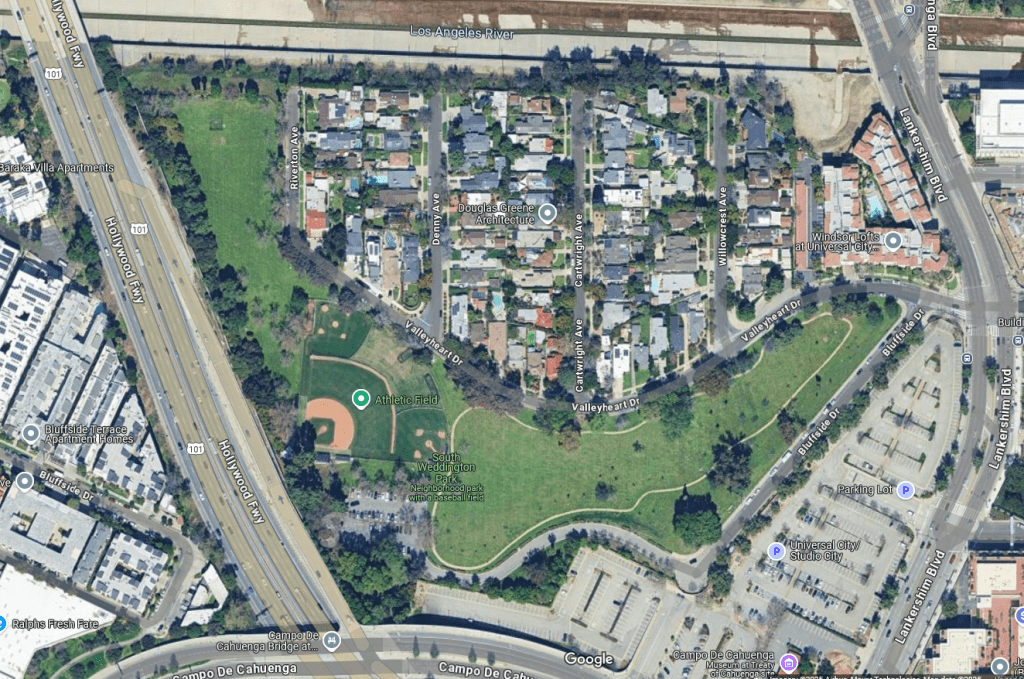
Between 1979 and 1984, Bluffside Park was the unofficial local name for South Weddington Park in Studio City, and it was the “secret” place where all of the hip cool young people from Studio City, North Hollywood, and the Hollywood Hills would meet up to find out the answers to the many important questions of the day:

  • Was there any good weed to score?
  • Does anyone know where to score some cocaine?
  • Where were the weekend house parties?
  • Were there any good bands playing at the Starwood, Gazzarri’s, or Phases?
  • Does anybody have any clove cigarettes?

Good weed was relatively easy to obtain around Los Angeles most of the time and some strains were vastly better than others—some of which would knock you on your ass—but getting your hands on some decent cocaine required knowing a guy who knew a dealer and trusting that the blow wasn’t cut with too much lactose or mannitol. Ultimately, you just had to trust the system and weren’t going to get ripped off.

The curious thing about cocaine is that while it impresses people as a classy drug used by sophisticated individuals such as artists, musicians, poets, actors, and writers—ergo, sophistication by association—it simultaneously drains your bank account at $100 per gram. That was a lot of money back then, especially for a low roller like me making only $5 per hour as an electricians apprentice. Indeed, a spare Benjamin was hard to come by but all too easy to spend foolishly in an attempt to impress friends and love interests. Although I did enjoy getting high on cocaine, I could only indulge in it occasionally because I needed to make rent on a regular basis, which was unlike some of the young adults in the neighborhood who were still living with their wealthy parents and always seemed to have a vial or two of cocaine in their pocket.

As it was, Bluffside was one of those local impromptu gathering places where sometimes only a handful of people would show up and at other times the small dirt parking lot was completely full of cars and anticipation. There was always a good chance that you would run into someone that you hadn’t seen in a while which would give you the opportunity to catch up on things, exchange phone numbers, and maybe get high together.

Unfortunately, the locals living in the Bluffside enclave hated the sometimes-noisy crowds that occasionally blasted the KROQ soundtrack of the day on the Blaupunkt radio installed in their parents BMW’s or Mercedes-Benz’s. Apparently, music by The Clash, The Dead Kennedys, The Police, the B-52’s, and Iggy Pop violated the collective sensibilities of the well-heeled neighborhood and so they would call the L.A.P.D. regularly.

The cops arrival would disburse the crowd remarkably fast when they rolled up because they were easily spotted due to the park being accessible only by two streets: Bluffside Drive to the east and Valleyheart Drive to the north. The park boundary was wedged between CA 101 to the west and the concrete L.A. River (a.k.a. “the wash”) to the north, and it was easy to ditch the cops along the verge of the 101 or the verge between the wash and the residential houses in the tony little neighborhood.

The unofficial yet generally accepted schedule at Bluffside was to meet on Friday night after work, disseminate and absorb all of the critical information, chose your adventure, and then meet again on Saturday night and repeat the process. By Sunday night, the talk was mostly about the disasters, misadventures, and the highlights of the previous 48-hours. There were also plenty of casual conversations revolving around music and food and books and movies and sometimes a bit of juicy gossip would creep into the conversation about who started dating, who broke up, and who was having sex with whom.

The legendary house parties were absolutely wild. There were many wealthy families living in the area who worked in the automotive, aerospace, music, television, or film industries, and some of them lived in these fabulous hillside houses that had large swimming pools some of which included detached cabanas or pool houses. Often, the parents would go on a lengthy vacation and leave their eighteen-year-old or so offspring at home by themselves because there is nothing more tedious and troublesome than traveling with adult children, the term of which appears to be an oxymoron.

Leaving an unsupervised eighteen-year-old “adult” at home was analogous to leaving an arsonist with a five-gallon jerrycan of gasoline and a match: At some point combustion was going to happen. One phone call to one friend would start a chain-reaction of other phone calls to other friends, and exponentially, the news got around quickly. Soon, hundreds of random people—some known, others being perfect strangers (if there is such a thing)— start showing up on a Saturday night to party their asses off like there was no tomorrow because, frankly, at that age most of us were living in the moment which was all that truly mattered.

The age span between eighteen and twenty-one is like purgatory because you are considered an adult and are of legal age to vote and engage in contracts or join the military or buy a car or borrow money from the bank to buy a house, but you can’t buy alcohol, one of the great privileges and pleasures of true adulthood. When you are stuck in this underage limbo, the only way to get alcohol was to know somebody who was old enough to buy it for you, or you had to resort to “pigeon” for it. To pigeon was to hang out in a liquor store parking lot out of sight of the store clerk and ask someone who was going inside the liquor store to purchase your alcohol for you. At best, the odds were 50/50. Circus Liquor in North Hollywood was my liquor store parking lot of preference because it was close to where I lived. Indeed, the only way to get your fifth of Cuervo Gold or a six-pack of Bud tall boys was by proxy. There were other, more nefarious ways like shoplifting, but I always considered theft one of the lowest forms of human conduct and refrained from engaging in such a lowly act.

This was a pre-GPS era, so unless you had a Thomas Guide in your car and knew the street address of the house party (of at least the general vicinity), you would often pile into the car of a guy who said that he knew where the party was, and along with your plain brown paper bag of beer or tequila, you drove off to parts unknown. We would often get lost and missed out on many house parties with this method. The surest way to find the house party was to convoy with a bunch of other cars that were following the guy in front who did have a Thomas Guide and snake your way up into the narrow streets of the Hollywood Hills.

One of these house parties was near Laurel Canyon Blvd and Mulholland Drive, overlooking Hollywood. The house was stylishly furnished, replete with leather couches, crystal chandeliers, marble, and all manner of artwork. There was a better than average live rock band playing under a cabana on the pool deck. There were several kegs of beer on ice in plastic trash cans that were lined up along the back wall of the house. Drinking Heineken from a keg is not the same as drinking Heineken from a bottle—it was considerably better, and so it flowed endlessly into my bottomless red cup. The house was jam-packed with partygoers and marijuana and clove cigarette smoke permeated the air. People were smashing out their cigarette butts on the hardwood floors and spilling their beers all over the house. Some people were snorting cocaine from the marble countertops in the kitchen.

As I was bumping my way through the crowd toward the band, Tom Armstrong, an old hooligan friend that I hadn’t seen in a while, spotted me from the opposite side of the pool and yelled out my name. We acknowledged each other. He was there with his friend Duke. Tom said something in Duke’s ear, and then they started walking briskly in opposite directions around the pool toward me. This could only mean one thing: They had conspired to throw me into the pool. Not tonight, boys! I spotted some Italian cypress trees at the far edge of the pool deck and decided that I was going to hide behind them. The thick crowd of people slowed them down considerably and I bent down as low as I could while winding my way through the thicket of people toward the trees hoping that Tom and Duke would lose sight of me.

When I got to the edge of the slate pool deck, I briefly glanced back to see Tom and Duke closing in on me. I took a step beyond the deck thinking that it was a planter bed where the Italian cypress trees were located, but it wasn’t…it was the ledge of a concrete retaining wall. I stepped off the ledge and fell down about twelve feet into the darkness and almost landed on a couple who were making out on a bench in the planter below. I hit the dirt hard on my right side. It knocked the wind out of me, and I was sure that I broke my right arm and maybe some ribs. The guy on the bench jumped up and said, “Dude—are you okay?” I couldn’t talk yet because I was still struggling to catch my breath, so I just nodded my head, slowly stood up, and limped away holding my arm and headed back toward my car to drive myself to the emergency room. On the way to my car which was parked way up the road, I ran into my friend Mark Flaata who had just arrived. By then I had recovered considerably in the miraculous way that one recovers quickly when one is young. My arm and ribs were definitely not broken, but my confidence definitely took a major hit. We went back into the party and stayed until the cops showed up around midnight and shut it down.

Meeting back at Bluffside the next night, we heard many other stories about the same wild party. It’s funny how people can be at the same place at the same time yet not run into each other while also having a completely different experience. Drama, comedy, run-ins with law enforcement, breakups, hookups, philosophical conversations, religious conversations, swearing off drinking alcohol or doing drugs, passing out on the front lawn, and musings about the meaning of life were all part of the various storylines that were told. In those moments, we represented our fleeting wasted youth in the truest form possible.

This was all part of an earnest—although ultimately futile—effort to stave off the requirement to get serious about life because no young person wanted to end up like their parents working long hours in jobs that they hated and being stuck with all of those serious adult responsibilities like insurance and mortgages and car payments and the multitudes of problems that seem to accompany them.

No matter our purest intentions, time marches forward mercilessly regardless of how tenaciously we try to hold it back, and most of the once fierce, invincible, carefree teenagers eventually become another cog in a massive, indifferent, mindless system that strips them of their soul and spits out their bones when it is done with them, repeating the infinite cycle of modern society.

Luckily, some of them survive with their souls intact. These are my kind of people.

Instagram: @m.snarky

Blog: https://msnarky.com

©2025. All rights reserved.

The Pinball Wizard of NoHo

Story 44 of 52

By M. Snarky

In 1974, the California Supreme Court ruled that pinball was more a game of skill than chance and overturned its prohibition in Los Angeles, prompting a pinball arcade renaissance in the city.

Our local pinball arcade which practically popped up overnight was on the east side of Lankershim Blvd near the corner of Weddington Street, in North Hollywood, California, or NoHo as it is now called. It was almost directly across the street from the old El Portal theater and was located in an old single-level brick building. I don’t remember the official business name of the pinball arcade, but it was definitely not the Funky Flipper which closed in 1973 and was further south on Lankershim near Otsego Street, famous for its proximity to Bill Elkins’ The Basement recording studio where people could catch a glimpse of Linda Ronstadt, or Tom Petty, or Jackson Browne.

The prices were one game for a dime and three games for a quarter and if I added up all of the money that I spent at that pinball arcade, it would have been about $26 over a one-year period. Adjusted for inflation, it would be $163.57. Wowzah—it seemed like cheap entertainment at the time. There was, however, a certain level of social status if you held the high score on one of the machines. It was also a gathering place for locals. My brother Scott, cousin Chris, and I would often walk together to meet up at the arcade with other friends in the neighborhood. We would often play against each other, but it was ultimately about getting the highest score and getting your name on the board.

There were also some older boys and men hanging around who smoked cigarettes while they played pinball (there were ashtrays on many of the pinball machines) and it seemed to be very tense when a few of them would be standing around a single-player machine while someone else was playing with intent, indicating, perhaps, that the gambling rumors were not a myth.

The pinball machines of that era were all analog electromechanical devices and did not have any solid-state components. They were built with incandescent lights, switches, transformers, relays, and solenoids and they were always warm to the touch.

In the summer of 1974, I was thirteen years old and I held the high score of 74,800 points on the Bally’s Fireball pinball machine for two weeks. Fireball was a challenging game. It had a spinning disc in the center, a kickback kicker on the left, two captive/kickout holes (Odin and Wotan), a Flipper Zipper feature that would bring the flipper tips close together allowing you to hold a ball captive, and the usual scoring bumpers. If you were good, you could play three balls at a time and quickly rack up the points. The tilt on this machine wasn’t too touchy, so you could get away with some relatively aggressive table shaking.

I learned all of the nuances of the pinball machine, for example, the exact pullback length of the plunger to give the pinball just enough momentum to drop into the 3,000-point chute. I knew where the dead zones were, and the exact point on the flippers to launch the pinball exactly in the direction where I wanted it to go on the board, and precisely how much shaking I could get away with. I always scored enough points for at least one Replay (a free game!), which were signified by a loud knock emanating from inside the machine, the replay point thresholds of which were 52,000, 72,000, and 96,000. I could play Fireball for about half an hour at a stretch on one thin dime. Indeed, I was the temporary Pinball Wizard of Fireball.

The male arcade manager, a thin, bearded, middle-aged hippie type with long stringy black hair that he parted on the side for a world-class comb-over to hide the top of his balding head kept a blackboard behind the change counter where he tracked the names, dates, and pinball machine scores, and it looked something like this:

It didn’t take long before the pinball arcade manager determined that he was probably losing money with kids playing for such a long time on one dime, so he adjusted the tilt setting on all of the pinball machines to ridiculously low, hyper-sensitive levels that essentially tilted out with the slightest nudge. This made it much harder to get a high score or a replay. Subsequently, the high scores listed on the chalkboard were impossible to surpass and as time went on, the dates were never updated. This may have also been part of the calculus of the arcade manager in that people would spend more money to try and beat the old high scores.

One fall day, as I was walking home from Walter Reed Junior High School, I wandered over to the pinball arcade with two dimes rattling in my pocket with the intent of setting the high score on Fireball once again, but when I got to the building there was a large sign on the door that said, “Business Closed.” I peered into the dusty window and saw that all of the pinball machines had vanished, but the high score blackboard was still hanging on the back wall without my name on it, mocking me.

There were rumors floating around about the arcade closure; it was a front for a gambling operation; it was a front for a drug dealing operation; there was an armed robbery, and the owner/manager was shot and killed; a jealous woman caught her man with another woman and shot him dead.

Rumors aside, I never found out what truly happened there, but it never reopened as a pinball arcade.

It’s all gone now. All of the nineteenth century brick buildings have been replaced with trendy new movie theaters, shiny office buildings, and fast-food restaurant chains.

Links

Funky Flipper https://www.facebook.com/groups/losangelesnostalgia/posts/462213053236535/

Bill Elkins’ The Basement (renamed The Alley) https://nohoartsdistrict.com/the-legendary-alley-studios/

Bally’s Fireball pinball machine https://pinside.com/pinball/machine/fireball-bally

That Time America Outlawed Pinball https://www.history.com/articles/that-time-america-outlawed-pinball

Instagram: @m.snarky

Blog: https://msnarky.com

©2025. All rights reserved.

Lifeguard Queen

This is an AI generated image that looks remarkably like the Lifeguard Queen of my youth.

Story 42 of 52

By M. Snarky

Late summer, 1974, North Hollywood, Calif. The walk from our apartment at 5342 Cahuenga Blvd to the North Hollywood Pool was about a mile, and for 25¢ you could swim all day. With only our towels in hand and one quarter each in our pockets (Grandma Opal Hess would say, “two-bits”), we walked directly west down the dry and dusty Union Pacific Railroad tracks that paralleled Chandler Blvd to North Hollywood Park, and then turn left at Tujunga Ave where the pool was located on the west side of the street just beyond the public parking lot. When the temperature rose above 100-degrees, it was like walking through the sweltering heat of a desert, but it was always worthwhile because I knew she would be there.

I had just turned 13, my younger brother Scott was 11-1/2, and our younger cousin Chris was 10-1/2. The three of us were accidentally representing the poor white boys of North Hollywood with our holey T-shirts, cut-off jeans, knee-high tube socks with holes in the heels and the toes and our worn out Keds and Converse sneakers. We had no food, no water, no sunscreen, and usually no extra money – not even a nickel for some bubble gum. Our parents were so broke that we would often have to resort to scouring the neighborhood for returnable soda bottles to collect enough money for the pool entry fee.

Whenever we did have any extra change, we would stop by the Winchell’s Donut House near the corner of Lankershim Blvd and Chandler because it was on the way to the pool, and we would have been foolish not to pick up a few 5¢ donuts.

At the front counter of the pool house, you handed over your hard-earned quarter to the attendant for a ticket, then you took the ticket over to the men’s side of the pool house where there was another counter. There was a hand painted sign above that counter that said, “No Cut-Off Jeans!” and, “No Swimming in Underwear!” and “No Urinating in the Pool!” There was another hand painted sign above the door that exited to the pool deck that said, “Rinse Off Before Entering Pool.” Being the ignorant youth that I was, I would have argued that the no cut-off jean policy was dumb and that the no swimming in underwear and no urinating in the pool rules were obvious, but why do I need to rinse off? But rules are rules, and in a public space they must be posted…and obeyed, that is, if you want to avoid getting kicked out.

There was this persistent rumor going around that there was a chemical in the pool water that turned bright red if you peed in it, which signals to everyone in the water around you AND the lifeguard staff that, a) you are a rule breaking savage, and b) you will be promptly removed from the pool, Pissboy will be tattooed onto your forehead, and you will be escorted off of the premises by two burly lifeguards, and banned for life from entering any of the Los Angeles County Parks & Recreation managed public pools. I will tell you unequivocally (although not without some level of embarrassment) that this was indeed just a persistent rumor that I believe was likely propagated by the lifeguard union.

Anyway, you gave the male attendant your ticket and they would hand you a mesh bag with what I can only describe as a large diaper pin that had a number stamped on the end of it which matched the stamped metal number tag attached to the bag. The first time we went to the pool I had no idea what I was supposed to do with the mesh bag or with the pin. After observing what the other men and boys did with them, I quickly figured out what to do, so I put my beat-up shoes, tube socks, T-shirt, and cut-off jeans in the bag, attached the pin to my swim shorts, and handed the bag over to the young man behind the counter who promptly hung the bag on a rack in numerical order.

Scott, Chris, and I, after rinsing off in the remarkably cold water (why was there never a hot water valve?), walked out onto the pool deck like we owned the place. Around the entire pool deck, about every ten feet or so, painted in fire engine red, was “NO RUNNING!” in huge, stenciled letters. More rules. So, with our towels draped around our necks, we briskly walked over to our favorite spot on the deck near the far southeast corner of the deep end where I could observe the high lifeguard chair from afar, which was the throne upon which my Lifeguard Queen sat.

She was a tan, brunette beauty with hazel eyes, wearing Ray Ban Aviator sunglasses, a white sun visor, and the iconic red one-piece Los Angeles County Lifeguard issued bathing suit. Being an official lifeguard, she also had the shiny metal whistle on a lanyard around her neck and a large megaphone by her side. She was a magnificent, powerful sight to behold, and I was crushing hard.

Mind you, I was not creeping on her or staring or ogling – I would simply glance over at her every now and then, hoping that one day she would notice me and smile and maybe wave at me. I had no idea what I was going to do if she ever did acknowledge me like that, but I probably would have suffered a heart attack.

I was comfortable in the water and thought that I knew how to swim, but I truly didn’t know how to swim well. You could say that I only knew how not to drown, just like most other recreational swimmers, I suppose. It wasn’t until I took professional swimming lessons decades later at Los Angeles Valley College for Ironman training with my wife Kim, that I realized how bad I was at swimming. How bad? It went something like this: On the first day of training, coach Stuart directed us (about three-dozen people) to self-seed ourselves along the pool coping thusly, “Advanced swimmers in the right-hand lanes, intermediate swimmers in the middle lanes, and beginning swimmers in the left-hand lanes.” I considered myself an intermediate swimmer and lined up in the middle lane.

Then coach Stuart said, “Okay swimmers, we’re going to split lanes for this drill in a clockwise direction, so we don’t swim into each other. Tom, Frank, Lisa, and Caroline will demonstrate this for you.” The four of them jumped into the middle lane and with a “Yip!” command from the coach, they started swimming in single file along the left-side next to the pool lane divider and when they got to the far end of the lane they turned around and came back along the right-side pool lane divider, passing each other without crashing as they swam in opposite directions.

Coach Stuart continued, “Does everyone understand this?” and we all nodded our heads in acknowledgement. “Now I want everyone to swim a few laps to warm up – Yip!” And with that, we jumped into the water and began swimming as directed. When I got back to the coaches side of the pool after a couple of laps, coach Stuart signaled me to the coping and asked me my name. “Okay, Kent, move down a lane to the left.” I moved down as directed. After a couple more laps, coach Stuart signaled me again and said, “Brad, move down another lane to the left.” I complied. By the time the warmup was over, my name was Norman, and I was standing in the wading pool.

But back in 1974 at North Hollywood Pool, I felt like I was channeling Olympic Gold Medalist Mark Spitz, and I was positive that I caught the queen’s eye once or twice as I swam by her elevated throne.

On the opposite side of the pool from the lifeguard chair were the two glorious springboards – one set at 1-meter, and the other set at 2-meters. These were our favorite activity to do at the pool. We got pretty good at doing jackknifes and swan dives (or so we thought), but big fat cannonball and cherry bomb splashes were our favorites. We mostly just goofed around doing boyish things like belly flops, lazy forward flips, mostly out-of-control back flips, and “Change-your-minds” where you acted like you were going to dive straight into the water but tucked into a cannonball at the last second.

On the last August day of the summer pool season – which was coincidentally also an extremely hot day – a Speedo wearing whale of a man swam right into the diving lane impact zone as I launched myself off of the springboard. I was in midair when I heard the whistle blow, but I didn’t see him until it was too late because I was looking across the pool to the Lifeguard Queen of all my dreams who was blowing said whistle. I collided with him upon entry of my almost perfect starfish belly flop, the impact of which knocked the wind out of me. I involuntarily inhaled a lungful of water which burned my lungs like fire. I began gasping uncontrollably for air under the surface of the water as I started sinking. The last thing I remembered was hearing a muffled splash next to me as I was looking up at the blazing, shimmering sun through the rippled surface of the water.

When I came back to my senses, there she was, smelling like Coppertone coconut tanning oil, leaning over me with the bleach scented chlorinated pool water dripping off of her face and hair and red swimsuit, giving me mouth-to-mouth resuscitation on the warm concrete pool deck. Her lips tasted like cherry flavored ChapStick. She was even more beautiful close up. Was I in heaven? I looked into her stunning hazel eyes and smiled. She pulled back and asked, “Kent, are you okay?” She knew my name! THE LIFEGUARD QUEEN KNEW MY NAME! Wait! How did she know my name? What happened? Never mind – let it happen! I started to say, “I love you, Lifeguard Queen!” but before I could say anything, I was rudely awakened by a big splash of pool water. Alas, it was all just a very vivid dream, probably intensified by the heat, hunger, and dehydration. But it seemed so real.

On the way out through the pool house that day she was working the front counter. We made eye contact, and I bashfully looked away. She said, “Cool Tee-shirt!” I was wearing a classic white Coca-Cola Tee-shirt with the red arm and neck ringer bands. I blushed. Then she said, “Have a nice day – see you next summer.” My heart skipped a beat. In an awkward, broken voice, I barely got, “See you next summer,” out of my mouth. At that age, “next summer” always seemed such a long way off and it would never come soon enough.

Summer, 1975, North Hollywood, Calif. This year we had secondhand BMX bicycles that we pieced together to get to the pool faster! On opening day, we raced each other down the railroad tracks from the apartment to the pool. All along the way we kept trying to one-up each other to see who could bunny-hop the highest or ride a wheelie the longest – this turned into a serious competition! Breathless, we locked our bikes to the rack at the pool and rushed to the front counter to get our tickets. The three of us; Scott, Chris, and myself, breathing heavily and dripping with sweat, didn’t even register with the attendant who just smiled at us as he took our quarters and handed us our tickets.

The singular thing that was occupying my mind was the Lifeguard Queen.

This time, the cold shower before entering the pool area was appreciated after riding our bikes so hard in the summer heat. We speed-walked toward our regular corner when we heard “Slow down!” coming over the staticky public address system, clearly directed at the three of us. We complied and slowed down – barely. As we briskly walked behind the queens throne I glanced up to get a brief look of her highness without being too obvious, but this time, the occupant of the throne was not the queen, instead, there was an imposter in her place: the throne was being occupied by one of the male lifeguards. Noooo! Where in the world was my Lifeguard Queen? Wahhhh! Sadly, I never saw her again. The pool days were never the same afterward. I felt an emptiness in her absence and became less enthusiastic about going to the pool.

Although I didn’t learn what her real name was, I imagined that it was something regal like Elizabeth, Genevieve, Catherine, or Margaret.

The summertime always reminds me of those carefree days at that pool with my brother and cousin, but mostly, I wonder about the Lifeguard Queen.

Old crushes die hard.

Instagram: @m.snarky

Blog: https://msnarky.com

©2025. All rights reserved.

Old Zoo Nights

Story 38 of 52

By M. Snarky

One hot July night in 1976, we pulled up to the locked Griffith Park gate on Crystal Springs Drive near the Wilson & Harding golf course. It was after 10:00 PM. We were in Mark Flaata’s mom’s massive, dark green, fake wood paneled 1972 Chrysler Town & Country station wagon, the same car I wrote about here. Mark turned off the radio and we were given instructions to “Be quiet.” Actually, his instructions were to “Shut the hell up!” Just to the left side of the gate was an equestrian trail that was barely wide enough to allow the humongous station wagon to squeeze through. Mark turned off the lights and drove along the dirt equestrian trail slowly until we got past the ranger station, and then turned back onto Crystal Springs Drive, flicked the lights back on, and drove to the first parking lot near the merry-go-round. There were maybe a half-dozen other cars parked there too.

Although, from a purely technical legal standpoint, we were definitely trespassing into the park after hours, however, the cars that were already inside the park after hours could drive out of the south entrance at Crystal Springs Drive and Los Feliz Boulevard without being harassed by the park rangers. But, if the rangers caught you hiking or walking around inside the park after hours, they would warn you that you could be cited and strongly encourage you to leave RIGHT NOW, or they would radio in for law enforcement which meant the LAPD. I know this from personal experience. Back then the park rangers were not sworn peace officers and were unarmed, so they were basically LAPD-light.

For us, we just didn’t care whether or not we were technically trespassing with our single-minded purpose of going to the Old Zoo to get high and have some fun. Back in those days, the exuberance of our wasted youth was boundless, and we weren’t going to let any legal technicalities prevent us from achieving our mission.

The passengers were Mark Flaata and his girlfriend Eve Anton, Tom Armstrong, Van Cognata, and yours truly. We brought a couple joints of good weed – well, good weed for the era anyway – and two six packs of Bud tall boys in a brown paper bag that we had to pigeon for over at Circus Liquor at the corner of Burbank Boulevard and Vineland Avenue in North Hollywood (NoHo), famous for its landmark giant clown neon sign and popularized in movies like Blue Thunder and Clueless. I should explain that to pigeon for beer meant hanging around the parking lot of a liquor store where the store clerk couldn’t see you and asking guys that looked like they were old enough to buy beer to buy some Bud tall boys for us, which was about $2.50 back then. It was also a 50/50 proposition at best. I personally hated doing it, but even so, I did it anyway mostly because I liked drinking beer, but also to not get hazed by the guys if I didn’t do it.

We hopped out of the station wagon and slinked across the road over to the Lower Old Zoo Trail, hiked up the trail about three-quarters of a mile to the dilapidated chain link fence on the boundary of the Old Zoo property which was, um, open? Someone had used some wire cutters to cut a gap in the fence just wide enough for a teenager to squeeze through. I was like going through a portal because as soon as you descended down the hill on the other side of the fence, you began to see some of the old overgrown structures looming in the darkness and it felt like you were transported into some dystopian Planet of the Apes future. It was the coolest thing that I had ever seen.

The local story of the Old Zoo (est. 1912) was that when the new L.A. zoo was finished being built in 1966, they simply transferred the animals over from the old to the new and then abandoned it as it was, tucked away in a canyon near Bee Rock. It was already 65-years old when I first saw it.

We walked over to a partially burned concession stand, put the six packs on what remained of the old counter, and we all cracked one open and started chugging them down while Tom fired up a joint and passed it around. It seemed as if we were the only people left on the planet.

Before this first visit to The Old Zoo, a.k.a., The Bear Caves, it was already a local legend in NoHo. There were dark, disturbing stories of people disappearing, rape, murders, dismembered bodies in trash bags, ghost sightings, and people dropping too much acid and going stark raving mad. There were also lighter stories of young people going there just to meet up and party and have a good time wandering around the abandoned administration buildings, concession stands, animal barns, aviary, monkey cages, and bear caves. Obviously, we were in the latter group, but that did not prevent talk of the scary stories which started freaking Eve out a little bit, so much so that every little noise in the periphery made her jump which, naturally, made all of us guys laugh.

We eventually found our way over to the back access road for the bear cave entrances. At the entrances, there were a series of levers and pulleys and cables and sliding metal doors that were used to manage the animals, and surprisingly some of them still worked.

We descended down a couple of steep flights of concrete steps into what could only be described as a black hole. The first flight was to the dark main bear den on the left that reeked like piss. The second flight of steps went to the open viewing area out in front. For the moment, you could say that we were the ones that were on display, Adolescens Americanus, if you will. We drank the remaining beers that, by then, were barely below ambient temperature, and smoked the remaining joint.

We talked about all sorts of things, you know, the sorts of things that factually naïve yet miraculously all-knowing teenagers talk about, like how out-of-touch our parents were, books, movies, music, love, God, Jesus, the meaning of life, what we’ll do after graduation, who’ll go to college and who’ll go to trade school and who will get married first, how many children we wanted to have, where we wanted to live and work, and so on and so forth, all compressed into a lively ninety-minute or so ebb and flow conversation with completely inappropriate jokes being cracked all along the way because no topic was off-limits – not even God.

Suddenly, Tom shushed us with his index finger over his pursed lips and said in a low voice, “I hear something!” We collectively listened and heard a vehicle driving on the access road behind us. We immediately understood that it must be the park ranger and we went into Ranger Danger dead-silent mode. They stopped at the back entrance of the bear cave. We could hear some chatter coming over the ranger’s radio. They got out of their truck, flicked their bright flashlights on and pointed them down the steep steps with a sweeping motion and said, “The park is closed; come out of there NOW!” We were quiet as a mausoleum; you could have heard a pin drop. “We know you’re in there!” More hold-your-breath silence. After about a minute more, the flashlights turned off and the rangers got back in their truck, more radio chatter could be heard, and they slowly drove off. Time to go!

We slowly crept up the steps to the road and could see the taillights of the ranger pickup in the distance to our right. We went left and found our way back to the parking lot as fast as we possibly could. We were high and slightly tipsy and very paranoid about getting busted, so Mark wasted no time in getting us out of the park. It was around midnight. Van said, “Let’s drive down Hollywood Boulevard!” We turned west at  Los Feliz and drove past the magnificent homes to where Los Feliz turns south and becomes Western Avenue. We turned right onto Hollywood Boulevard and headed west again. This was a very different neighborhood. We saw bums sleeping in the doorways of the shops, hookers and John’s, drug dealers, drug addicts, and tourists, and rundown buildings in various stages of urban decay. Mark turned right at Highland Avenue, and we quietly drove back to the Valley through Cahuenga pass.

Over the following years, I would take my friends to party at the Old Zoo many more times with whatever party materials we could get our hands on. It was mostly weed and beer, sometimes tequila and limes, and occasionally some LSD to go tripping around the Old Zoo and watch the sun rise over Griffith Park. During that time period, the word got out about it, and it soon became crowded (like everything else in L.A.) and fires, trash, crime, gang activity, and graffiti took their collective toll, destroying all of the remaining buildings, leaving only the bear caves and various chain link and metal barred cages intact but all covered with the various rival L.A. street gang tags, and some stupid token suburban white boy tags like, “Greg Was Here,” or, “I Love Laurie.”

Now renamed Old Zoo Picnic Area, the city cleared out the overgrown trees and shrubs, cleaned up the trash, back-filled the bear cave pit area in front, and welded the metal doors either open or closed, providing limited access to our old familiar haunt, you know, all in the name of public safety.

Nowadays, the Los Angeles Haunted Hayride takes over the Old Zoo area in the fall, hinting at the haunted notoriety of the past.

More Information:

Hadley Meares from PBS SoCal wrote a good article about it here.

Wikipedia link to Griffith Park Zoo is here.

Los Angeles Haunted Hayride is here.

Instagram: @m.snarky

Blog: https://msnarky.com

©2025. All rights reserved.

Laundromats – Part 1

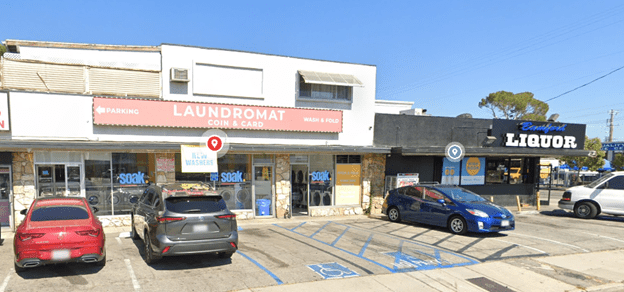
Our local laundromat at the northeast corner of Cahuenga and Magnolia Boulevards in North Hollywood, CA.

Story 14 of 52

By M. Snarky

Even if you have never personally been to a laundromat or needed to use one because you lived in a sucky apartment building that didn’t have a laundry room, you probably know about these places, or at least are familiar with the laundromat scene in the movie Fight Club or have seen a few of them as you drive through the city.

Growing up, my family moved around about every 1-2 years or whenever and wherever my dad could get work as an electrician. Even though we often lived in the boondocks outside of city limits where renting an old farmhouse was cheap, my parents always managed to make sure that a washer and dryer were available for our family of six. It wasn’t until my parents split up that I had my first of many laundromat experiences in 1973 after we moved into a duplex apartment in North Hollywood, or NoHo as it is now called.

My mom would wait until everything was dirty twice-over before overloading a shopping cart – which was somehow appropriated from the Market Basket grocery store on Ventura Boulevard, about 2-miles away – with a mountain of said dirty clothes along with a box of Tide and a white, plastic bottle of Clorox bleach. She wheeled it on down to the laundromat at the northeast corner of Cahuenga and Magnolia Boulevards, usually with my brother and I in tow. We were 10 and 12-years old, respectively. Our local laundromat was adjacent to the Bamford Liquor store, and my mom would sometimes hand over 10¢ to each of us boys to buy some candy to placate us. Our local laundromat was a very basic, utilitarian, no-frills place at the time.

For me, the laundromat was a wonderland of coin-op vending machines. Of course, there was the change machine, plus there was a mini soapbox machine where you could buy a single load sized box of powdered Tide, Cheer, Ivory Snow, or All. You put your coins into the coin slot below your preferred brand of laundry detergent, push the coin slot in, and the soapbox would drop into the metal bin below with a light thud.

There was also a molded, padded TV chair with a small six-inch black and white TV screen and tuner built into it that cost 10¢ for 30-minutes of broadcast TV. In the greater Los Angeles area at the time, the options were channels 2 (CBS), 4 (NBC), 5 (KTLA), 7 (NBC), 9 (KCAL), 11 (KTTV), and 13 (KCOP). That padded, spongy TV chair was the most comfortable seat in the entire laundromat, and someone – generally another mom – was always lounging in it without paying for the television service. They would get annoyed with you if you asked them to move so you could actually watch TV. I watched many reruns of Star Trek at the laundromat.

Directly outside the laundromat door was a ubiquitous Los Angeles Times newspaper vending machine too – 10¢ for the daily paper, 25¢ for the Sunday edition.

There was also one of those 5¢ triple-head candy vending machines inside the laundromat and it didn’t take long for us boys to figure out that the peanuts and bubblegum were perpetually stale in that vending machine so we would go over to the liquor store and buy candy from there where we could get a 3-foot-long whip of purple grape or green apple flavored bubblegum for 10¢. The flavor in that gum was gone in 5-minutes, and the more you chewed it, the stiffer it got. I’m surprised we didn’t get TMJ from chewing that stuff.

Sometimes mom would let us feed the last three dollars of cash that she had in the whole world into the change machine which was sort of a mechanical wonder when you’re a 12-year-old boy. The machine would only accept the dollar bill when oriented correctly and if the paper money was in reasonably good condition. If you put the dollar bill into the slot incorrectly, or if the dollar bill was too faded or crumpled, it would just spit the bill back out looking as if the machine was sticking it’s tongue out at you with a resounding virtual message of REJECT! In those cases, mom would send us over to the liquor store for change, but the liquor store policy was NO CHANGE – DON’T ASK according to a sign on the wall behind the cash register. So, we had to buy 5¢ of candy to get change, which was usually five 1¢ pieces of Bazooka bubblegum. That liquor store was definitely benefiting from the laundromat. I was also secretly hoping that every dollar bill would get rejected so we could buy more candy. I also wondered how many pints of liquor were sold to the laundromat patrons.

When the change machine did accept a dollar bill, the sound of the four quarters hitting the metal tray at the bottom of the machine was glorious – it was like you won the jackpot from a slot machine in Las Vegas!

Mostly out of curiosity but with a potential monetary side benefit, I tried to trick the change machine once by tracing out the face and the back of a dollar bill on a piece of blank translucent tracing paper using a No. 2 pencil and then carefully cutting it out to the exact (well, mostly exact) size of a dollar bill. The anticipation of getting free quarters for a forged dollar bill as it was being fed into the waiting illuminated slot using the correct orientation of George Washington’s head was met with the cold rejection of a machine that was not so easily tricked. So much for my scheme to make more fake bills if it worked. In retrospect, it appears that my juvenile delinquency started earlier than I thought.

The change machine would also give change for coins: two-dimes and a nickel for a quarter, and two nickels for a dime. This was handy for the 35¢ washer and 10¢ dryer.

My mom would use three or four washing machines at-a-time, all in a row if possible, and separate the laundry mostly into whites and colors and transfer the dirty clothes from the shopping cart to the top-loading, large-capacity washing machines. She would tell us which settings she wanted on each load, for example, hot wash and warm rinse for the whites, and warm wash and cold rinse for the colors. She would then tell us how many scoops of detergent or how much bleach to add to each load.

We got to feed the coins into the waiting washing machines too, I think, mostly to continue keeping us boys occupied. We set the coins vertically into the appropriate slots, and then pushed the slotted coins into the machine which, coincidentally, also sounded like a slot machine payout.

However, some of the washing machine coin slots were occasionally jammed with what appeared to be foreign coins or metal slugs which made them completely inoperable. No doubt this irritated the owner/maintenance guy to no end and made him rethink his life choices. Also, what kind of lowlife cheapskate doesn’t have 35¢ for a load of laundry and needs to resort to such measures?

The laundromat also had these high, square laundry baskets on wheels with a hanger bar across the top. The top of the laundry basket was at the same height as the top of the washing machines, so it made loading and unloading clothes easy. These were also great for wheeling your little brother around inside the laundromat as fast as possible much to the irritation of other laundromat patrons sitting around and reading their copy of the Los Angeles Times or Time magazine while waiting for their clothes to finish.

Laundromat environments are this peculiar confluence of heat and humidity blending with the many laundry detergent scents competing with each other as they waft through the air. One moment you definitely smell the fresh scent of Tide and the next moment you get a nose full of flowery smelling Cheer. Occasionally, you’ll get hit with the chemical smell of bleach. Makes me wonder about the long-term hazards of inhaling all this stuff.

One time, I convinced my little brother to get inside one of the massive front-loading dryers under the premise that it was going to be like a carnival ride. He crawled in and sat in it like a recliner and braced himself. I closed the door and popped the dime into the coin slot and selected the cool setting and pressed the start button. There was a low hum as the dryer started to turn slowly and within a couple of seconds my poor little brother was getting the tumble dry treatment which looked like he was doing endless in-place somersaults. He started yelling “STOP!” and I quickly pulled the dryer door open to stop it. He jumped out of it like he was shot from a cannon. He said, “Now, it’s your turn.” I smiled at him, spun around on my heels, and ran out of the laundromat as fast as I could with my brother hot on my heels, as he was hollering, “YOU TRICKED ME!” I heard my mom yell out, “Knock it off boys!” as we passed by.

Eventually, we helped mom transfer the freshly laundered clothes from the washing machines to the dryers, and within the next 40-minutes or so, we were folding laundry and reloading the shopping cart for the return trip back to the apartment. I have a distinct memory of pushing the shopping cart down Cahuenga Boulevard with the pleasant scent of clean laundry in the air.

To be continued next week…

Instagram: @m.snarky

©2024. All rights reserved.