Future Former L.A. Resident

Story 50 of 52

By M. Snarky

Our written plan to exit from Van Nuys (gentrified in 2007 as Lake Balboa), located in the San Fernando Valley, a suburb north of Los Angeles proper, stemmed from an encounter with a person I dubbed Dirtman.

In and of itself, taking the effort to write out an exit plan makes it a serious affair by default. It makes it tangible. It makes it actionable. It moves it from a nebulous idea to reality.

How we met Dirtman was something out of a dark comedy. You see, my wife Kim and I walk with our Aussie-Doodle dog named Sydney almost every night around our neighborhood. We arguably know it better than any of our neighbors. I wrote about Walking in My Neighborhood in detail in July of 2024. It hasn’t changed much.

We know which houses have the dogs that start barking a block away, and which houses have the dogs that start barking when you are two doors down, and which houses have the lying-in-wait assassins that postpone barking until you are directly in front of them before they release their fury…and subsequently makes you release your adrenaline. These furry fuckers are almost exclusively the mean little dog breeds. I recently wrote about my firsthand experience with Mean Little Dogs too. You can hear some of these dogs continue to bark long after you are gone and onto the next block…or two.

On a recent July evening as we were walking our usual three-mile route around the neighborhood, we turned the corner into the second cul-de-sac south of our house and this is where we first encountered Dirtman. There he was, standing on top of a large pile of dirt that was dumped in the street, stomping his feet on it, and raising a huge cloud of dust. Apparently, this dirt was originally to be used for someone’s backyard landscaping project, but since it was on a public street, Dirtman appropriated it and then proceeded to flatten it out in his apparent rage against dirt.

Next, Dirtman took off his backpack and his heavy canvas jacket­­—which was already completely out of place for a hot July evening—and then he started dragging the jacket back and forth through the loose dirt very deliberately (as if he were dredging a piece of chicken through a pan of flour), and then he threw the jacket down and started throwing huge handfuls of dirt all over the entire garment. Dirtman then proceeded to carefully pick up his jacket by the collar and gently shake the dirt off—emulating the character Pigpen from the Peanuts comic strip the entire time—and then he folded it up carefully and angrily threw it back down on the pile of dirt again. Then he proceeded to roll his body around in the dirt pile like he was a human steamroller, or as if he were practicing the Stop, Drop, and Roll fire safety technique that he learned in elementary school, assuming of course that he did attend an elementary school of some sort.

He didn’t say one single word, but he did sneeze uncontrollably a few times. By now, his perspiration was turning the layer of dirt that was stuck to his face, neck, and arms into a thin layer of dark mud, looking like something you’d get in a fancy day spa for $500. Maybe he was just trying to channel an Aboriginal man living in the outback.

It was next to impossible to tell how old he was with the coating of dirt and mud, but I would guess he was thirty-something. His dark eyes had a glazed, wild look in them indicating that he was probably very high on something, and I did my best not to make direct eye contact as we passed him at a distance. I once read in some psychology article somewhere that direct eye contact with a person who is having an obvious mental breakdown can trigger a violent reaction. This no-direct-eye-contact technique comes in handy here in the suburbs of Los Angeles where the crazies now rule the streets.

As we walked past Dirtman, I noticed that the gate at the end of the street that leads to the infernally busy Balboa Blvd was wide open. The only thing missing was a flashing neon sign that said, “Open.” This was unusual because everyone who lives on any of the six cul-de-sacs that dead-end at Balboa know to keep the gates closed and locked to prevent the encroaching homeless population from entering the neighborhood, or at least offer a minor deterrent for the lazy ones. I believed keeping the gates locked was common knowledge around here, but someone apparently didn’t get the memo. It was probably a preoccupied teenager staring at the screen of their smartphone.

As I walked past the gate, I closed it and made sure that it locked. Kim said (in the sweetest, most sarcastic voice one could ever hear), “Great; now he’s trapped in our neighborhood.” It made me chuckle at first, but in the next moment I realized my folly: By not knowing the true state of mind of this Dirtman fellow, closing that gate may have seemed to him like I was locking him in and now my mind was racing with all sorts of wild what-if scenarios of nasty in-your-face verbal altercations and unrelenting physical violence. Then I remembered that I had my pepper spray with me and felt a sense of relief, but I kept him in the corner of my eye anyway.

As we turned the corner out of the cul-de-sac to continue our walk, Kim uttered the words that no husband ever wants to hear: “I don’t feel safe in our neighborhood anymore.” This sent a chill down my spine. We have lived in this neighborhood for 26-years. This statement meant—in no uncertain terms—that we were going to need to start planning our exit NOW. Our hand was forced not by a job change, or by a bad economic situation, nor by any other internal, familial, or personal issues; it was forced by externalities that we have no control over.

Granted, this homeless population has been slowly yet perpetually closing in from all of the major boulevards and streets around our neighborhood: Roscoe Blvd to the north, Saticoy Street to the south, Balboa Blvd to the east, and Louise Ave to the west. We found ourselves living on an island surrounded by a sea of homelessness and lawlessness.

Street takeovers, street gang graffiti, deadly assaults on public transportation, homeless encampments, wildfires started by people living in homeless encampments, robberies, burglaries, RVs in various states of decay parked on the streets, abandoned cars, piles of trash, fires, squatters, open drug deals and open drug use in the middle of the day, and people sleeping on the sidewalks have been pervasive for years, but it has mostly stayed in the periphery of our neighborhood. I’m sorry to say that we had become mostly desensitized to it because you see it everywhere, every single day!

The city and county of Los Angeles are abject failures on so many levels that it truly was only a matter of time before we would be forced to leave in order to preserve what waning sanity, patience, and hope that we have left. Mind you, this is not a trivial decision. I was born in Los Angeles, and I’ve lived here for most of my life. I met Kim (who was born in Burbank) and we got married and raised our children here. Our eldest son Travis died here. It makes me so sad that this formerly fantastic city—a city of the world—is now entirely crestfallen and has become so incredibly untenable that it repels its own native sons and daughters.

Los Angeles has completely lost its soul and there is zero sense of community anymore. It is now mostly populated by cliques who are only looking out for themselves. The harsh reality is that tribalism rules the day here as the corrupt cabal in city hall continues to circle the drain.

What was once a shining city on a hill, Los Angeles is now an imploding, burning city poised at the gates of hell. The City of Angels has completely ceased to exist—nowadays it more closely resembles Gotham City.

The reasons most people moved into the Valley in the first place was that it was not like living in Los Angeles: The Valley was less congested with traffic and less crowded, it was cleaner, it had better schools, it had newer malls, it was suburbia on steroids for all of the right reasons. But now the Valley has simply become an extension of Los Angeles for all of the wrong reasons, and it is hard to tell the difference between the two anymore.

Fortunately, our little 73-year-old post war tract house sold quickly, and we close escrow soon. We bought a place in another county as far away from Los Angeles as our jobs and careers would allow. I hope the new neighbors will forgive us for being from L.A. On second thought, maybe we should downplay that little fact

Best of luck with the 2028 Olympics, Los Angeles, but I’m sure that the city will put on a lovely façade as only phony Tinseltown can do, and then it will be back to business as usual: broke, broken, corrupt, dysfunctional, and crime ridden. I wonder where they’ll hide all of the homeless people and their derelict RVs and travel trailers for the television coverage of the games. Maybe the city will give them an EBT card and directions to Slab City.

Perhaps Dirtman was simply a metaphor for this insane, dirty, scummy, out of control city.

Vaya con Dios, Los Angeles.

Instagram: @m.snarky

Blog: https://msnarky.com

©2025. All rights reserved.

Laundromats – Part 2

Story 14 of 52, continued.

By M. Snarky

To the contrary of Laundromats – Part 1, my extremely frugal paternal grandmother Mary Alice never stepped foot inside a laundromat. She had an old electric semi-automatic open top 1940’s era Maytag washing machine with a wringer that sat out on the back patio. Nothing fancy. I saw her doing a load of laundry once in that odd machine. Odd, in that it was cylindrical and didn’t connect to any plumbing and had to be filled with a combination of garden hose water and boiling water from a tea kettle. It also had an external drain hose that was connected to a wye cleanout plumbing fitting on the back wall of the patio. There was a foot switch, a lever, and a knob to control it. It had a clutch. It also required the user to have one or two rinse tubs full of water available.

The semi-automatic washing machine process went something like this:

  1. Place dirty laundry in the tub and fill with water of the desired temperature.
  2. Add laundry soap.
  3. Turn the machine foot switch on, engage the wash tub agitator, and set an egg timer for 15-minutes.
  4. Disengage the wash tub agitator.
  5. Engage the pump.
  6. When the wash tub is fully drained, disengage the pump.
  7. Engage the wringer.
  8. Wring out the clothes and place them into rinse tub 1. Agitate by hand.
  9. Wring out the clothes from rinse tub 1 and place them into rinse tub 2. Agitate by hand.
  10. Wring out the clothes from rinse tub 2 and place clothes in laundry basket for clothesline drying, or place directly into dryer.
  11. Disengage the wringer.
  12. Engage the pump to drain the tub of the water collected from all of the wringing.
  13. When the wash tub is fully drained, disengage the pump.
  14. Turn the foot switch off.
  15. Drain the rinse tubs.

Obviously, this was really only a semi-semi-automatic process, and a very hazardous and ridiculously tedious one, but she didn’t mind doing it. Thank god for the modern automatic washing machine. I hope the person that invented them won a Nobel Peace Prize!

Mary Alice didn’t have nor apparently need a gas or electric dryer. Instead, she had one of those rotating umbrella clotheslines that looked like a TV antenna that she used for drying her laundry naturally with only sunlight and a light breeze. She also knew not to dry laundry on the clothesline if the gusty Santa Ana winds were blowing, shrewdly circumventing the possibility of having to fetch her undergarments from the neighbors sycamore tree.

Fast forward to when I was about 19 and lived in a 2-story 20-unit apartment building with my younger brother and my mom at 6037 Hazelhurst Place in NoHo. The apartment building had a small room on the ground floor near the pool equipment that had one heavy-duty top-loading coin-op washer and one heavy-duty front-loading coin-op dryer that were situated to the left side of the room and a small, convenient counter to the right side for folding your clothes. Above the folding counter was a soapbox vending machine. It was ostensibly a micro laundromat. Sorry, no fluff ‘n’ fold services available.

However, there were rules for using the laundry room to prevent any conflicts. On the back of the laundry room door, the apartment manager had posted a framed 8 ½ x 11-inch mimeographed schedule with gridlines for which apartment had access on which days of the week and which 2-hour time slots. There was another larger, 2-foot by 3-foot professionally hand painted sign from Erroll Sign Company in NoHo (I actually worked for the owner, Erroll Biggs, over one summer) that was screwed to the back of the door that had the following:

LAUNDRY ROOM RULES       

HOURS – 8:00 AM to 10:00 PM ONLY!                                                    

NO SMOKING!

CLEAN OUT THE LINT SCREEN IN THE DRYER WHEN YOU ARE DONE!

DO NOT LEAVE ANY TRASH BEHIND!

They went a little overboard with all capitalized letters and the exclamation points which gave me the impression that they were a little bit angry and very shouty. Reading between the lines, the sign inferred that people used the laundry room between 10:00 PM and 8:00 AM, regularly smoked in it, didn’t clean the dryer screen, and left trash lying around which probably consisted mostly of empty soapboxes, empty beer bottles, and flattened cigarette butts extinguished on the floor with a shoe. 

One Sunday night when our apartment number had the scheduled laundry time of 8:00 – 10:00 PM, I went downstairs to do my load of laundry at 8:00 sharp, but someone had apparently lost track of time and there was a load of laundry in both the washer and the dryer. Looking at the schedule, it was apartment #10 that had the 6:00 – 8:00 time slot. Not wanting to wait (nor should I have had to wait because of the established rules), I moved the clothes that were in the dryer to the folding table and moved the wet laundry from the washing machine and placed them in the dryer. I figured if the person came back while my clothes were still in the washer, they would just start the dryer and when I came down later the dryer would be available to me.

In the meantime, I went back upstairs and smoked a little weed and was feeling alright when I realized it was time to pop my clothes into the dryer at around 8:30 PM. I went back downstairs, and nothing had changed; the wet clothes were still in the dryer and the dry clothes were still in a pile on the folding table. No biggie – I decided to move #10’s wet clothes from inside the dryer and put them on top of it and put my clothes in the dryer and carry on with my business. But while I was loading the dryer, I noticed a rather large, middle-aged woman in a muumuu with these big curlers in her hair looming in the laundry room doorway, standing there in silence, and puffing on a cigarette. She was straight out of a Gary Larson cartoon.

I turned to say hello when she started in on me in a very nasty, throaty, gravelly tone of voice – the kind of voice brought on only from years of smoking. “What do you think you’re doing touching my clothes, you pervert!” Pervert? I don’t believe I deserved that. I defended myself by saying, “Actually, ma’am, this is my time slot (I gestured toward the posted schedule on the back of the door), and you left your laundry unattended, so I just moved it out of the way to make room so I could do my laundry.” I was talking in a low-key matter-of-fact tone of voice. Then she said, sarcastically, “Actually, it is against standard laundry room etiquette to touch anyone else’s clothes!” Standard laundry room etiquette? I didn’t know this was a thing – they certainly didn’t teach this is school.

Sensing the mounting agitation and wanting to avoid conflict, I said, “No problem. I’ll take my clothes out of the dryer and let you finish drying your clothes first and then I’ll come back later.” I grabbed my little white plastic laundry basket and filled it with my wet clothes from the dryer. Then she said, in a very demanding femdom-like voice, “Now you put my wet clothes back into the dryer!” I was shocked at her talking at me like I was her BDSM partner, and so I looked her straight in the eye and sarcastically replied, “I thought I wasn’t supposed to touch anyone else’s clothes, you know; standard laundry room etiquette!”

This snarky rebuff made her snap – she was apparently an angry woman who likes to get her way – she clenched the cigarette in her teeth and then she stepped into the laundry room and took a right-hand swing at me with all of the flabby power that she had in her big, puffy arms. I ducked and took a quick step backyard like a boxer in a prize fight. She missed hitting me by a mile. I said, “Are you crazy?” Then she said in a huffing voice, “You little bastard!” and took another step toward me as she was cocking her right arm back in preparation of taking another swing at me. I noticed that now there was just enough room behind her to squeeze between her body and the doorway. With newfound cat-like reflexes, I grabbed my laundry basket of wet clothes and faked a step to my right, which she jerkily followed while she was swinging at me which took her off balance making her fall softly against the dryer with all of her mass but catching herself from falling on the floor at the last moment. I took another quick step to the left and ran right by her, slightly bumping her, ah, equally puffy butt which prompted her to yell out loud, “DON’T YOU TOUCH ME YOU LITTLE FAGGOT!” So, within about a minute, I was labeled a perverted little bastard faggot. She was batshit crazy. Good job, Karen.

I had half a mind to call the cops on her for aggravated assault but thinking it through to the logical conclusion where the both of us are interviewed about what transpired while the cops are trying to keep a straight face and ultimately advising us to forgive each other and go back to our apartment prevented me from doing so. That, and I may have had a little bit of weed in my pocket.

This experience made me wonder about the frequency of laundromat violence, what was considered the ultimate unforgivable offense, and what the fatality rate was. It both slightly amused and somewhat disturbed me thinking about people snapping over such a trivial thing like touching someone else’s clothes. How about this, Karen: Follow the laundromat rules and don’t leave your damn clothes unattended!

Fortunately, laundromats have changed much from their utilitarian roots over the decades and have become much more civilized, but nowadays it costs like $5 to wash and dry a load of laundry. There are newer, fancier attended laundromats with attached sports bars where you can get a cheeseburger and a beer and watch a baseball game while you are doing your own laundry, or have someone else do your laundry for you, vis-à-vis, Fluff ‘n’ Fold service.

The fact of the matter is that I really don’t mind if someone else touches my clothes. As far as I’m concerned, standard laundry room etiquette can go to hell.

Instagram: @m.snarky

©2024. All rights reserved.

Hello Back – A Lost Art

Story 13 of 52

By M. Snarky

I’ve mentioned in a previous post (https://msnarky.com/2024/08/30/walking-in-my-neighborhood/) that I do my best to get my ten-thousand daily steps. It’s good for me. It gets me away from my screens for an hour or so. It gets my heart rate up a little bit. I also benefit from the sunshine and fresh air and the endorphins especially after getting chased by a dog for half a block. I do most of my walking around my neighborhood and I’ve become familiar with the streets and the houses and the other regular walkers.

I’ve gotten myself into the habit of saying hello to everyone that I pass. Not an over-the-top, phony “HELLO!” like what the salesman at the car dealership says as if they know me, it’s just a regular, friendly, low-key “Hello,” which to me is a simple greeting and an acknowledgment of someone’s presence. Oddly, my hello back ratio is lacking, like maybe I get a one out of five response, or 20%. On a good day, maybe one out of four, or 25%. My ratio is 100% because I always say hello back.

There is a semi-regular walker in my neighborhood that I call Bigfoot. He is a thinnish sixty-something year old mustachioed man with a ruddy complexion and thinning hair and he’s maybe five-feet-nine-inches tall. He wears Ray-Ban Aviator sunglasses…even at night. He walks with duck feet (out-toeing) at such an unbelievable angle with shoes so large that it reminds me of Bigfoot, hence the nickname. He walks with his head at a downward angle as if he is avoiding making eye contact with anyone. His body language tells me that he is walking reluctantly – as if he’s only doing it because of doctor’s orders.

I have said hello to this man at least dozen times. He has never, ever, said hello back. My first inclination was that he was tuned out with earbuds (which, unfortunately, is often the case) and maybe blasting Liberace’s Greatest Hits and simply didn’t hear me, but there was nothing jammed into his ears. My second inclination was that he had a hearing deficit and simply couldn’t hear me. But then I saw him having a conversation with someone in the neighborhood which ruled this out. So, if he can hear me, there must be another reason. Maybe he’s just a shy person. Maybe he’s just going through the motions of life and not really engaging in it, which is sad, really. Perhaps he is in a witness protection program and is suspicious of everyone, which pretty much borders on paranoia. Or maybe he’s just an anti-social crank that hates the world. I’m leaning toward that last one.

So, this got me thinking about the actual word, hello, where it came from, what it means, etc., and down the world-wide-web rabbit hole I went…

According to Merriam-Webster, the etymology of the word hello is that it is an alteration of the word hollo (14th century) which was originally used as an exclamation or to attract attention. The Oxford English Dictionary notes the earliest known use of the word hello is in the 1820s. Okay, so the word has been in use for a couple of centuries so it’s not like it’s a new word that hasn’t caught on.

According to NPR, Thomas Edison is credited for popularizing the word hello by suggesting that this is how you should answer your newfangled telephone in the late 19th century. His rival, Alexander Graham Bell, however, thought the better word was “ahoy.” I can’t imagine answering my phone with, “Ahoy!” instead of, “Hello!” unless, of course, I was a pirate.

Anyway, I’m not exactly sure why there is a hello back deficit and I do have some theories about this. But first, some definitions (that I made up):

  1. Hello-er [he-loh-er] – the person who says hello first.
  2. Hello-ee [he-loh-ee] – the person who is the recipient of the hello.

Theory 1 – People are Generally Unfriendly

For whatever reason (or reasons), people, in general, are just not that friendly. By default, they are wary of a random stranger talking to them. Maybe they think replying with a hello back will open up an opportunity for a life insurance sales pitch. Or maybe this is just an L.A. thing.

Theory 2 – Avoiding Conversation

People might think that if they respond with a hello back, it will open up the floodgates of a potentially awkward conversation with the unknown hello-er, so they avoid replying back because they don’t want to get pulled into a discussion about politics or religion or veganism.

Theory 3 – Cultural

Unless you have been introduced to a person by a friend or a family member of a member of the clergy, you just don’t talk to strangers unless you want to get flogged. This is probably more applicable to women than men because it is mostly men that make up the rules that incorporate flogging.

Theory 4 – Stranger Danger

Similar to Theory 3 but without the flogging part, Stranger Danger mandates that by default you don’t talk to any stranger for any reason or under any circumstances because they might be a slasher or a rapist or a politician. Don’t even make eye contact. Be a ghost. Indeed, we teach our children to be paranoid and anti-social at an early age here in the USA.

The response of some hello-ee’s is sometimes that of a happy surprise,  as if they didn’t expect you to acknowledge them at all, and when you did, they smile and say hello back. These are my favorite people – they are spontaneous and genuine.

For example, there is a family in my neighborhood that has a special needs daughter in her late teens or early twenties. She is non-verbal and the parents have this special three-wheeled wheelchair contraption for her that straps her feet onto pedals and her hands onto handlebars that are articulated to encourage motion in her withered limbs. It is both heartbreaking and beautiful to see parents that are so devoted to their daughter that they regularly walk her around the local elementary school.

The first time we walked by them we were walking in opposite direction around the school, so we saw them face-to-face. I said hello, not only out of being social, but also to convey to them that I see them and that I acknowledge them. They probably didn’t sense that I silently understood the 24/7 anguish they must be experiencing. The response from the parents was as if they had become so accustomed to being invisible that they didn’t think anybody cared to say anything to them, especially a perfect stranger, and I think that I caught them off guard. My hello evoked from them a quick smile and a friendly hello back. It appeared to me that this family had grown accustomed to people walking silently past them. They were used to people ignoring them, not particularly out of callousness or indifference, but because people don’t naturally know how to act or what to say to someone that is clearly living day-to-day with such hardship.

I strongly recommend that people say hello to the passersby that are less fortunate – you might just make their day.

I’ve also noticed that there are vast differences between the hello back response rates of men versus women. In my experience, the man-to-man hello back rate is probably close to one in two, or 50% while the man-to-woman hello back rate is much lower, like maybe one in five, or about 20%.

Not being a woman, I have no idea what the woman-to-woman or woman-to-man hello back ratio is, but I imagine that it is not exactly the inverse. What I mean is that perhaps the woman-to-woman is on par with the man-to-man ratio but the woman-to-man hello back percentage is probably much higher because most men are, frankly, a bunch of horndogs. I also wonder what the national average is between the hello-er and hello-ee ratios between the sexes.

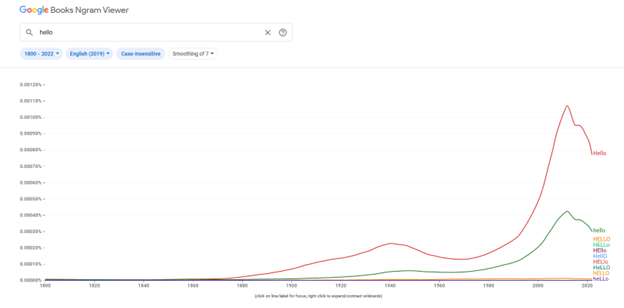
I recently discovered the Google Books Ngram Viewer, and it appears that the frequency of the word hello peaked around 2012:

Google Books Ngram Viewer results for “hello.”

Is hello getting cancelled? If so, we’re doomed.

I’m going to rebel against this trend and keep saying hello anyway.

Instagram: @m.snarky

© 2024. All rights reserved.

Supporting Links

Hollo – https://www.merriam-webster.com/dictionary/hollo

Hello – https://www.merriam-webster.com/dictionary/hello, https://www.oed.com/dictionary/hello_int?tab=factsheet#1691340

NPR – https://www.npr.org/sections/krulwich/2011/02/17/133785829/a-shockingly-short-history-of-hello

Google Books Ngram Viewer for hello https://books.google.com/ngrams/graph?content=hello&year_start=1800&year_end=2022&corpus=en-2019&smoothing=7&case_insensitive=true