Mean Little Dogs

Story 47 of 52

By M. Snarky

During my post-lunch walk today I saw a woman walking an outwardly spoiled Yorkshire Terrier on a leash while also pushing a fancy pet stroller. You know the kind; fresh groomed cut; shiny white fangs; ribbons and bows; blingy designer collar; claws painted fire-engine red. Remember that I’m writing about the dog here, not the woman.

Seeing that dog immediately transported me back to when my Aunt Lois’ pampered Yorkie, Coco, ran up from behind me and viciously bit me on my right Achilles tendon for no reason. It was a completely unprovoked attack. I was thirteen years old, and the injury hobbled me a little bit and so I limped around for a few days afterward looking like some dumbass poor suburban white boy trying to emulate the homeboy street walk of a hardcore inner-city gangbanger.

It’s strange how a mundane observation like seeing that Yorkie can immediately trigger an unpleasant experience from decades past. It also occurred to me how ridiculous it was that a little dog could be a PTSD inducing monster for a grown man. Coco’s bite was the first but certainly not the last dog bite I would ever receive from a lapdog, but the embarrassment of getting victimized by that spoiled little dog still haunts me, and although punting Coco across the room did flash across my mind at the time, retaliation was not an option because my Uncle Benny was standing right next to Aunt Lois with a half-crooked smile. It was as if he was saying, “Welcome to my world, kid.”

I had a best friend named Mark Flaata who lived on the corner of Cartwright Avenue and Chandler Blvd in North Hollywood, which was only a couple of blocks west from the apartment I was living in with my mom and siblings which was near Cahuenga Blvd and Chandler. Mark’s mom ran a small business named Showtime Kennels out of the house. The red and white sign on the corner of the property read:

Showtime Kennels
Grooming Boarding Breeding
AKC Certified
Call 606-0842

Mark apparently held an unpaid intern position with Showtime Kennels management that could best be described as Kennel Technician III, which involved the following dog kennel related maintenance tasks:

Pick up the empty food bowls.
Wash the empty food bowls.
Scoop up the dog poop.
Hose out the pee.
Fill the water bowls.
Feed all the dogs.

He alternated days with his brother Alan, and Mark was not allowed to go around terrorizing the neighborhood with me until his chores were done, so I volunteered to help so I could get him out on parole early. This was my apprenticeship phase of learning how to work with all of the cute pampered AKC (America Kennel Club) certified four-legged savages that you can imagine. I believe that you could have called my position, Kennel Technician Lackey I.

Mark taught me the ropes and I was a quick study. The three most important things were #1: Do not let a dog escape, and #2: Do not get the dogs wet while hosing out their dog run, and #3: DO NOT EVER turn your back on the dogs while inside or exiting the kennel or they will almost certainly bite you. I believe that #3 should have been #1 because it was unquestionably the most hazardous part of the job, but I wasn’t willing to go to Showtime Kennels management to file a grievance.

As it turned out, Showtime Kennels is where I learned to truly fear the small breed dogs like Maltese, Pekingese, Phalene, Pomeranian, Shih Tzu, and my least favorite, Yorkshire Terrier. These were neurotic, yappy, compact, savage little beasts, and even though I was helping Mark feed them their yummy horse meat soup with a generous scoop of kibble (in the exact proportions based on the size of the dog, of course), they barked, snarled, and gnashed their teeth at me more often than not. You’d think we’d be friends, but this was never the case: I was their eternal foe and perpetually on the menu.

Whenever rule #3 slipped my mind, sometimes the gnashing teeth found themselves embedded into my ankle or sometimes my lower calf if the little devil put in some extra effort and lunged a little bit. This was way back in the 70’s so there weren’t any emergency room visits or filing of personal injury lawsuits through the likes of the Larry H Parker law firm; it was simply a life lesson for volunteering in general. I’ll leave it at that. Anyway, a little swab of witch hazel and some gauze and a strip of duct tape over the bite wound, and I was good as new.

You might ask: But what about getting rabies? This was highly unlikely because most of these animals were AKC certified purebred breeding and show dogs, and they lived a life in the lap of luxury exclusively indoors, insulated from the outside world (much like a modern-day celebrity) so there was practically zero chance of ever getting rabies from them because these dogs were never, ever allowed to fraternize with the mutts or the squirrels or the cats or the rats in the neighborhood.

The usual feeding routine was that before we started, we’d blast Emerson Lake & Palmer’s Brain Salad Surgery on the old beater Hi-Fi system in the garage and smoke a little bit of weed to get primed up. It helped me relax and allay the fear of getting chomped on (again) by someone’s precious little ill-mannered and extremely unpredictable lapdog.

When feeding time came around, the dogs sensed it, and the anticipation was palpable as we filled the bowls and loaded them onto a cart to roll down the dog run. The dogs would start barking and banging against the chain-link gates of their kennels in an almost unbearable cacophony, and this is why we blasted ELP on the stereo.

Some dogs had a very rhythmic chain-link gate pounding routine that went like this:

They would stand on all fours on the concrete deck about a foot away from the gate, bark three times at the sky, lunge at the gate with their front paws to make the gate rattle, bark three more times through the fence, drop back to the deck, reposition, and repeat.

Some dogs would run around in a circle rapidly two or three times, lunge the gate and bark five times, rest, bark five more times, drop, rest, and repeat. I think the rest was so they could catch their breath because they got gassed out from the overly enthusiastic barking due to their tiny lungs.

Other dogs were much more obnoxious and would stand on their hind legs with their front paws against the chain-link gate and rattle the gate with the rhythm of their unrelenting barking. Think of this as a dog bark synchronized with the metallic rattle of a slightly loose chain-link gate. Charming.

One of my feeding hacks was to open the gate just wide enough for the food bowl to squeeze through—strategically placing the metal bowl between the gnashing teeth of a mean dog and my quivering hand—and then slide the metal bowl across the concrete deck with a flick of my wrist as you would toss a Frisbee. I was able to develop some impressive accuracy and get the bowl to stop exactly where I wanted it, which was at the back of the dog run just in front of the doghouse. This would also get the menacing little dog to chase the bowl down and put some distance between us. The grating sound of the metallic bowl sliding across the slightly abrasive concrete deck is something that I’ll never forget.

While the dogs ate, the din of the kennel dropped dramatically for about thirty-seconds, and the only sounds you could hear were the metal buckles of their dog collars banging against the metal food bowl, and the chomping and the crunching and the gulping of the food. It amazed me how quickly these little monsters could woof down their food. I’d bet a dozen of them could finish me off in five minutes—like furry little land piranhas.

I’ll also never forget the yelps and the remarkable blue streak of expletives flying out of my mouth whenever I forgot rule #3 and felt the sharp, immediate pain of small canine teeth embedding themselves into my flesh from behind…again. Over and over, I had to fight back the urge to punt the perpetually angry little dogs over the fence onto Chandler Blvd and into the unknown suburban landscape. That would have been mean and inhumane, right? Yeah, right.

I never counted how many times I was bitten, nor tracked the breed-to-bite ratio—although I’d guess Yorkie’s would rank #1—but it was definitely more than enough to last several lifetimes.

If nothing else, being a volunteer Kennel Technician Lackey taught me one thing: Little dogs simply cannot ever be trusted.

Now you’ll understand why I flinch and break into a cold sweat whenever a small dog starts barking.
Instagram: @m.snarky

Blog: https://msnarky.com

©2025. All rights reserved.

Watered Up

Story 46 of 52

By M. Snarky

There are few things in life that are more satisfying than a nice glass of cold water—especially when you are thirsty—but who decided that we should all be drinking an entire gallon of water a day and practically waterboarding ourselves on a regular basis? Was it the bottled water companies? The metal water container companies? The American Plastics Council? The urologists union?

When I was growing up in the San Fernando Valley, the only water I drank was from the Los Angeles Department of Water and Power (LADWP) city water supply that came directly out of my tap…or sometimes I drank it from a garden hose if I was desperate and close to dying from dehydration. I didn’t mind the sun warmed water with the funky black rubber taste coming out of the hose. I only drank water when I was thirsty and stopped drinking it when I was satiated. Seemed like a natural thing to me.

I also drank water out of those colored see-through plastic acrylic cups, pastel colored aluminum cups, and those weird, funny smelling primary colored Tupperware cups. I’m sure that I consumed some toxic materials and microplastics along with the water, but in my defense, there weren’t any California Proposition 65 warning labels at that time. Yes, I’m a survivor.

Back then, there simply wasn’t a daily water volume standard: You drank water when you were thirsty and that was about the only reason to do it. For me, maybe it was about a pint or so, unless I was doing some physical activity—like skateboarding—which would maybe double that amount. If I had some spare change, I could also buy a 16-oz Coke (which is mostly water anyway) at Bamford Liquor store on the corner of Magnolia and Cahuenga boulevards for 15 cents. All in, it was maybe a maximum of 1.5 quarts of daily liquid intake, nowhere near the 1 gallon per day (GPD) volume as “recommended.”

This new GPD standard has given rise to the following:

  • Mass consumption of bottled water in clear disposable plastic containers that make it impossible to differentiate whether or not your coworker is drinking water or day-drinking vodka at their desk.
  • Expensive designer water; Perrier; San Pellegrino; VOSS, etc. I’m not sure why people are willing to pay 1,000x  the cost of tap water, but they do.
  • Portable metal tankards of all sizes, often used for lifestyle and political statement stickers. I read that people are now getting tendinitis from carrying around their ridiculously large one-gallon jugs. It has also been reported that several small dogs met their demise when their owners dropped said jug due to finger fatigue.
  • Urinating 10x the normal frequency. This, my friends, is going to wear out your bladder. This may also give your friends and coworkers the impression that you have a bladder infection or a prostate problem.
  • Depletion of the public water supply from all of the excessive drinking and flushing. Indeed, we are simultaneously drying out the planet and pissing our lives away.

Furthermore, nothing looks sillier than an adult puckering up to drink from their disgusting encrusted straw with god only knows what kind of bacteria living on it, especially men. Also, you probably aren’t going to die from dehydration during your commute or when going to the supermarket for groceries, so it is completely unnecessary to bring your dumbass super-sized drinking vessel with you.

Were people ever regularly drinking a GPD of water? No! The closest thing to it that I could find was from way back in 1945 when the U.S. Food and Nutrition Board of the National Academy of Sciences recommended eight 8-ounce glasses of water per day—that’s all. This adds up to a total of 64-ounces, which is only a half-gallon. Apparently, someone in a corporate boardroom somewhere decided to round this up to a gallon to perhaps sell more bottled water and portable water container products. I stand by my list of suspects noted at the beginning.

You might think that municipal water is unhealthy, however, many bottled water companies use municipal water as their source and simply run it through a series of process treatments like pre-filtration, Reverse Osmosis (RO), Ozonation, UV lighting, post-filtration, and mineral additions, and now it can be sold as “purified” water. We already know that highly processed foods are bad for you, but what about this highly processed water? Just asking questions.

Sourcing municipal water is super cheap too. For this exercise I’ll use the common measurement of one acre foot of water, which is 325,851 gallons. One acre foot of municipal water costs an average of about $1,000, which is only (rounding up) about .004 cents per gallon. Super cheap was an understatement: It’s practically free!

Packaging this newly processed gallon (3.78541 liters) of purified water (which I’ll round down to seven half-liter units) in 500ml plastic bottles is going to cost about 2.6 cents each, including labels, for a grand total of 18.2 cents to package a gallon of water into seven 500ml plastic bottles give or take a half penny. This is how the bottled water companies sell bottled water for massive profits. This is also how we are getting totally ripped off when we pay 39 cents for a 500ml bottle of water at the corner mini mart.

Clean, safe municipal water is a relatively new thing too. It used to be that drinking local water was genuinely dangerous and could make you incredibly sick or kill you, so people used to drink a lot more beer, wine, and spirits because they were simply safer to drink. By all appearances, people back then must have been under the influence of some level of alcohol consumption day and night (and may have been a happier lot), however, I don’t think it was ever recommended by anyone to drink a gallon of any of these alcoholic beverages a day but knowing human nature and a little bit of history, some certainly did. This also suggests that the great thinkers and artists and writers did their best work while under the influence.

I’ll drink to that.

Instagram: @m.snarky

Blog: https://msnarky.com

©2025. All rights reserved.

Bluffside Park

Story 45 of 52

By M. Snarky

Between 1979 and 1984, Bluffside Park was the unofficial local name for South Weddington Park in Studio City, and it was the “secret” place where all of the hip cool young people from Studio City, North Hollywood, and the Hollywood Hills would meet up to find out the answers to the many important questions of the day:

  • Was there any good weed to score?
  • Does anyone know where to score some cocaine?
  • Where were the weekend house parties?
  • Were there any good bands playing at the Starwood, Gazzarri’s, or Phases?
  • Does anybody have any clove cigarettes?

Good weed was relatively easy to obtain around Los Angeles most of the time and some strains were vastly better than others—some of which would knock you on your ass—but getting your hands on some decent cocaine required knowing a guy who knew a dealer and trusting that the blow wasn’t cut with too much lactose or mannitol. Ultimately, you just had to trust the system and weren’t going to get ripped off.

The curious thing about cocaine is that while it impresses people as a classy drug used by sophisticated individuals such as artists, musicians, poets, actors, and writers—ergo, sophistication by association—it simultaneously drains your bank account at $100 per gram. That was a lot of money back then, especially for a low roller like me making only $5 per hour as an electricians apprentice. Indeed, a spare Benjamin was hard to come by but all too easy to spend foolishly in an attempt to impress friends and love interests. Although I did enjoy getting high on cocaine, I could only indulge in it occasionally because I needed to make rent on a regular basis, which was unlike some of the young adults in the neighborhood who were still living with their wealthy parents and always seemed to have a vial or two of cocaine in their pocket.

As it was, Bluffside was one of those local impromptu gathering places where sometimes only a handful of people would show up and at other times the small dirt parking lot was completely full of cars and anticipation. There was always a good chance that you would run into someone that you hadn’t seen in a while which would give you the opportunity to catch up on things, exchange phone numbers, and maybe get high together.

Unfortunately, the locals living in the Bluffside enclave hated the sometimes-noisy crowds that occasionally blasted the KROQ soundtrack of the day on the Blaupunkt radio installed in their parents BMW’s or Mercedes-Benz’s. Apparently, music by The Clash, The Dead Kennedys, The Police, the B-52’s, and Iggy Pop violated the collective sensibilities of the well-heeled neighborhood and so they would call the L.A.P.D. regularly.

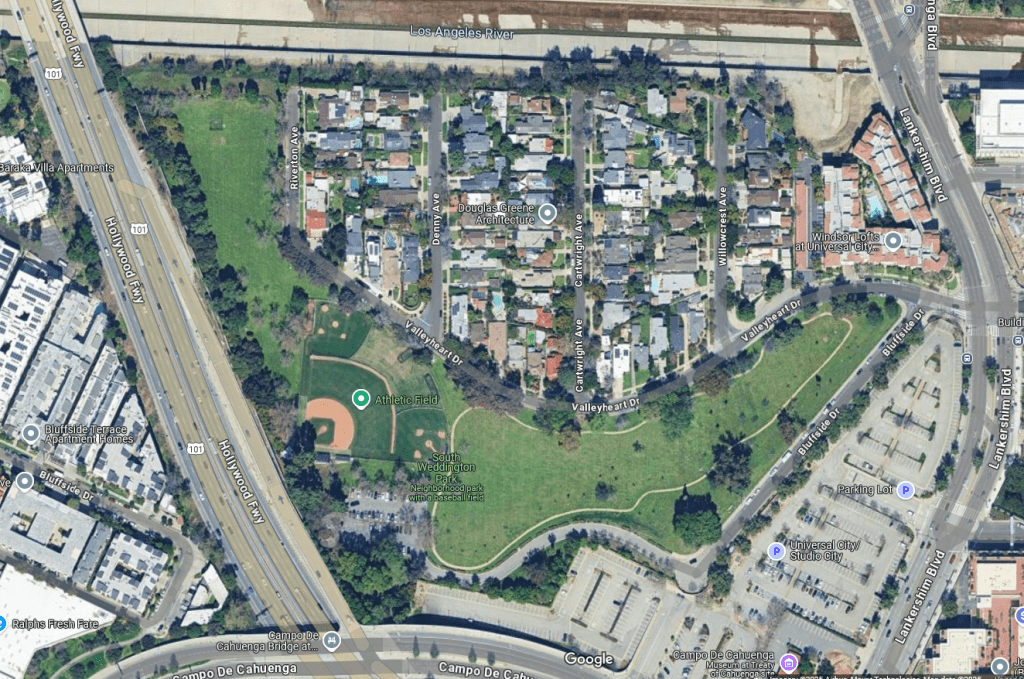
The cops arrival would disburse the crowd remarkably fast when they rolled up because they were easily spotted due to the park being accessible only by two streets: Bluffside Drive to the east and Valleyheart Drive to the north. The park boundary was wedged between CA 101 to the west and the concrete L.A. River (a.k.a. “the wash”) to the north, and it was easy to ditch the cops along the verge of the 101 or the verge between the wash and the residential houses in the tony little neighborhood.

The unofficial yet generally accepted schedule at Bluffside was to meet on Friday night after work, disseminate and absorb all of the critical information, chose your adventure, and then meet again on Saturday night and repeat the process. By Sunday night, the talk was mostly about the disasters, misadventures, and the highlights of the previous 48-hours. There were also plenty of casual conversations revolving around music and food and books and movies and sometimes a bit of juicy gossip would creep into the conversation about who started dating, who broke up, and who was having sex with whom.

The legendary house parties were absolutely wild. There were many wealthy families living in the area who worked in the automotive, aerospace, music, television, or film industries, and some of them lived in these fabulous hillside houses that had large swimming pools some of which included detached cabanas or pool houses. Often, the parents would go on a lengthy vacation and leave their eighteen-year-old or so offspring at home by themselves because there is nothing more tedious and troublesome than traveling with adult children, the term of which appears to be an oxymoron.

Leaving an unsupervised eighteen-year-old “adult” at home was analogous to leaving an arsonist with a five-gallon jerrycan of gasoline and a match: At some point combustion was going to happen. One phone call to one friend would start a chain-reaction of other phone calls to other friends, and exponentially, the news got around quickly. Soon, hundreds of random people—some known, others being perfect strangers (if there is such a thing)— start showing up on a Saturday night to party their asses off like there was no tomorrow because, frankly, at that age most of us were living in the moment which was all that truly mattered.

The age span between eighteen and twenty-one is like purgatory because you are considered an adult and are of legal age to vote and engage in contracts or join the military or buy a car or borrow money from the bank to buy a house, but you can’t buy alcohol, one of the great privileges and pleasures of true adulthood. When you are stuck in this underage limbo, the only way to get alcohol was to know somebody who was old enough to buy it for you, or you had to resort to “pigeon” for it. To pigeon was to hang out in a liquor store parking lot out of sight of the store clerk and ask someone who was going inside the liquor store to purchase your alcohol for you. At best, the odds were 50/50. Circus Liquor in North Hollywood was my liquor store parking lot of preference because it was close to where I lived. Indeed, the only way to get your fifth of Cuervo Gold or a six-pack of Bud tall boys was by proxy. There were other, more nefarious ways like shoplifting, but I always considered theft one of the lowest forms of human conduct and refrained from engaging in such a lowly act.

This was a pre-GPS era, so unless you had a Thomas Guide in your car and knew the street address of the house party (of at least the general vicinity), you would often pile into the car of a guy who said that he knew where the party was, and along with your plain brown paper bag of beer or tequila, you drove off to parts unknown. We would often get lost and missed out on many house parties with this method. The surest way to find the house party was to convoy with a bunch of other cars that were following the guy in front who did have a Thomas Guide and snake your way up into the narrow streets of the Hollywood Hills.

One of these house parties was near Laurel Canyon Blvd and Mulholland Drive, overlooking Hollywood. The house was stylishly furnished, replete with leather couches, crystal chandeliers, marble, and all manner of artwork. There was a better than average live rock band playing under a cabana on the pool deck. There were several kegs of beer on ice in plastic trash cans that were lined up along the back wall of the house. Drinking Heineken from a keg is not the same as drinking Heineken from a bottle—it was considerably better, and so it flowed endlessly into my bottomless red cup. The house was jam-packed with partygoers and marijuana and clove cigarette smoke permeated the air. People were smashing out their cigarette butts on the hardwood floors and spilling their beers all over the house. Some people were snorting cocaine from the marble countertops in the kitchen.

As I was bumping my way through the crowd toward the band, Tom Armstrong, an old hooligan friend that I hadn’t seen in a while, spotted me from the opposite side of the pool and yelled out my name. We acknowledged each other. He was there with his friend Duke. Tom said something in Duke’s ear, and then they started walking briskly in opposite directions around the pool toward me. This could only mean one thing: They had conspired to throw me into the pool. Not tonight, boys! I spotted some Italian cypress trees at the far edge of the pool deck and decided that I was going to hide behind them. The thick crowd of people slowed them down considerably and I bent down as low as I could while winding my way through the thicket of people toward the trees hoping that Tom and Duke would lose sight of me.

When I got to the edge of the slate pool deck, I briefly glanced back to see Tom and Duke closing in on me. I took a step beyond the deck thinking that it was a planter bed where the Italian cypress trees were located, but it wasn’t…it was the ledge of a concrete retaining wall. I stepped off the ledge and fell down about twelve feet into the darkness and almost landed on a couple who were making out on a bench in the planter below. I hit the dirt hard on my right side. It knocked the wind out of me, and I was sure that I broke my right arm and maybe some ribs. The guy on the bench jumped up and said, “Dude—are you okay?” I couldn’t talk yet because I was still struggling to catch my breath, so I just nodded my head, slowly stood up, and limped away holding my arm and headed back toward my car to drive myself to the emergency room. On the way to my car which was parked way up the road, I ran into my friend Mark Flaata who had just arrived. By then I had recovered considerably in the miraculous way that one recovers quickly when one is young. My arm and ribs were definitely not broken, but my confidence definitely took a major hit. We went back into the party and stayed until the cops showed up around midnight and shut it down.

Meeting back at Bluffside the next night, we heard many other stories about the same wild party. It’s funny how people can be at the same place at the same time yet not run into each other while also having a completely different experience. Drama, comedy, run-ins with law enforcement, breakups, hookups, philosophical conversations, religious conversations, swearing off drinking alcohol or doing drugs, passing out on the front lawn, and musings about the meaning of life were all part of the various storylines that were told. In those moments, we represented our fleeting wasted youth in the truest form possible.

This was all part of an earnest—although ultimately futile—effort to stave off the requirement to get serious about life because no young person wanted to end up like their parents working long hours in jobs that they hated and being stuck with all of those serious adult responsibilities like insurance and mortgages and car payments and the multitudes of problems that seem to accompany them.

No matter our purest intentions, time marches forward mercilessly regardless of how tenaciously we try to hold it back, and most of the once fierce, invincible, carefree teenagers eventually become another cog in a massive, indifferent, mindless system that strips them of their soul and spits out their bones when it is done with them, repeating the infinite cycle of modern society.

Luckily, some of them survive with their souls intact. These are my kind of people.

Instagram: @m.snarky

Blog: https://msnarky.com

©2025. All rights reserved.

The Pinball Wizard of NoHo

Story 44 of 52

By M. Snarky

In 1974, the California Supreme Court ruled that pinball was more a game of skill than chance and overturned its prohibition in Los Angeles, prompting a pinball arcade renaissance in the city.

Our local pinball arcade which practically popped up overnight was on the east side of Lankershim Blvd near the corner of Weddington Street, in North Hollywood, California, or NoHo as it is now called. It was almost directly across the street from the old El Portal theater and was located in an old single-level brick building. I don’t remember the official business name of the pinball arcade, but it was definitely not the Funky Flipper which closed in 1973 and was further south on Lankershim near Otsego Street, famous for its proximity to Bill Elkins’ The Basement recording studio where people could catch a glimpse of Linda Ronstadt, or Tom Petty, or Jackson Browne.

The prices were one game for a dime and three games for a quarter and if I added up all of the money that I spent at that pinball arcade, it would have been about $26 over a one-year period. Adjusted for inflation, it would be $163.57. Wowzah—it seemed like cheap entertainment at the time. There was, however, a certain level of social status if you held the high score on one of the machines. It was also a gathering place for locals. My brother Scott, cousin Chris, and I would often walk together to meet up at the arcade with other friends in the neighborhood. We would often play against each other, but it was ultimately about getting the highest score and getting your name on the board.

There were also some older boys and men hanging around who smoked cigarettes while they played pinball (there were ashtrays on many of the pinball machines) and it seemed to be very tense when a few of them would be standing around a single-player machine while someone else was playing with intent, indicating, perhaps, that the gambling rumors were not a myth.

The pinball machines of that era were all analog electromechanical devices and did not have any solid-state components. They were built with incandescent lights, switches, transformers, relays, and solenoids and they were always warm to the touch.

In the summer of 1974, I was thirteen years old and I held the high score of 74,800 points on the Bally’s Fireball pinball machine for two weeks. Fireball was a challenging game. It had a spinning disc in the center, a kickback kicker on the left, two captive/kickout holes (Odin and Wotan), a Flipper Zipper feature that would bring the flipper tips close together allowing you to hold a ball captive, and the usual scoring bumpers. If you were good, you could play three balls at a time and quickly rack up the points. The tilt on this machine wasn’t too touchy, so you could get away with some relatively aggressive table shaking.

I learned all of the nuances of the pinball machine, for example, the exact pullback length of the plunger to give the pinball just enough momentum to drop into the 3,000-point chute. I knew where the dead zones were, and the exact point on the flippers to launch the pinball exactly in the direction where I wanted it to go on the board, and precisely how much shaking I could get away with. I always scored enough points for at least one Replay (a free game!), which were signified by a loud knock emanating from inside the machine, the replay point thresholds of which were 52,000, 72,000, and 96,000. I could play Fireball for about half an hour at a stretch on one thin dime. Indeed, I was the temporary Pinball Wizard of Fireball.

The male arcade manager, a thin, bearded, middle-aged hippie type with long stringy black hair that he parted on the side for a world-class comb-over to hide the top of his balding head kept a blackboard behind the change counter where he tracked the names, dates, and pinball machine scores, and it looked something like this:

It didn’t take long before the pinball arcade manager determined that he was probably losing money with kids playing for such a long time on one dime, so he adjusted the tilt setting on all of the pinball machines to ridiculously low, hyper-sensitive levels that essentially tilted out with the slightest nudge. This made it much harder to get a high score or a replay. Subsequently, the high scores listed on the chalkboard were impossible to surpass and as time went on, the dates were never updated. This may have also been part of the calculus of the arcade manager in that people would spend more money to try and beat the old high scores.

One fall day, as I was walking home from Walter Reed Junior High School, I wandered over to the pinball arcade with two dimes rattling in my pocket with the intent of setting the high score on Fireball once again, but when I got to the building there was a large sign on the door that said, “Business Closed.” I peered into the dusty window and saw that all of the pinball machines had vanished, but the high score blackboard was still hanging on the back wall without my name on it, mocking me.

There were rumors floating around about the arcade closure; it was a front for a gambling operation; it was a front for a drug dealing operation; there was an armed robbery, and the owner/manager was shot and killed; a jealous woman caught her man with another woman and shot him dead.

Rumors aside, I never found out what truly happened there, but it never reopened as a pinball arcade.

It’s all gone now. All of the nineteenth century brick buildings have been replaced with trendy new movie theaters, shiny office buildings, and fast-food restaurant chains.

Links

Funky Flipper https://www.facebook.com/groups/losangelesnostalgia/posts/462213053236535/

Bill Elkins’ The Basement (renamed The Alley) https://nohoartsdistrict.com/the-legendary-alley-studios/

Bally’s Fireball pinball machine https://pinside.com/pinball/machine/fireball-bally

That Time America Outlawed Pinball https://www.history.com/articles/that-time-america-outlawed-pinball

Instagram: @m.snarky

Blog: https://msnarky.com

©2025. All rights reserved.

4th of July at the Beach

Story 43 of 52

By M. Snarky

There is absolutely nothing like celebrating the 4th of July at the beach. Standing there at the edge of the land, with nothing but the expansive, reflective ocean in front of you, fireworks take on an entirely different dimension of beauty.

Ironically, here in Southern California where fireworks are practically outlawed, the acquisition and ignition of illegal fireworks goes on virtually unabated and are generally flaunted in the faces of law enforcement and firefighting personnel. This is not hard to imagine being that Mexico, with its year-round, inexpensive fireworks available nearly everywhere south of the border, is so close to Los Angeles.

One of my most memorable 4th of July celebrations was at Topanga State Beach in 1976 for the bicentennial. Back then there were no designated campsites, and you were allowed to pitch a tent directly on the sand and camp, which we did along with hundreds of other people with their tents which were scattered around the beach but in relatively close proximity. It looked exactly like a modern-day homeless encampment.

I was a 15-year-old punk-ass white boy juvenile delinquent, and my friend Jerry had taught me how to make really good firecrackers – the recipe of which I will not reveal as it may run me afoul of the law – but I made about a hundred of them because, why not. These were on par with the Mexican M-80s but were also waterproofed with beeswax. I would light one and throw it into the ocean and it would still explode underwater – like little depth charges. Although the fuses were cut to the same length, they were a little bit unpredictable with their burn time and sometimes the firecracker would explode before hitting the water or sometimes in midair. It’s not lost on me that I’m lucky that I still have all of my digits…and both hands…and my face.

Down the beach about fifty feet away from us toward the water, a couple of guys dug a pit in the sand – about eight-feet in diameter and a few feet deep – and lined it with rocks from nearby Topanga Creek and then started an impressive bonfire before dusk. When the coals were hot enough, they tossed in a 5-gallon bucket of magnesium shavings from their machine shop, and a few bright, errant sparks went aloft as the magnesium shavings began to heat up. In the meantime, fireworks and firecrackers were going off all up and down the beach; Roman candles; large and small bottle rockets; Buzzbombs (not the beverage); and loud, ear-piercing M-80 and M-100 explosions could be heard every half-second. It was pure mayhem. Happy 200th Birthday, ‘Merica!

Then one of the bonfire guys walked down to the edge of the water and filled his bucket with saltwater and then came back up to the bonfire, paused for a moment, and then started pouring the water directly into the pit. The result of the saltwater hitting the hot magnesium shavings was more than magnificent: It was ephemeral art. The fleeting, white hot fireball and radiating heat were impressive. The gathering crowd of people were oohing and aahing and clapping as the guys threw even more magnesium strips and water into the pit to keep their little show going.

Then there’s always that one guy in a crowd that will one-up anyone no matter the circumstances.

Two tents to our right, another guy, who was standing on the beach and smoking a joint in the glowing magnesium firelight, went into his tent and pulled out a shovel and a black six-foot long by six-inch wide pipe that had handles mounted on the sides. He dug a hole about three feet deep and put one end of the pipe in the hole and then back-filled the sand around the pipe to hold it in place. He tapped on the side of pipe and pointed the open end of it ever so slightly seaward. Then, again, from inside his tent, he pulled out what appeared to be a black bomb with a long fuse in it – like what you’d see in a Spy vs. Spy cartoon in Mad Magazine.

He lit the fuse with his joint, dropped the “bomb” into the tube fuse first, and took a couple of steps back. There was a slightly muffled PHOOM! and it launched that bomb looking thing high into the night sky like it was an artillery shell. Then there was a much louder BOOM! from above and a professional pyrotechnic level burst of red stars went off over the water. This prompted the crowd to cheer and applaud. People pulled their cars over and stopped on Pacific Coast Highway behind us to watch. Then he lit another one. And then another. It went on for about 15-minutes, the duration of which all of the other fireworks up and down the beach had ceased. It was spectacular.

After that impromptu semi-professional fireworks show, all of the other fireworks seemed puny, silly, and totally insignificant. We sadly carried on anyway.

We found out afterward that the guy worked in the pyrotechnics department at a very famous Southern California amusement park located in Anaheim. By all considerations, it was a pro level show, and the crowd loved it.

Then the waves from the incoming tide came up the sand and started flooding the magnesium fire pit, turning it into a hellish fireball which glowed under the surface of the water. Everyone began to scramble, and people were pulling up their tents and grabbing their camping gear and hauling them up to higher ground. It was complete chaos. I managed to save Jerry’s Coleman cooler full of Bud tall boys before it drifted out to sea. With the combined smells of marijuana, hot dogs, sulfur, and burnt arm hairs wafting through the air, we cracked open a couple of beers and gulped them down. They tasted like freedom.

Instagram: @m.snarky

Blog: https://msnarky.com

©2025. All rights reserved.

Lifeguard Queen

This is an AI generated image that looks remarkably like the Lifeguard Queen of my youth.

Story 42 of 52

By M. Snarky

Late summer, 1974, North Hollywood, Calif. The walk from our apartment at 5342 Cahuenga Blvd to the North Hollywood Pool was about a mile, and for 25¢ you could swim all day. With only our towels in hand and one quarter each in our pockets (Grandma Opal Hess would say, “two-bits”), we walked directly west down the dry and dusty Union Pacific Railroad tracks that paralleled Chandler Blvd to North Hollywood Park, and then turn left at Tujunga Ave where the pool was located on the west side of the street just beyond the public parking lot. When the temperature rose above 100-degrees, it was like walking through the sweltering heat of a desert, but it was always worthwhile because I knew she would be there.

I had just turned 13, my younger brother Scott was 11-1/2, and our younger cousin Chris was 10-1/2. The three of us were accidentally representing the poor white boys of North Hollywood with our holey T-shirts, cut-off jeans, knee-high tube socks with holes in the heels and the toes and our worn out Keds and Converse sneakers. We had no food, no water, no sunscreen, and usually no extra money – not even a nickel for some bubble gum. Our parents were so broke that we would often have to resort to scouring the neighborhood for returnable soda bottles to collect enough money for the pool entry fee.

Whenever we did have any extra change, we would stop by the Winchell’s Donut House near the corner of Lankershim Blvd and Chandler because it was on the way to the pool, and we would have been foolish not to pick up a few 5¢ donuts.

At the front counter of the pool house, you handed over your hard-earned quarter to the attendant for a ticket, then you took the ticket over to the men’s side of the pool house where there was another counter. There was a hand painted sign above that counter that said, “No Cut-Off Jeans!” and, “No Swimming in Underwear!” and “No Urinating in the Pool!” There was another hand painted sign above the door that exited to the pool deck that said, “Rinse Off Before Entering Pool.” Being the ignorant youth that I was, I would have argued that the no cut-off jean policy was dumb and that the no swimming in underwear and no urinating in the pool rules were obvious, but why do I need to rinse off? But rules are rules, and in a public space they must be posted…and obeyed, that is, if you want to avoid getting kicked out.

There was this persistent rumor going around that there was a chemical in the pool water that turned bright red if you peed in it, which signals to everyone in the water around you AND the lifeguard staff that, a) you are a rule breaking savage, and b) you will be promptly removed from the pool, Pissboy will be tattooed onto your forehead, and you will be escorted off of the premises by two burly lifeguards, and banned for life from entering any of the Los Angeles County Parks & Recreation managed public pools. I will tell you unequivocally (although not without some level of embarrassment) that this was indeed just a persistent rumor that I believe was likely propagated by the lifeguard union.

Anyway, you gave the male attendant your ticket and they would hand you a mesh bag with what I can only describe as a large diaper pin that had a number stamped on the end of it which matched the stamped metal number tag attached to the bag. The first time we went to the pool I had no idea what I was supposed to do with the mesh bag or with the pin. After observing what the other men and boys did with them, I quickly figured out what to do, so I put my beat-up shoes, tube socks, T-shirt, and cut-off jeans in the bag, attached the pin to my swim shorts, and handed the bag over to the young man behind the counter who promptly hung the bag on a rack in numerical order.

Scott, Chris, and I, after rinsing off in the remarkably cold water (why was there never a hot water valve?), walked out onto the pool deck like we owned the place. Around the entire pool deck, about every ten feet or so, painted in fire engine red, was “NO RUNNING!” in huge, stenciled letters. More rules. So, with our towels draped around our necks, we briskly walked over to our favorite spot on the deck near the far southeast corner of the deep end where I could observe the high lifeguard chair from afar, which was the throne upon which my Lifeguard Queen sat.

She was a tan, brunette beauty with hazel eyes, wearing Ray Ban Aviator sunglasses, a white sun visor, and the iconic red one-piece Los Angeles County Lifeguard issued bathing suit. Being an official lifeguard, she also had the shiny metal whistle on a lanyard around her neck and a large megaphone by her side. She was a magnificent, powerful sight to behold, and I was crushing hard.

Mind you, I was not creeping on her or staring or ogling – I would simply glance over at her every now and then, hoping that one day she would notice me and smile and maybe wave at me. I had no idea what I was going to do if she ever did acknowledge me like that, but I probably would have suffered a heart attack.

I was comfortable in the water and thought that I knew how to swim, but I truly didn’t know how to swim well. You could say that I only knew how not to drown, just like most other recreational swimmers, I suppose. It wasn’t until I took professional swimming lessons decades later at Los Angeles Valley College for Ironman training with my wife Kim, that I realized how bad I was at swimming. How bad? It went something like this: On the first day of training, coach Stuart directed us (about three-dozen people) to self-seed ourselves along the pool coping thusly, “Advanced swimmers in the right-hand lanes, intermediate swimmers in the middle lanes, and beginning swimmers in the left-hand lanes.” I considered myself an intermediate swimmer and lined up in the middle lane.

Then coach Stuart said, “Okay swimmers, we’re going to split lanes for this drill in a clockwise direction, so we don’t swim into each other. Tom, Frank, Lisa, and Caroline will demonstrate this for you.” The four of them jumped into the middle lane and with a “Yip!” command from the coach, they started swimming in single file along the left-side next to the pool lane divider and when they got to the far end of the lane they turned around and came back along the right-side pool lane divider, passing each other without crashing as they swam in opposite directions.

Coach Stuart continued, “Does everyone understand this?” and we all nodded our heads in acknowledgement. “Now I want everyone to swim a few laps to warm up – Yip!” And with that, we jumped into the water and began swimming as directed. When I got back to the coaches side of the pool after a couple of laps, coach Stuart signaled me to the coping and asked me my name. “Okay, Kent, move down a lane to the left.” I moved down as directed. After a couple more laps, coach Stuart signaled me again and said, “Brad, move down another lane to the left.” I complied. By the time the warmup was over, my name was Norman, and I was standing in the wading pool.

But back in 1974 at North Hollywood Pool, I felt like I was channeling Olympic Gold Medalist Mark Spitz, and I was positive that I caught the queen’s eye once or twice as I swam by her elevated throne.

On the opposite side of the pool from the lifeguard chair were the two glorious springboards – one set at 1-meter, and the other set at 2-meters. These were our favorite activity to do at the pool. We got pretty good at doing jackknifes and swan dives (or so we thought), but big fat cannonball and cherry bomb splashes were our favorites. We mostly just goofed around doing boyish things like belly flops, lazy forward flips, mostly out-of-control back flips, and “Change-your-minds” where you acted like you were going to dive straight into the water but tucked into a cannonball at the last second.

On the last August day of the summer pool season – which was coincidentally also an extremely hot day – a Speedo wearing whale of a man swam right into the diving lane impact zone as I launched myself off of the springboard. I was in midair when I heard the whistle blow, but I didn’t see him until it was too late because I was looking across the pool to the Lifeguard Queen of all my dreams who was blowing said whistle. I collided with him upon entry of my almost perfect starfish belly flop, the impact of which knocked the wind out of me. I involuntarily inhaled a lungful of water which burned my lungs like fire. I began gasping uncontrollably for air under the surface of the water as I started sinking. The last thing I remembered was hearing a muffled splash next to me as I was looking up at the blazing, shimmering sun through the rippled surface of the water.

When I came back to my senses, there she was, smelling like Coppertone coconut tanning oil, leaning over me with the bleach scented chlorinated pool water dripping off of her face and hair and red swimsuit, giving me mouth-to-mouth resuscitation on the warm concrete pool deck. Her lips tasted like cherry flavored ChapStick. She was even more beautiful close up. Was I in heaven? I looked into her stunning hazel eyes and smiled. She pulled back and asked, “Kent, are you okay?” She knew my name! THE LIFEGUARD QUEEN KNEW MY NAME! Wait! How did she know my name? What happened? Never mind – let it happen! I started to say, “I love you, Lifeguard Queen!” but before I could say anything, I was rudely awakened by a big splash of pool water. Alas, it was all just a very vivid dream, probably intensified by the heat, hunger, and dehydration. But it seemed so real.

On the way out through the pool house that day she was working the front counter. We made eye contact, and I bashfully looked away. She said, “Cool Tee-shirt!” I was wearing a classic white Coca-Cola Tee-shirt with the red arm and neck ringer bands. I blushed. Then she said, “Have a nice day – see you next summer.” My heart skipped a beat. In an awkward, broken voice, I barely got, “See you next summer,” out of my mouth. At that age, “next summer” always seemed such a long way off and it would never come soon enough.

Summer, 1975, North Hollywood, Calif. This year we had secondhand BMX bicycles that we pieced together to get to the pool faster! On opening day, we raced each other down the railroad tracks from the apartment to the pool. All along the way we kept trying to one-up each other to see who could bunny-hop the highest or ride a wheelie the longest – this turned into a serious competition! Breathless, we locked our bikes to the rack at the pool and rushed to the front counter to get our tickets. The three of us; Scott, Chris, and myself, breathing heavily and dripping with sweat, didn’t even register with the attendant who just smiled at us as he took our quarters and handed us our tickets.

The singular thing that was occupying my mind was the Lifeguard Queen.

This time, the cold shower before entering the pool area was appreciated after riding our bikes so hard in the summer heat. We speed-walked toward our regular corner when we heard “Slow down!” coming over the staticky public address system, clearly directed at the three of us. We complied and slowed down – barely. As we briskly walked behind the queens throne I glanced up to get a brief look of her highness without being too obvious, but this time, the occupant of the throne was not the queen, instead, there was an imposter in her place: the throne was being occupied by one of the male lifeguards. Noooo! Where in the world was my Lifeguard Queen? Wahhhh! Sadly, I never saw her again. The pool days were never the same afterward. I felt an emptiness in her absence and became less enthusiastic about going to the pool.

Although I didn’t learn what her real name was, I imagined that it was something regal like Elizabeth, Genevieve, Catherine, or Margaret.

The summertime always reminds me of those carefree days at that pool with my brother and cousin, but mostly, I wonder about the Lifeguard Queen.

Old crushes die hard.

Instagram: @m.snarky

Blog: https://msnarky.com

©2025. All rights reserved.

Beef Enchiladas

Although my mom was not a Latina, she made killer 6-ingredient beef enchiladas on a tight budget. Slow braised chuck roast with onions, tortillas, lard, Las Palmas red enchilada sauce (“A must!”), and cheddar cheese. The secret ingredient was love.

Zombie Shifts

Story 41 of 52

By M. Snarky

For the last three months I have been working the overnight shift on a retail store network equipment refresh project for a global shoe brand. Due to contractual obligations, I am not at liberty to disclose the company name, but what I can say is that they’re kind of a big deal and I’m grateful for being part of this project.

However, working the night shift is hard for us humans. It throws our circadian rhythm so far out of whack that what once was perhaps a pleasant samba groove in 4/4 time becomes an offbeat primal sound more like that of a chimpanzee on meth beating on a metal trash can with a crowbar.

Getting out of the familiar 8 AM to 6 PM daytime rat race schedule and into the 6 PM to 4 AM nocturnal racoon schedule – the wee hours of which, incidentally, are the same as those of the tweakers, serial killers, zombies, vampires, and aging rock stars – is certainly not for everyone. I don’t love it, but it is necessary and mercifully temporary.

Your instincts are that when it gets dark outside, you are supposed to be winding down, not up. By 2:00 AM, you find yourself in an epic mental battle between your mind desperately wanting to sleep and your mind needing to stay wide awake and mentally sharp. You oscillate between these wildly opposite mental states. It’s not easy. It’s an eternal battle between Greek gods Hypnos and Argus Panoptes.

But you find ways to stay awake, like reading a book, listening to upbeat music, or playing a newly discovered online version of Whist, a popular 19th century card game that Dostoevsky mentions in The Brothers Karamazov that I had to Google when I read it. Whist was a predecessor of modern Contract Bridge, which is my dad and stepmom’s favorite card game. Sometimes I find myself doing all of these at once.

I feel oddly guilty about pouring a dram of whiskey at 4:00-AM and getting up at the crack of noon. It feels strange going to sleep for 8-hours and waking up on the same day. And even though I do typically sleep for 8-hours, I still feel tired. But why though? I mean, it’s just a time shift, right? I should feel totally normal, right? Well, not exactly…

In 1972, geologist Michel Siffre, one of the early pioneers of experiments on human circadian rhythms, spent six months in Midnight Cave in southern Texas. Siffre suffered both acute and lasting effects, only partially recovering from the isolation physically, mentally, and emotionally. His internal clock shifted to 48-hours, and he completely lost track of hours, days, weeks, and months. He stayed awake for 36-hours straight and slept for 12-hours at a stretch. His Day 63 inside Midnight Cave was really Day 77 above ground.

Siffre later described the experience as: “A slow slide into madness.” He talked to insects for company. He found comfort in his own voice, but silence always returned, crushing and relentless. After 180 days, Siffre’s team removed him from the cave. To him, only 151 days had passed. 29 days were unaccounted for in his daily diary. Time literally slowed down, stretched out, and slipped away from him.

So, from Siffre’s experiments we can conclude that our circadian rhythm is nothing to trifle with or you just might risk losing your mind a little bit. Duly noted. It’s still May, right?

I have one more week to go. I hope I make it. But if you see me talking to insects, you’ll understand why.

Instagram: @m.snarky

Blog: https://msnarky.com

©2025. All rights reserved.

It’s Everybody’s Fault

Story 40 of 52

By M. Snarky

Another controversy and another peaceful protest that morphed into a riot in Los Angeles which looks remarkably similar to a Dodgers World Series championship celebration. Some things will never change.

This time, it’s about federal Immigration and Customs Enforcement (ICE) agents in the sanctuary city of Los Angeles within the sanctuary state of California enforcing federal immigration law, the media narrative of which is labeled as “ICE Raids.”  When the citizens of L.A. got news of this, the peaceful protests began. Not soon afterward, the wolves amongst the peaceful protesters started vandalizing public and private property and then they started flying foreign flags and started burning American flags amongst many other things and then they started looting businesses and hurting people. This is the point at which the protesters completely lost my support for their cause, however noble it may have been.

President Trump, in his usual fascist bullying manner deployed the National Guard to support ICE allegedly without notifying Mayor Karen Bass or Governor Gavin Newsom. Mayor Bass blames Trump for the rioting yet resists cooperating with ICE. Governor Newsom blames Trump for the rioting yet resists cooperating with ICE. And then in Governor Newsom’s perpetual effort to both appear on national television and not let a crisis go to waste (right out of the Rahm Emanual playbook), thumbs his nose at Trump and promises to sue but does nothing to actually deescalate the violence. The idiocy of this is breathtaking.

Thomas Jefferson once said, “The government you elect is the government you deserve.” Well, here we are. Great job everyone.

For the record, I completely reject Trump dispatching military resources to my city – this is not 1930’s fascist Germany or Italy. People are going to get hurt and killed, and this blood will be on the hands of Trump, Newsom, and Bass, the trifecta of disastrous political leadership.

That being said, I don’t see this immigration issue as black-and-white at all; I see this as the culmination of failure of leadership at the federal, state, and city government levels for decades which has brought this city to another boiling point. The only black-and-white that I can discern from all of this chaos is that you have the open border advocates (typically Democrats) on the one side, and you have the law-and-order advocates (typically Republicans) on the other side, and on this illegal immigration issue, the two of these are mutually exclusive.

I am a U.S. citizen that was born right here in Los Angeles. I’m also a migrant every time I travel internationally, and not only do I have to prove who I am with my U.S. government issued passport, I also have to fill out a visa form, letting the foreign government know whether I’m there for business or leisure, where I’m going to, and where and for how long will I be staying. Sometimes they also want to know what my profession is and my annual income, whether I’m married or single, and so on and so forth. My face is scanned. My thumbprint is taken. This is all in an effort to validate that I am who I say I am. In the background, I’m sure that my information is checked with INTERPOL and FBI databases to assure that I am not a terrorist threat, or a criminal, or a person of interest. Only after getting clearance, will I be allowed into their country. Fair enough.

It’s a slight inconvenience, but not insanely difficult. I have no idea what actually happens to someone who is red flagged other than they are taken to a secure area, but it is probably very inconvenient and very likely to include incarceration and deportation, and maybe a strip search and a body cavity check and a beating or two, none of which I want to experience.

But here at the southern border of the U.S. we are not so vigorous as out international counterparts, and this is where things really start falling apart with our immigration policy and law enforcement, and I think that there is plenty of blame to go around.

I believe that the federal government is complicit (dare I say derelict?) when they elected to not vigorously enforce existing federal immigration laws at the porous southern border for decades, under both Democratic and Republican administrations.

The state of California is complicit in its effort to ignore federal immigration laws by allowing undocumented migrants to work in the state without proper federal authority or approval, essentially ignoring appropriate lawful identification and immigrant status verification.

The Los Angeles City Council are complicit in their sanctuary city policy prohibiting city resources from being used to assist federal immigration enforcement. Was this actually approved by the voters in the city, or is this just a flex?

The California Democratic party is complicit for allowing undocumented immigrants to obtain driver’s licenses and for providing public services at the expense of the state taxpayers like in-state tuition discounts for universities, Medi-Cal (California’s Medicaid program) coverage, financial aid like Cash Assistance for Program for Immigrants (CAPI), food and nutrition assistance like California Food Assistance Program (CFAP), and not requiring voters to present photo identification at the polls. This, I think, smacks of pandering to a group of vulnerable people for a voting bloc that will keep Democrats in power. These programs and services also make the state of California a magnet for illegal immigration.

The Republican party is complicit due to their “pro-business” platform (which really isn’t) and wanting cheap labor for their business constituency, so they turn a blind eye to the illegal immigration issue, allowing undocumented migrants to work in the U.S. without proper identification or authority, again, taking advantage of a group of vulnerable people.

The corruptible Mexican government is complicit for not enforcing international immigration law but being that remittances from the U.S. are a significant part of the Mexican economy (around 4%, or $64.75B), they have zero incentive to do so. By the way, this money is not spent stateside stimulating local economies; it is exported U.S. dollars. They are complicit for allowing the drug cartels to cross the U.S. border virtually unabated, providing access for them to sell their deadly drugs inside the U.S. Moreover, having an economy that is so terrible that its poorest citizens choose to leave for better opportunities in the U.S. speaks volumes about Mexico’s domestic economic problems that have been ongoing for generations.

The undocumented immigrants are complicit themselves in that many of them have been here in the U.S. for decades and either let their visitor or work visa expire or crossed the border illegally yet have not applied for a visa renewal or citizenship or a green card or amnesty. To me, this means that they want to remain a foreign national and have no desire to become a legal U.S. citizen or obtain legal permanent U.S. residency – which is fine – but that does not give them a pass to not have their legal documents in order. I’m not going to buy the media narrative that this is because they are afraid of deportation, or that they are poor, or illiterate, or ignorant – it’s paperwork, not rocket science. There are also plenty of free or low-cost public resources available to help them navigate the process, so there really aren’t any excuses not to do it, which begs the question; why haven’t they already done so?

The media are also complicit in changing the language of the narrative from “illegal alien” (a common term used in law) to “undocumented alien” then to “undocumented migrants” or “undocumented immigrants” and then to just using “immigrants” or “migrants,” intentionally blurring the line between legal and illegal status and conflating the significant differences between them and also downplaying the possibility of any criminals crossing the border into the U.S. illegally which may be a low number, like maybe, I don’t know, let’s say a few cartel members here or a few street gang members there or a few murderers and rapists trickling in across the border here and there, but it is definitely not zero. But the fact that we don’t really know this information should enrage Americans of all stripes.

My understanding is that if someone crosses the border of a sovereign country without going through the proper customs checkpoints and processes, they are violating the law. This is known as an illegal entry. If they are a foreigner, they are considered an alien (a term from the 14th century), ergo, illegal alien, the specific term of which has been around for about 100 years. It seems harsh and maybe sounds a little bit dehumanizing, but maybe it should be because they are actually breaking the law! Is breaking the law not a crime? It appears that it depends upon whom you ask.

Twisting a longstanding term like illegal alien into something more generic and friendly sounding like migrant is a serious dereliction of journalistic duty because there is a gulf of distinction between them. It’s like calling trespassing some squishy euphemism like unintentional intrusion. Would anyone call rape overly passionate hyper-sexual activity, or call murder sudden cessation of biological activity? No! Rape is rape, and murder is murder, and everyone knows what these words mean, both of which are heinous, serious crimes, but they are factually crimes. Trespassing is also a crime and so is illegal entry. But when facts are politically unpopular and get in the way of advancing a political narrative, the language is changed by the various factions in power to distract from the truth.

Senator Daniel Patrick Moynihan once said, “Everyone is entitled to his own opinion, but not his own facts,” and John Adams said, “Facts are stubborn things; and whatever may be our wishes, our inclinations, or the dictates of our passion, they cannot alter the state of facts and evidence.” In essence, facts are truth. Truth has meaning. Truth has weight. Truth cannot be altered. Truth actually matters.

But when truth becomes inconvenient and gets in the way of a political movement, truth must become the enemy. Truth must be entirely disregarded or distorted, dissected, parsed, and contorted into something that it isn’t. Through this process, truth becomes fiction, and an alternate definition (the untruth) is brought forward as a replacement. This is how illegal alien becomes immigrant. This is how the narrative is changed from someone who has factually entered the country illegally and violated the law (the truth) to someone who is just a poor, honest, hard-working person looking for a better life for their family (the replacement), which may have some truthiness to it, but it does not excuse the actual truth. My head truthfully hurts thinking about this.

I think our political leadership across the board need to grow up and deescalate the rhetoric and the finger pointing, and the name calling and take a step back and ask themselves this: How can we cooperatively reform this colossal failure of immigration policy in a fair, compassionate, humane manner? These politicians created this unbelievable quagmire and now it is time for them to clean it up.

 I have a few suggestions:

  • Discontinue the ICE raids. These appear to be too much like a Gestapo tactic. In political speech; bad optics.
  • Lock down the U.S. Mexico border. Might be hard, but it’s not impossible. Lots of other countries do it.
  • Allow for a temporary immigration law enforcement hiatus with a hard one-year deadline to allow undocumented immigrants already residing in the U.S. for more than one-year to file appropriate forms. This puts the onus of documentation on their shoulders while also giving them the opportunity to choose whether to stay or to leave.
  • Make it a felony for U.S. employers to knowingly hire undocumented workers. It’s not asking too much for job applicants to prove their immigration status if they want to work here.
  • Make it a felony to enter the U.S. illegally. Lots of other countries do this too.
  • Vigorously enforce immigration laws after the one-year hiatus expires. No more catch-and-release policies.

This, I think, will give undocumented immigrants the time and the space needed to get their legal affairs in order while also deterring illegal entry. If they intentionally choose not to do it, then the full force of the law should be applied to them. No more excuses.

These are not inhumane, unreasonable, or radical ideas, rather, I believe they are sensible and achievable.

Our spineless political leadership just needs to grow the backbone to do it.

Supporting links:

https://oag.ca.gov/immigrant/resources

https://worldpopulationreview.com/country-rankings/punishment-for-illegally-entering-countries

https://www.cato.org/blog/illegal-alien-one-many-correct-legal-terms-illegal-immigrant

https://www.goodreads.com/quotes/32621-facts-are-stubborn-things-and-whatever-may-be-our-wishes

https://www.goodreads.com/quotes/1745-everyone-is-entitled-to-his-own-opinion-but-not-to

Instagram: @m.snarky

Blog: https://msnarky.com

©2025. All rights reserved.

Adulting is NOT Optional

Story 39 of 52

By M. Snarky

That’s right ladies and gentlemen, read that again; adulting is NOT optional – it is MANDATORY! It’s time for you to grow up and put on your big boy and big girl panties and stop acting so outrageously childish and selfish. This might come as a shocking revelation to you: The world does not actually revolve around you. Your lack of politeness and social skill deficiencies do not go unnoticed, dumbass, it’s just that people don’t want to correct you or engage with you in public because you just might be the type of person to snap and attack someone. Indeed, we live in dangerous times.

I see you inconsiderate, selfish, self-centered jerks perpetually in a rush and cutting in line everywhere and all of the time. Maybe time management isn’t your thing, but your lack of skill in this department does not make you more important than everybody else. Get in the back of the line like what polite, conscientious everyday people do and wait your damn turn. Or better yet just turn around and hop back onto your dinosaur and go back to your cave, you Neanderthal.

I see you ordering for a dozen people (although it could be just for you) in the drive-through, holding up what was previously a quick, convenient way to get something, but now, because of your inconsideration, you drag the entire process down to glacial speed. Waiting behind someone who not only is ordering food for a horde, but also asking a bunch of questions about the very simple, intentionally limited choice hamburger menu, and making special extra sauce-on-side requests is an unwelcome time suck for everyone else behind you. After that ordeal, we now have to wait for your massive 6-bag food order to cook and get passed through the little window as the line of cars behind you spill out onto the boulevard. Then we have to wait for you to verify that the extra sauce is actually on the side as you quarrel with the person in the window about not seeing it and then getting extra, extra sauce on the side as is your regular ploy. Here’s a nice, considerate rule of thumb: If ordering for more than four people, park your goddamn car, and walk your lazy ass up to the order counter. You just made a million new friends!

I see you driving around like a clown on crack and as if you own the road. Here’s a clue, Barney; Fast & Furious is FICTION! Knock it off with the speeding, tailgating, street takeovers, sophomoric burnouts, and the reckless driving and the crashes that kill people, you lizard brained cretins. In other words, stop driving like a complete asshole, asshole! Better yet, sell your car and get a lifetime bus pass – society will be much safer without you behind the wheel!

I see you double (sometimes triple!) parking and blocking traffic to deliver groceries or a burrito or a toaster oven. Maybe you should consider a career that doesn’t enrage people on a daily basis. How about law school? On second thought, lawyers enrage people too. How about trade school instead?

I see you arguing with the cashier at the supermarket because your Ben and Jerry’s coupon expired a year ago, and yet you still want the discount on the dozen pints of ice cream that are now slowly melting on the counter as you bicker. The incredulous look of defeat on your face when the store manager holds firm, and you have to cough up the extra two dollars – paid for with the change that you dredged up from your dusty old pocketbook – is almost worth waiting the extra five minutes for. No, I take that back – not worth it – my time is too valuable.

I see you throwing trash and cigarette butts and plastic e-cig cartridges out of your car windows and onto the streets and into the gutters. This city is NOT your trash can, idiot. Do you throw your trash on the floor of your house or apartment? No! Or, at least highly unlikely. I’ll give you the benefit of the doubt, but If you do, you need to get some therapy. Anyway, clean up your act. Here’s a clue: trash cans are EVERYWHERE, and you can even get one for your car! Use them as intended. Thank you so much!

I see you having a BF like some 5-year-old child because your double-pump double-shot skinny vanilla latte wasn’t delivered to you “extra hot,” but maybe you don’t know that coffee can only be a maximum of 211 °F, because at 212 °F it boils and becomes steam. It’s science. Also, who actually enjoys sipping scalding hot liquids anyway? Only masochists come to mind, which brings me full circle.

What happened to normal, ordinary, everyday social politeness anyway? Do they not teach Social Studies in school anymore? Have all the parents gone rogue? Is it perhaps because the Karen’s, Brad’s, and Barney’s of the world now outnumber the normies?

Or is it that these people were raised by the Internet?

Instagram: @m.snarky

Blog: https://msnarky.com

©2025. All rights reserved.