I’m not talking about trophy wife robots here; I’m talking about modern-day car bumpers.
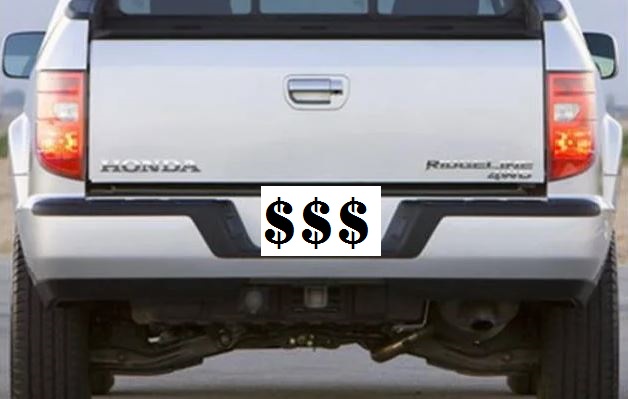
A few years back I was rear-ended on the eternally godawful I-405 south. It was 5-MPH bumper-to-bumper morning traffic. I was driving a 2012 Honda Ridgeline. She was driving a BMW 3-Series. There was more damage to her car than my truck. The young woman who hit me was very apologetic and polite. The rear bumper had a few scrapes and a gouge and was slightly dented inward. We pulled over to the right shoulder and exchanged information and went about our business.
I took my truck to a well-respected repair shop – the kind where they replace broken parts with OEM parts – for an estimate. They told me they had to break down the bumper to check for internal damage, so I had to leave it for a day. Bumpers with internal damage already concerned me.
The $3,600 cost for the repair left me gasping for air. This was basically 2-months’ of mortgage payments! The short, line-item estimate went something like this:
Bumper skin
Foam core
Mounting brackets
Mounting clips
Primer paint
OEM color matched paint
Clear coat
Labor
Why does it cost almost four grand to replace what is seemingly a cheap plastic-skinned styrofoam-cored bumper? Manufacturing the replacement parts can’t be that expensive! And why does it wrap around from wheel well to wheel well anyway? The car manufacturers will tell you that it’s a safety feature; that the bumpers are essentially sacrificial to prevent further, more expensive damage to the frame, radiator, etc. I think they intentionally integrated the headlights, electronics, and grille into the entire assembly too so that a minor fender bender has a major repair cost.
But what if the manufacturers actually conspired with the sacrificial wrap around bumper design to maximize minor collision repair costs and the “safety feature” language is just a steaming pile of PR BS?
OR is it that the car manufacturers are sticking it to the insurance companies who ultimately pay for the repairs?
Either way, we are getting royally screwed.
I believe that we are being duped by BIG CARMA and I demand Congress to investigate!
December 26, 2024. Yesterday marked the 30th anniversary of an industrial accident that almost killed me. According to the ER doctor at Providence Saint Joseph’s Medical Center in Burbank CA, it should have killed me.
I was working as a Journeyman in the electrical trade at the time, and the contractor I was working for landed a job for some tenant improvement (TI) work on the 6th floor of the DIC Enterprises building. It was a relatively simple job; relocate some 3-way light switches in the file room from one of the existing doorways that was going to be removed and closed off and move the switches to a new doorway location that was cut in on an adjacent wall. In the trade, this was typical, benign TI work that I had done hundreds of times before.
A 3-way switch means that there are two switch locations where the lights can be turned on or off as you enter or exit a room, generally, on opposite sides of a room.
Also typical was that this was a commercial office building with a 480-volt 3-phase wye alternating current power supply that utilized 277-volt A, B, and C phases for the lighting circuits. Yeah, that’s right kids: 277-volts from one leg (one wire) of the wye. This is common, industrial strength power here in the US and it must be handled with great respect, or it will unceremoniously kill you.
The 12-foot high suspended 2-by-2 acoustic t-bar ceiling of this room was also typical of a commercial office building. It’s one of those ceilings with 2-foot square drop-in tiles and a metal t-bar grid to hold them in place. The t-bar grid also holds the lighting fixtures in place. Everything is held and tied together with #10 or #12 tie wire where one end is tied off to the t-bar, and the other end is tied off to an eyebolt or a bracket that is fastened to the metal decking or concrete building structure above. Light fixtures have additional #8 or #10 self-tapping sheet metal screws that fasten them to the t-bar. All in the name of seismic safety.
I was working with an apprentice named Miguel. In trade parlance, he was “green,” meaning inexperienced – he only had a couple of years under his belt. But Miguel was a quick learner and we got along well.
I proceeded to do the investigative pre-work. This consisted of identifying the line side conduit which is the conduit that contains the “feeder” wires – a.k.a., “hot side” – of the circuit, and then identifying the load side conduit which is the conduit that connects to the lighting.
I won’t bore you with the details, but both switch conduits connected to a common junction-box (j-box) above the ceiling, and the feeder side was at the switch that was not being relocated. Easy-peasy: remove both switches, open the wiring on the feeder side switch and cap it off, pull out some wiring, cut in a new switch box, drop in a new conduit, pull in new wiring, make appropriate splices and pigtails, reinstall switches. Done.
During a critical part of the work, I had instructed Miguel not to splice and pigtail either switch until I was done with working with the j-box in the ceiling, which was sandwiched between an air duct and the t-bar, and I only had about 6-inches of space to work with. Well, apparently the part about not splicing did not get through, and Miguel energized the circuit anyway…and me along with it.
I was standing on the 9th rung of a 10-foot ladder and was leaning heavily into one of the 2-by-2 openings to access the j-box, partially resting my arms on the metal t-bar. I am always careful when I’m doing make-up work, which is trade slang for stripping and splicing wiring, however, you handle the make-up work differently if you know you are working on a hot circuit. Well, I did not know I was working on a hot circuit until I was stripping a wire and the finger of my right hand was touching the exposed metal of my wire stripping tool. This now made me part of the circuit, and the 277-volts flowed through my body because my arms were grounded to the t-bar ceiling.
Being that your muscles work with small electrical currents that are controlled by your brain, when higher voltage goes through your body, your muscles contract violently. I was situated in such a way that when my muscles contracted, I lifted myself off of the ladder and suspended my body by my arms and the pain from this hyper-contraction of my muscles was unbelievable.
Oddly, even though I was aware that I was being electrocuted, I could still think clearly, and I was telling myself to let go, but I had no control over my body that was now vibrating with the 60hz of the electrical current flowing through me.
I could smell my hair and flesh burning and sensed a metallic taste in my mouth.
Suddenly, I felt that I could float, and this is the moment when I saw the white light in front of me. I stopped feeling pain. It seemed that I could gravitate toward the white light without much effort, almost as if it was pulling me – beckoning me – to go to it. I could still think crystal clear. The last thought I remembered thinking in my semi-conscious state was, “I can’t go; my wife and kids need me…I can’t go!”
The next thing I knew was that I had hit the floor and landed hard on my right-hand side. I have no memory of falling. Hitting the floor either knocked the wind out of me or knocked the life back into me, but I was sucking really hard for air. Now that I was awake and conscious and could think clearly, the first thing I tried to do was stand up. I was extremely wobbly. I looked around and Miguel was standing there like a statue with his mouth agape and his eyes popping out, like he had just seen a ghost. I tried to yell, “Call 9-1-1!” but the voice that came out of my mouth was not mine; it sounded unintelligible, and strangely like someone that had a severe speech impediment.
It’s hard to pin this down, but I think the entire ordeal lasted about a minute. A minute that would forever change my life.
When I realized that my speech was compromised, I tried walking but ended up stumbling clumsily over to the wall and tried to write 9-1-1 on it. But I couldn’t write it out. My body was not fully responding to my brain. It was at this point that I remember thinking to myself, “God, thank you for letting me live,” and, in a moment of amor fati, “Well, if this is my permanent state, I’ll just have to accept it.” Suddenly, about four people from the office rushed into the file room, evidentially after hearing my body hit the floor, took one look at me, told me to lie down and someone called 9-1-1. I couldn’t even figure out how to take off my tool belt – my brain was saying one thing, but my body was doing something else – and so I lied down on the floor with tools and parts spilling out all over.
I remember not saying another word while lying on the floor uncomfortably, writhing in pain, not knowing how bad I was injured, and staring at the 2-by-2 opening in the ceiling that tried to kill me and asking myself how did I survive this? Why, did I survive this?
The paramedics got to me pretty quickly. As they were taking my vitals and connecting electrodes for the EKG machine, one of them started asking questions and I was terrified about answering them because it might validate that I was perma-fried. “Can you tell me what happened?” I hesitated for a moment, then slowly replied, “I was electrocuted by a 277-volt lighting circuit.” My voice actually sounded better, but it was still far from normal. “Were you standing on that ladder when this happened?” “Yes.” “Do you know what day this is?” “Yes, it’s Monday, December 26, 1994, the day after Christmas.” “Do you know where you are?” “Yes, I’m at the DIC Enterprises building in Burbank.” The questioning was interrupted by one of the other paramedics; “The victim is in atrial fibrillation!” “Get him ready for transport,” said the other.
They lifted me to the gurney, strapped me in, and wheeled me to the elevator. On the way to the ground floor, one of the paramedics said, “You’re lucky you’re alive!” I was loaded into the ambulance and transported to “St. Joe’s,” as the locals call Saint Joseph’s Medical Center. This was the most swerving, jarring, bouncy, uncomfortable ride I ever experienced. I started to wonder if the ambulance had wandered onto a demolition derby track. To occupy my mind while en route, I performed a self-check to determine if I had lost control of any of my extremities, and to my delight, I had no problem moving anything. At least this part of me was not perma-fried.
During the ride, they asked more questions. They needed my full name, address, phone number, emergency contact, my current health status, and if I was taking any prescription medications, etc. It wasn’t long before we were pulling into the ambulance driveway at St. Joe’s where some hospital staff members were waiting for our arrival. They quickly exchanged information and wheeled me into the ICU where they moved me from the gurney to the bed, switched EKG connections, and started an IV drip. I was still in shock, the word of which now took on an entirely new meaning to me.
“Patients heart is still in A-Fib, there’s a 1st to 2nd degree burn line across the shoulders below the back of the neck, and a 3rd degree burn on the bottom of the right forearm about the size of a quarter. The patient lost consciousness during the electrocution, but he’s lucid now.”
All of this happened before noon.
As the attending physician was examining me, he said, “Hello Mr. Freeman, it appears that you’ve had quite the morning; can you tell me what happened?” I gave him the same story I gave to the paramedics. “I see,” he replied. “Where does it hurt?” I replied in a wavering voice, “My head is pounding. My right shoulder is throbbing. All of my upper body muscles are extremely sore. I feel like I got run over by a trash truck.” “Okay, I hear you, and here’s what we’re going to do; we’re going to put you on a morphine drip to ease the pain and give you some medication to get your heart back into normal sinus rhythm, then we’re going to treat that 3rd degree burn on you arm and send you over to x-ray to make sure that you didn’t fracture your arm or shoulder. You’re lucky to be alive.” I replied, “That’s the second time this morning that I’ve been told how lucky I am, how do you mean that, exactly?” The doctor replied with, “Well, Mr. Freeman, that 277-volt shock you received has a nasty reputation of being fatal. The ones that survive are usually in such bad shape that we’re just trying to find out what’s still working. You, on the other hand, not only survived the shock, but you are also apparently in pretty good shape, considering the circumstances, and we’re going to find out what, if anything, is not working for you.” Lucky me. Just another day in the life of an electrician.
Shortly thereafter, my wife Kim walked into the ICU which raised my spirits considerably. I was in the midst of telling her what happened when the doctor came into the room. Lots of Q&A ensued. This is when the doctor told me that if the medication did not bring my heart back into normal sinus rhythm…they were going to have to use the defibrillator. Yes, that’s right; they might have to shock me again. I was not keen on the possibility of this happening.
Over the course of the next several hours, my voice went back to normal, and my body started responding to my brain.
The good news was that although the shoulder x-ray revealed some tissue damage and joint swelling, there wasn’t a fracture or break, and my body eventually responded to the heart medication and after 48-hours, my heart was back to normal sinus rhythm. After 72-hours, I was released to go home. The bad news was that the 3rd degree burn on my arm was going to need a skin graft which was performed at the Grossman Burn Center in Sherman Oaks, CA several days later.
Oddly, after only a couple of days of recovery at home, I received two visitors from my employers insurance company asking me if I was ready to go back to work. Go back to work? Seriously? This didn’t pass the smell test. I told them that my doctor hasn’t authorized me to go back to work yet, and they needed to check with him. This is when it occurred to me that the insurance company was overtly trying to rush me to go back to work. This is when I knew that I needed a professional to represent me, so I hired George Shulman, a workers comp attorney who took care of my case.
Due to the extensive muscle damage to my upper body, it took 7-months of twice weekly physical therapy sessions before I was allowed to return to work. The first couple of months of recovery were brutal. It hurt to raise my arms. It hurt to breathe deeply. It was a struggle to get dressed or take a shower. I was extremely weak. My muscles were so damaged that it limited my upper body range of motion. I had to stretch all of those muscles back out over the course of the PT sessions, which was a slow, painful process.
I’ll tell you right now that the economic reality at the time was that the workers compensation payments didn’t even come close to my normal income, and we found ourselves on the brink of bankruptcy during my recovery.
I don’t know if the law has changed since then, but at the time, I was eligible to take advantage of vocational rehabilitation training which would expire within a 5-year window. I took the required aptitude test and was told that they have never seen anyone score so highly and that I was eligible to take any of the training they had in their extensive catalog. The problem was that there was no new career that was going to put me in the same income level that I was already making, so I passed on retraining and went back into the trade.
I didn’t want to go back to work for the same electrical contractor that I was working for when I got hurt, so I called Joe Kamashian, one of my old bosses and after hearing my story he offered to rehire me for more money than I was making with the previous company. This was another lucky break.
In the meantime, my dad upgraded the old DOS computer that he bought the family a year earlier to Windows 95…and I was hooked. I learned as much as I could about PC’s, even considering computer programming. This set the wheels in motion for my interest in somehow making a living in the computer field.
By spring of 1999, I called Mr. Shulman and told him that I wanted to revisit the vocational retraining opportunity, and to my amazement, there were two new computer focused certification training paths. One was for Certified Novell Engineer (CNE) and the other was for Microsoft Certified Systems Engineer (MCSE) for Windows NT 4.0. At the time, Novell was the well-established 800lb gorilla in the network operating system (NOS) space, and Microsoft was a newcomer. I consulted with my dad about which one I should choose, and my dad quipped, “Go with Novell. Microsoft sucks.” Naturally, I went with Microsoft.
But this choice did not come without sacrifice or great effort.
To beat the 5-year sunset for retraining, I had to double-up on night classes at Mount Sierra College in Pasadena to finish certification in 9-months instead of the usual 1.5 years while also working full time, but I sucked it up. I had little time for any social activities. After 9-months of long days and longer nights, I pulled it off and obtained my MCSE certification on December 27, 1999, exactly 5-years and 1-day after the accident.
Incidentally, before I was fully certified, I was invited to a meeting with Dave Farguson, the GM of Center Automotive Group (BMW, and Chrysler/Jeep). I had already been moonlighting for him doing some electrical work at the dealership during a parts department remodel, so we already had a working relationship. What I didn’t know was that he was looking at a new Windows based Dealer Management System (DMS) named Carman to replace his mainframe-based Reynolds & Reynolds DMS at BMW, and ADP DMS at Chrysler/Jeep.
I was unaware that during a previous meeting with all of the departmental managers discussing the move to Carman, Dave asked the group if they knew anyone who he could hire to manage the new computers and network. My brother Scott was working as the BMW parts manager and Scott knew that I was attending night school and working toward my MSCE and threw my name into the conversation. Lucky once again.
At our meeting, Dave asked me some questions about my certification training status and when I would obtain it. I told him that I had a couple more classes to finish before taking the Pearson certification tests, but I should be done by the end of the year. This is when Dave offered me a job starting with an $80,000 salary. I was only making about $52,000 per year in the electrical trade, so this was a major bump in income for me and my family. Lucky yet again. Or was it providence?
1994 was a rough year for my family. It started with the Northridge earthquake in January and ended with a near electrocution in December. I’m lucky to be alive.
Looking back through the lens of time, this accident provided opportunities that I never would have had otherwise. It also changed my focus and my outlook on life in so many positive ways that it’s hard to define. I’ll put it this way; Being so close to death actually brought me closer to life, and something positive can come from an unfortunate circumstance.
The accident also made me more spiritual in that I now believe that there is an afterlife, but this is a complicated topic because this also validates that there must be a world of spirits. If there is a world of spirits, does this also mean that there is a heaven and a hell? If so, this also means that God and Jesus Christ and the Virgin Mary and Satan are not fictional characters. If these biblical figures are not fictional characters, it means that the bible is true. If the bible is true, and God exists, I have questions. Questions like, “God; why did you create the mosquito and the tsetse fly? What purpose do they serve other than to spread blood borne diseases (that you also presumably created) that kill people in some of the most agonizing, horrific ways possible?” “Why did you take our son Travis away from us?” Questions like this flood my mind. This is my Pandora’s box.
I may be conflicted but I’m still the luckiest man on the planet.
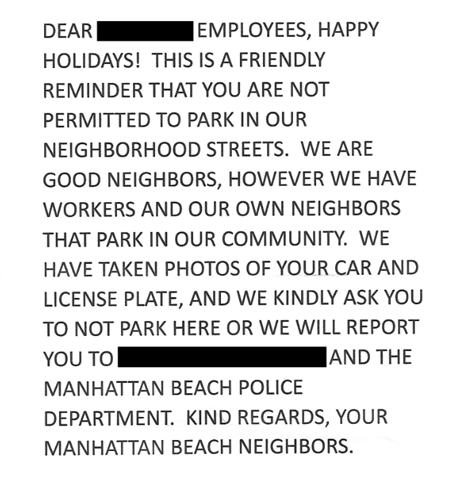
I don’t like passive-aggressive people at all because of their indirect and often murky communication methods that are often rife with thinly veiled threats. They also think that they are cleverer than they actually are. With this in mind, I found the preceding note on my windshield this week while parked on a public street in front of a public building (power distribution substation) without any posted parking restrictions, of which I will intensely dissect.
First of all, writing in all caps is the equivalent to YELLING AT THE READER. This is a trigger from the start. It is also an extremely juvenile way to communicate with people. Calm down a pop a Prozac which I bet you have in abundance.
For one thing, I am not an employee of the redacted company name, so there’s that little nugget. Also, writing “Happy Holidays” is code for not wanting to offend any non-Christian people. The last time I checked my Gregorian calendar, December 25 still says “Christmas Day,” not, “Happy Holiday Day” which would be ridiculously redundant and meaningless. And idiotic.
Sentence 2: THIS IS A FRIENDLY REMINDER THAT YOU ARE NOT PERMITTED TO PARK IN OUR NEIGHBORHOOD STREETS.
Actually, this is a not so friendly reminder because you are still yelling at me, and according to the parking signage on the street, I do not need a permit. Also, I think you meant to write, “…TO PARK ON OUR NEIGHBORHOOD STREETS.” Parking in your neighborhood street would mean that my car is encased in asphalt. Preposition choice matters! Writing “…our neighborhood streets” is a possessive statement, as if you own the street, which you don’t because it belongs to the public. In other words, the public paid for it, so the public may use it. Facts.
Sentence 3: WE ARE GOOD NEIGHBORS, HOWEVER, WE HAVE WORKERS AND OUR OWN NEIGHBORS THAT PARK IN OUR COMMUNITY.
At this point, I’m not sold on the good neighbors declaration. It also appears that they are implying that I am a bad neighbor. Additionally, and I’m not claiming to be an English expert here, but I’m pretty sure there should be a semicolon after NEIGHBORS not a comma, at least according to my word processor. Oh, and I too have workers and my own neighbors parking in my community – so what? It’s a public street. I have no beef against anyone parking on it.
Sentence 4: WE HAVE TAKEN PHOTOS OF YOUR CAR AND LICENSE PLATE, AND WE KINDLY ASK YOU TO NOT PARK HERE OR WE WILL REPORT YOU TO __________________ AND THE MANHATTAN BEACH POLICE DEPARTMENT.
So, you’re going to call 9-1-1 and SWAT me for legally parking my car? Wow! This is not a thinly veiled threat; it is an actual threat. “We” also implies that there is more than one person involved in the photo shoot, but I’m thinking this is a solo effort. This is also creepy and probably illegal. Is this person a run-of-the-mill nosey neighborhood busybody or a wannabe lawyer? Also, I don’t know the redacted person’s name you are threatening to report me to but reporting me to anybody feels so high-schoolish. I’m still not sure whether this is a Karen or a Brad who wrote this note, but I’m pretty sure you have better things to do with your apparently ample spare time than walking around the neighborhood and putting your little missives on the windshields of random cars. Or is it the only the cars that are more than 3-years old? Oh, and the police department cannot do anything to a car that is parked legally with current registration tags nor to the person with a driver’s license in good standing that parked it, whether you like it or not. Get over yourself.
Sentence 5: KIND REGARDS, YOUR MANHATTAN BEACH NEIGHBORS.
This is how you sign off with an unkindly threatening note? No name, phone number, or email address to respond to? What a chickenshit. Now I will look at everyone in this neighborhood with suspicion. I do love the tony neighborhood of Manhattan Beach, but I’m better off not being your actual neighbor because I don’t believe we would get along very well. And are you really speaking for all of the Manhattan Beach Neighbors? How many neighbors are we talking about anyway? A thousand? Ten? One? You?
The Retort
DEAR KAREN OR BRAD,
I RECEIVED YOUR NASTYGRAM…
Wait, let me start over without the yelling. I’ll use my internal NPR host voice…
Dear Karen or Brad,
I received your note on my car windshield yesterday. At first, I thought it was a parking ticket. I was relieved to find out that it wasn’t because at the time my car was certainly lawfully parked and intentionally parked in front of a public building because I am mindful not to park in front any of the multi-million-dollar houses, one of which you apparently live in. Good for you!
After reading the overtly hostile note, I immediately looked around and noticed that there were many, many other available parking spots up and down the block of the public street in question, so it’s not as if I was taking the last parking spot on the block that you may have needed to park your Tesla, Porsche, Mercedes-Benz, Aston Martin, Ferrari, or Lamborghini that I often see excessively speeding up and down your neighborhood streets and running the stop signs. Same goes for the spoiled rich kids on their $5,000 e-bikes.
Threatening to report a person to anybody – especially the police – who has not committed any crime whatsoever is beyond ludicrous; it smacks of elitist localism of which it appears that you are gleefully engaged in. I’m pretty sure there is a lawyer somewhere amongst your ilk that would inform you that you cannot prevent anyone from parking on a public street, posted parking restrictions notwithstanding. They would also likely advise you that threatening to call the police on a law-abiding citizen that has not committed a crime a serious waste of public resources and that you may be cited and fined.
Anyway, Karen, or Brad, I will continue to park my classic 1972 Winnebago Indian RV anywhere I want to on your street. One day, if I get lucky, maybe you’ll find it parked directly in front of your house and block your view of the ocean. Lawfully parked, of course, but for no more than 72-hours at a time.
Maybe I’ll drain my black water tank while I’m there, you know, like what cousin Eddie did in National Lampoon’s Christmas Vacation.
As a general rule, I walk at lunch, unless, of course, the weather sucks. Movement is good and it gives me a chance to reset and clear my head.
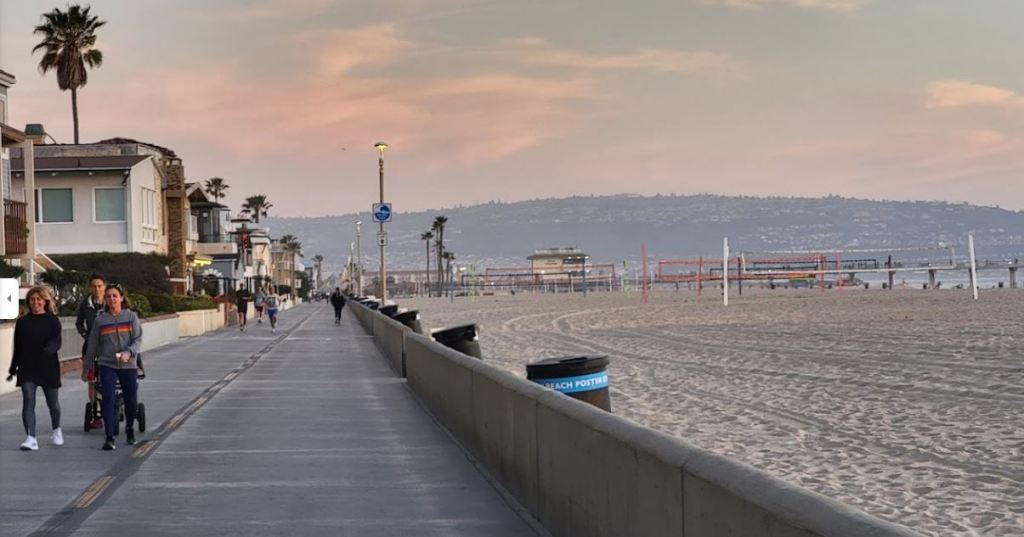
I’m currently working in Manhattan Beach, CA, and there’s a path a half mile away in Hermosa Beach that goes right between the multi-story, multi-million-dollar homes and the beach that the locals call “The Strand.” It’s nice. It’s a beautiful place. Sometimes it is so clear that I can see the west end of Santa Catalina island. It’s great for people watching. I see the beautiful people on a regular basis. I also see the locals and tourists, has-beens and wannabes, beauty, beasts, homeboys with their pit bulls, and burnouts. I’m sure I’ve seen a couple of drug deals go down. It’s an interesting dichotomy of the people that live in Southern California.
Some of them are day drinking a bottle or a can of something from a brown paper bag as they sit along the low wall between the sand and the path or as they cruise along the path on a beater bicycle. Some of them are smoking weed with the warm smell of colitas rising up through the air. Hotel California reference aside, I often wonder what the people living in those beachside houses do for a living. They certainly are not flipping burgers. These are the often-derided Coastal Elites: Educated, wealthy, influential, and meddling.
There’s also a regular mix of walkers, runners, cyclists, skateboarders, and roller-bladers on The Strand. Occasionally, I see a wipeout when someone hits the loose sand that is often on the concrete path. Most of them get right back up, dust themselves off, and go on about their activity. Others act as if they are waiting for an ambulance and Larry H. Parker to show up.
I’ve recently come to the realization that not every stroller has a small child sitting in it enjoying the fresh air and sunshine or taking a nap as you would expect. Indeed, many of the strollers I see actually have a small dog (or two) and sometimes even an occasional cat. Cats and strollers seem like a recipe for, well, a catastrophe. I can barely get my cat Cheeto into his cat carrier to get him to the veterinarian and the thought of getting him into a stroller “voluntarily” for a lovely walk down The Strand would turn into a bloody mess. My blood, not Cheeto’s. It might actually work out if Cheeto is inside the cat carrier first and the cat carrier is loaded and strapped onto the stroller, but I’m not willing to get shredded to find out. You can read more about Cheeto in an earlier post here.
Now, as I walk down The Strand, I play a game inside of my head called People and Strollers: Pet or Child? I haven’t really been keeping score, but I am often surprised, especially when it is a young woman or a young couple pushing a stroller with animals inside instead of the expected little human being.
Ironically, the animals are often much cuter than the children.
American supermarkets are true wonders of choice and convenience. You can practically find everything you need at almost any time that you want it. You can also tell a lot about people by observing what they put on the conveyor belt in the checkout line.
I love to cook, and my shopping list is built exclusively around the menu for the week. My product choices are almost never driven by coupons or discounts – they are largely driven by what I want to cook and eat in the upcoming week. Admittedly, I’m a very pragmatic shopper and don’t diverge much from my list. However, if I see that tri-tip is on sale as I’m cruising through the meat department, I’ll grab one and save it for a future meal. Pragmatic, not foolish.
My shopping basket of groceries is practically all-telling with the protein, produce, baked goods, canned items, and condiment choices. I also like a wide variety of foods and cuisines, so my list is never static or based on a standard meal like meatloaf every Thursday night. I don’t even subscribe to the Taco Tuesday craze.
I can also always tell who the personal grocery shoppers, are, i.e., the Instacart and Uber Eats types. They are always in a rush and often have two or three shopping carts in tow clogging up the aisles while scrolling down their shopping lists on their phones. Can you really trust these people to buy produce for you? Like, do they really know how to pick out a ripe watermelon?
The produce department is also an interesting place to watch people. I have personally seen a person squeeze every single lime in the bin and pick out only the ones that apparently have the most juice potential. There are also the ones that grab a handful of string beans and eat them while they shop; grazing while shopping (GWS?), if you will. This is why it’s imperative to wash your produce before eating it.
While waiting in the checkout line, I look at what the shoppers in front of me are putting on the conveyor and play a game where I try to guess what they are cooking, essentially, foretelling their menu. I’m probably mostly wrong, but sometimes I do get some inspiration.
But some shopping carts make me scratch my head. For example, the ones with cases of soda pop, a dozen frozen pizzas, ten cans of canned stew, a liter sized yellow mustard container, and the largest bags possible of potato chips or cheese doodles. Maybe these are the coupon only driven shoppers.
I can ascertain a couple of things from this:
This person absolutely does not cook at home.
If this is what this person consumes on a regular basis, they are not going to live very long.
They are likely diabetic.
And sometimes there’s the female 3-item shopper buying a box of white wine, a frozen Lean Cuisine dinner, and cat food.
There’s also the male counterpart buying a six-pack of beer, a Hungry Man dinner, and dog food.
It’s not hard to guess that they are probably single. I think the supermarkets should use AI to identify shoppers like these in their expansive database and maybe play matchmaker.
There are also the single-minded shoppers purchasing a bottle of tequila, a bottle of orange liqueur, a bottle of agave syrup, and a dozen limes. Margarita, anyone?
Self-checkout is generally limited to 15-items, but people regularly exceed this limit and slow down the entire quick checkout process. The other night I witnessed a woman with two full shopping carts using the self-checkout. These are also the people that often cut in line. They should be banned.
The most interesting and sometimes comical interactions happen between the shopper and the cashier, and the shopper and the payment terminal.
I have seen people with what could be considered a purpose-built coupon wallet pulling out dozens of coupons. Sometimes a coupon is rejected for one reason or another which always prompts some often-intense verbal interaction between the shopper and the cashier. I have seen these people remove items from their purchase because the coupon expired, or it was the incorrect size per the coupon restrictions. I think these are also the people who never pay full price for anything – no ifs, ands, or buts.
Then there are the people paying cash, sometimes with fistfuls of coins. This coin counting takes way too much time and should be outlawed.
An honorable mention goes to the old-timey check writers. Albeit writing anything in cursive these days is becoming a lost art, writing out a check takes way too much time:
Date (after asking the cashier what the date is): 10-seconds.
Pay to the Order of: 5-seconds.
Entering the dollar and cent amount in the $ window: 5-seconds.
Writing out One hundred twenty seven & 32/100: 15-seconds.
Signature: from 2 to 10 seconds depending upon the number of syllables.
So, 10+5+5+15+5=40-seconds in total, the time of which you’ll never get back. It’s almost exclusively the old folks that do this.
How about using a debit or credit card instead? 5-seconds tops unless you fat-fingered the PIN code and have to re-enter it. The old folks almost never use these because they still don’t trust the system.
Writing checks is definitely a generational thing with the exception of someone intentionally “kiting” or “floating” a check which is to make use of non-existent funds in a checking or other bank account “until payday,” which is technically illegal. Others are “paper hangers,” that intentionally write bad or stolen checks. No matter how good the economy is, there are still lowlifes like this running around.
Anyway, this last Tuesday, someone had the following on the conveyor:
Flank steak.
Corn tortillas.
Two white onions.
Six Roma tomatoes.
A half-dozen Jalapeño peppers.
a half-dozen Serrano chilies.
One head of garlic.
One dozen tomatillos.
One bunch of cilantro.
One 12-pack of bottled Modelo beer.
I’m guessing carne asada tacos with salsa verde and pico de gallo and cold beer on a Taco Tuesday night. Hell yeah! Oh, wait – that was me!
To the contrary of Laundromats – Part 1, my extremely frugal paternal grandmother Mary Alice never stepped foot inside a laundromat. She had an old electric semi-automatic open top 1940’s era Maytag washing machine with a wringer that sat out on the back patio. Nothing fancy. I saw her doing a load of laundry once in that odd machine. Odd, in that it was cylindrical and didn’t connect to any plumbing and had to be filled with a combination of garden hose water and boiling water from a tea kettle. It also had an external drain hose that was connected to a wye cleanout plumbing fitting on the back wall of the patio. There was a foot switch, a lever, and a knob to control it. It had a clutch. It also required the user to have one or two rinse tubs full of water available.
The semi-automatic washing machine process went something like this:
Place dirty laundry in the tub and fill with water of the desired temperature.
Add laundry soap.
Turn the machine foot switch on, engage the wash tub agitator, and set an egg timer for 15-minutes.
Disengage the wash tub agitator.
Engage the pump.
When the wash tub is fully drained, disengage the pump.
Engage the wringer.
Wring out the clothes and place them into rinse tub 1. Agitate by hand.
Wring out the clothes from rinse tub 1 and place them into rinse tub 2. Agitate by hand.
Wring out the clothes from rinse tub 2 and place clothes in laundry basket for clothesline drying, or place directly into dryer.
Disengage the wringer.
Engage the pump to drain the tub of the water collected from all of the wringing.
When the wash tub is fully drained, disengage the pump.
Turn the foot switch off.
Drain the rinse tubs.
Obviously, this was really only a semi-semi-automatic process, and a very hazardous and ridiculously tedious one, but she didn’t mind doing it. Thank god for the modern automatic washing machine. I hope the person that invented them won a Nobel Peace Prize!
Mary Alice didn’t have nor apparently need a gas or electric dryer. Instead, she had one of those rotating umbrella clotheslines that looked like a TV antenna that she used for drying her laundry naturally with only sunlight and a light breeze. She also knew not to dry laundry on the clothesline if the gusty Santa Ana winds were blowing, shrewdly circumventing the possibility of having to fetch her undergarments from the neighbors sycamore tree.
Fast forward to when I was about 19 and lived in a 2-story 20-unit apartment building with my younger brother and my mom at 6037 Hazelhurst Place in NoHo. The apartment building had a small room on the ground floor near the pool equipment that had one heavy-duty top-loading coin-op washer and one heavy-duty front-loading coin-op dryer that were situated to the left side of the room and a small, convenient counter to the right side for folding your clothes. Above the folding counter was a soapbox vending machine. It was ostensibly a micro laundromat. Sorry, no fluff ‘n’ fold services available.
However, there were rules for using the laundry room to prevent any conflicts. On the back of the laundry room door, the apartment manager had posted a framed 8 ½ x 11-inch mimeographed schedule with gridlines for which apartment had access on which days of the week and which 2-hour time slots. There was another larger, 2-foot by 3-foot professionally hand painted sign from Erroll Sign Company in NoHo (I actually worked for the owner, Erroll Biggs, over one summer) that was screwed to the back of the door that had the following:
LAUNDRY ROOM RULES
HOURS – 8:00 AM to 10:00 PM ONLY!
NO SMOKING!
CLEAN OUT THE LINT SCREEN IN THE DRYER WHEN YOU ARE DONE!
DO NOT LEAVE ANY TRASH BEHIND!
They went a little overboard with all capitalized letters and the exclamation points which gave me the impression that they were a little bit angry and very shouty. Reading between the lines, the sign inferred that people used the laundry room between 10:00 PM and 8:00 AM, regularly smoked in it, didn’t clean the dryer screen, and left trash lying around which probably consisted mostly of empty soapboxes, empty beer bottles, and flattened cigarette butts extinguished on the floor with a shoe.
One Sunday night when our apartment number had the scheduled laundry time of 8:00 – 10:00 PM, I went downstairs to do my load of laundry at 8:00 sharp, but someone had apparently lost track of time and there was a load of laundry in both the washer and the dryer. Looking at the schedule, it was apartment #10 that had the 6:00 – 8:00 time slot. Not wanting to wait (nor should I have had to wait because of the established rules), I moved the clothes that were in the dryer to the folding table and moved the wet laundry from the washing machine and placed them in the dryer. I figured if the person came back while my clothes were still in the washer, they would just start the dryer and when I came down later the dryer would be available to me.
In the meantime, I went back upstairs and smoked a little weed and was feeling alright when I realized it was time to pop my clothes into the dryer at around 8:30 PM. I went back downstairs, and nothing had changed; the wet clothes were still in the dryer and the dry clothes were still in a pile on the folding table. No biggie – I decided to move #10’s wet clothes from inside the dryer and put them on top of it and put my clothes in the dryer and carry on with my business. But while I was loading the dryer, I noticed a rather large, middle-aged woman in a muumuu with these big curlers in her hair looming in the laundry room doorway, standing there in silence, and puffing on a cigarette. She was straight out of a Gary Larson cartoon.
I turned to say hello when she started in on me in a very nasty, throaty, gravelly tone of voice – the kind of voice brought on only from years of smoking. “What do you think you’re doing touching my clothes, you pervert!” Pervert? I don’t believe I deserved that. I defended myself by saying, “Actually, ma’am, this is my time slot (I gestured toward the posted schedule on the back of the door), and you left your laundry unattended, so I just moved it out of the way to make room so I could do my laundry.” I was talking in a low-key matter-of-fact tone of voice. Then she said, sarcastically, “Actually, it is against standard laundry room etiquette to touch anyone else’s clothes!” Standard laundry room etiquette? I didn’t know this was a thing – they certainly didn’t teach this is school.
Sensing the mounting agitation and wanting to avoid conflict, I said, “No problem. I’ll take my clothes out of the dryer and let you finish drying your clothes first and then I’ll come back later.” I grabbed my little white plastic laundry basket and filled it with my wet clothes from the dryer. Then she said, in a very demanding femdom-like voice, “Now you put my wet clothes back into the dryer!” I was shocked at her talking at me like I was her BDSM partner, and so I looked her straight in the eye and sarcastically replied, “I thought I wasn’t supposed to touch anyone else’s clothes, you know; standard laundry room etiquette!”
This snarky rebuff made her snap – she was apparently an angry woman who likes to get her way – she clenched the cigarette in her teeth and then she stepped into the laundry room and took a right-hand swing at me with all of the flabby power that she had in her big, puffy arms. I ducked and took a quick step backyard like a boxer in a prize fight. She missed hitting me by a mile. I said, “Are you crazy?” Then she said in a huffing voice, “You little bastard!” and took another step toward me as she was cocking her right arm back in preparation of taking another swing at me. I noticed that now there was just enough room behind her to squeeze between her body and the doorway. With newfound cat-like reflexes, I grabbed my laundry basket of wet clothes and faked a step to my right, which she jerkily followed while she was swinging at me which took her off balance making her fall softly against the dryer with all of her mass but catching herself from falling on the floor at the last moment. I took another quick step to the left and ran right by her, slightly bumping her, ah, equally puffy butt which prompted her to yell out loud, “DON’T YOU TOUCH ME YOU LITTLE FAGGOT!” So, within about a minute, I was labeled a perverted little bastard faggot. She was batshit crazy. Good job, Karen.
I had half a mind to call the cops on her for aggravated assault but thinking it through to the logical conclusion where the both of us are interviewed about what transpired while the cops are trying to keep a straight face and ultimately advising us to forgive each other and go back to our apartment prevented me from doing so. That, and I may have had a little bit of weed in my pocket.
This experience made me wonder about the frequency of laundromat violence, what was considered the ultimate unforgivable offense, and what the fatality rate was. It both slightly amused and somewhat disturbed me thinking about people snapping over such a trivial thing like touching someone else’s clothes. How about this, Karen: Follow the laundromat rules and don’t leave your damn clothes unattended!
Fortunately, laundromats have changed much from their utilitarian roots over the decades and have become much more civilized, but nowadays it costs like $5 to wash and dry a load of laundry. There are newer, fancier attended laundromats with attached sports bars where you can get a cheeseburger and a beer and watch a baseball game while you are doing your own laundry, or have someone else do your laundry for you, vis-à-vis, Fluff ‘n’ Fold service.
The fact of the matter is that I really don’t mind if someone else touches my clothes. As far as I’m concerned, standard laundry room etiquette can go to hell.
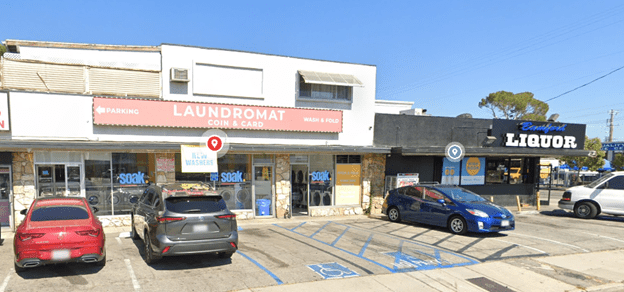
Our local laundromat at the northeast corner of Cahuenga and Magnolia Boulevards in North Hollywood, CA.
Story 14 of 52
By M. Snarky
Even if you have never personally been to a laundromat or needed to use one because you lived in a sucky apartment building that didn’t have a laundry room, you probably know about these places, or at least are familiar with the laundromat scene in the movie Fight Club or have seen a few of them as you drive through the city.
Growing up, my family moved around about every 1-2 years or whenever and wherever my dad could get work as an electrician. Even though we often lived in the boondocks outside of city limits where renting an old farmhouse was cheap, my parents always managed to make sure that a washer and dryer were available for our family of six. It wasn’t until my parents split up that I had my first of many laundromat experiences in 1973 after we moved into a duplex apartment in North Hollywood, or NoHo as it is now called.
My mom would wait until everything was dirty twice-over before overloading a shopping cart – which was somehow appropriated from the Market Basket grocery store on Ventura Boulevard, about 2-miles away – with a mountain of said dirty clothes along with a box of Tide and a white, plastic bottle of Clorox bleach. She wheeled it on down to the laundromat at the northeast corner of Cahuenga and Magnolia Boulevards, usually with my brother and I in tow. We were 10 and 12-years old, respectively. Our local laundromat was adjacent to the Bamford Liquor store, and my mom would sometimes hand over 10¢ to each of us boys to buy some candy to placate us. Our local laundromat was a very basic, utilitarian, no-frills place at the time.
For me, the laundromat was a wonderland of coin-op vending machines. Of course, there was the change machine, plus there was a mini soapbox machine where you could buy a single load sized box of powdered Tide, Cheer, Ivory Snow, or All. You put your coins into the coin slot below your preferred brand of laundry detergent, push the coin slot in, and the soapbox would drop into the metal bin below with a light thud.
There was also a molded, padded TV chair with a small six-inch black and white TV screen and tuner built into it that cost 10¢ for 30-minutes of broadcast TV. In the greater Los Angeles area at the time, the options were channels 2 (CBS), 4 (NBC), 5 (KTLA), 7 (NBC), 9 (KCAL), 11 (KTTV), and 13 (KCOP). That padded, spongy TV chair was the most comfortable seat in the entire laundromat, and someone – generally another mom – was always lounging in it without paying for the television service. They would get annoyed with you if you asked them to move so you could actually watch TV. I watched many reruns of Star Trek at the laundromat.
Directly outside the laundromat door was a ubiquitous Los Angeles Times newspaper vending machine too – 10¢ for the daily paper, 25¢ for the Sunday edition.
There was also one of those 5¢ triple-head candy vending machines inside the laundromat and it didn’t take long for us boys to figure out that the peanuts and bubblegum were perpetually stale in that vending machine so we would go over to the liquor store and buy candy from there where we could get a 3-foot-long whip of purple grape or green apple flavored bubblegum for 10¢. The flavor in that gum was gone in 5-minutes, and the more you chewed it, the stiffer it got. I’m surprised we didn’t get TMJ from chewing that stuff.
Sometimes mom would let us feed the last three dollars of cash that she had in the whole world into the change machine which was sort of a mechanical wonder when you’re a 12-year-old boy. The machine would only accept the dollar bill when oriented correctly and if the paper money was in reasonably good condition. If you put the dollar bill into the slot incorrectly, or if the dollar bill was too faded or crumpled, it would just spit the bill back out looking as if the machine was sticking it’s tongue out at you with a resounding virtual message of REJECT! In those cases, mom would send us over to the liquor store for change, but the liquor store policy was NO CHANGE – DON’T ASK according to a sign on the wall behind the cash register. So, we had to buy 5¢ of candy to get change, which was usually five 1¢ pieces of Bazooka bubblegum. That liquor store was definitely benefiting from the laundromat. I was also secretly hoping that every dollar bill would get rejected so we could buy more candy. I also wondered how many pints of liquor were sold to the laundromat patrons.
When the change machine did accept a dollar bill, the sound of the four quarters hitting the metal tray at the bottom of the machine was glorious – it was like you won the jackpot from a slot machine in Las Vegas!
Mostly out of curiosity but with a potential monetary side benefit, I tried to trick the change machine once by tracing out the face and the back of a dollar bill on a piece of blank translucent tracing paper using a No. 2 pencil and then carefully cutting it out to the exact (well, mostly exact) size of a dollar bill. The anticipation of getting free quarters for a forged dollar bill as it was being fed into the waiting illuminated slot using the correct orientation of George Washington’s head was met with the cold rejection of a machine that was not so easily tricked. So much for my scheme to make more fake bills if it worked. In retrospect, it appears that my juvenile delinquency started earlier than I thought.
The change machine would also give change for coins: two-dimes and a nickel for a quarter, and two nickels for a dime. This was handy for the 35¢ washer and 10¢ dryer.
My mom would use three or four washing machines at-a-time, all in a row if possible, and separate the laundry mostly into whites and colors and transfer the dirty clothes from the shopping cart to the top-loading, large-capacity washing machines. She would tell us which settings she wanted on each load, for example, hot wash and warm rinse for the whites, and warm wash and cold rinse for the colors. She would then tell us how many scoops of detergent or how much bleach to add to each load.
We got to feed the coins into the waiting washing machines too, I think, mostly to continue keeping us boys occupied. We set the coins vertically into the appropriate slots, and then pushed the slotted coins into the machine which, coincidentally, also sounded like a slot machine payout.
However, some of the washing machine coin slots were occasionally jammed with what appeared to be foreign coins or metal slugs which made them completely inoperable. No doubt this irritated the owner/maintenance guy to no end and made him rethink his life choices. Also, what kind of lowlife cheapskate doesn’t have 35¢ for a load of laundry and needs to resort to such measures?
The laundromat also had these high, square laundry baskets on wheels with a hanger bar across the top. The top of the laundry basket was at the same height as the top of the washing machines, so it made loading and unloading clothes easy. These were also great for wheeling your little brother around inside the laundromat as fast as possible much to the irritation of other laundromat patrons sitting around and reading their copy of the Los Angeles Times or Time magazine while waiting for their clothes to finish.
Laundromat environments are this peculiar confluence of heat and humidity blending with the many laundry detergent scents competing with each other as they waft through the air. One moment you definitely smell the fresh scent of Tide and the next moment you get a nose full of flowery smelling Cheer. Occasionally, you’ll get hit with the chemical smell of bleach. Makes me wonder about the long-term hazards of inhaling all this stuff.
One time, I convinced my little brother to get inside one of the massive front-loading dryers under the premise that it was going to be like a carnival ride. He crawled in and sat in it like a recliner and braced himself. I closed the door and popped the dime into the coin slot and selected the cool setting and pressed the start button. There was a low hum as the dryer started to turn slowly and within a couple of seconds my poor little brother was getting the tumble dry treatment which looked like he was doing endless in-place somersaults. He started yelling “STOP!” and I quickly pulled the dryer door open to stop it. He jumped out of it like he was shot from a cannon. He said, “Now, it’s your turn.” I smiled at him, spun around on my heels, and ran out of the laundromat as fast as I could with my brother hot on my heels, as he was hollering, “YOU TRICKED ME!” I heard my mom yell out, “Knock it off boys!” as we passed by.
Eventually, we helped mom transfer the freshly laundered clothes from the washing machines to the dryers, and within the next 40-minutes or so, we were folding laundry and reloading the shopping cart for the return trip back to the apartment. I have a distinct memory of pushing the shopping cart down Cahuenga Boulevard with the pleasant scent of clean laundry in the air.
I’ve mentioned in a previous post (https://msnarky.com/2024/08/30/walking-in-my-neighborhood/) that I do my best to get my ten-thousand daily steps. It’s good for me. It gets me away from my screens for an hour or so. It gets my heart rate up a little bit. I also benefit from the sunshine and fresh air and the endorphins especially after getting chased by a dog for half a block. I do most of my walking around my neighborhood and I’ve become familiar with the streets and the houses and the other regular walkers.
I’ve gotten myself into the habit of saying hello to everyone that I pass. Not an over-the-top, phony “HELLO!” like what the salesman at the car dealership says as if they know me, it’s just a regular, friendly, low-key “Hello,” which to me is a simple greeting and an acknowledgment of someone’s presence. Oddly, my hello back ratio is lacking, like maybe I get a one out of five response, or 20%. On a good day, maybe one out of four, or 25%. My ratio is 100% because I always say hello back.
There is a semi-regular walker in my neighborhood that I call Bigfoot. He is a thinnish sixty-something year old mustachioed man with a ruddy complexion and thinning hair and he’s maybe five-feet-nine-inches tall. He wears Ray-Ban Aviator sunglasses…even at night. He walks with duck feet (out-toeing) at such an unbelievable angle with shoes so large that it reminds me of Bigfoot, hence the nickname. He walks with his head at a downward angle as if he is avoiding making eye contact with anyone. His body language tells me that he is walking reluctantly – as if he’s only doing it because of doctor’s orders.
I have said hello to this man at least dozen times. He has never, ever, said hello back. My first inclination was that he was tuned out with earbuds (which, unfortunately, is often the case) and maybe blasting Liberace’s Greatest Hits and simply didn’t hear me, but there was nothing jammed into his ears. My second inclination was that he had a hearing deficit and simply couldn’t hear me. But then I saw him having a conversation with someone in the neighborhood which ruled this out. So, if he can hear me, there must be another reason. Maybe he’s just a shy person. Maybe he’s just going through the motions of life and not really engaging in it, which is sad, really. Perhaps he is in a witness protection program and is suspicious of everyone, which pretty much borders on paranoia. Or maybe he’s just an anti-social crank that hates the world. I’m leaning toward that last one.
So, this got me thinking about the actual word, hello, where it came from, what it means, etc., and down the world-wide-web rabbit hole I went…
According to Merriam-Webster, the etymology of the word hello is that it is an alteration of the word hollo (14th century) which was originally used as an exclamation or to attract attention. The Oxford English Dictionary notes the earliest known use of the word hello is in the 1820s. Okay, so the word has been in use for a couple of centuries so it’s not like it’s a new word that hasn’t caught on.
According to NPR, Thomas Edison is credited for popularizing the word hello by suggesting that this is how you should answer your newfangled telephone in the late 19th century. His rival, Alexander Graham Bell, however, thought the better word was “ahoy.” I can’t imagine answering my phone with, “Ahoy!” instead of, “Hello!” unless, of course, I was a pirate.
Anyway, I’m not exactly sure why there is a hello back deficit and I do have some theories about this. But first, some definitions (that I made up):
Hello-er [he-loh-er]– the person who says hello first.
Hello-ee [he-loh-ee] – the person who is the recipient of the hello.
Theory 1 – People are Generally Unfriendly
For whatever reason (or reasons), people, in general, are just not that friendly. By default, they are wary of a random stranger talking to them. Maybe they think replying with a hello back will open up an opportunity for a life insurance sales pitch. Or maybe this is just an L.A. thing.
Theory 2 – Avoiding Conversation
People might think that if they respond with a hello back, it will open up the floodgates of a potentially awkward conversation with the unknown hello-er, so they avoid replying back because they don’t want to get pulled into a discussion about politics or religion or veganism.
Theory 3 – Cultural
Unless you have been introduced to a person by a friend or a family member of a member of the clergy, you just don’t talk to strangers unless you want to get flogged. This is probably more applicable to women than men because it is mostly men that make up the rules that incorporate flogging.
Theory 4 – Stranger Danger
Similar to Theory 3 but without the flogging part, Stranger Danger mandates that by default you don’t talk to any stranger for any reason or under any circumstances because they might be a slasher or a rapist or a politician. Don’t even make eye contact. Be a ghost. Indeed, we teach our children to be paranoid and anti-social at an early age here in the USA.
The response of some hello-ee’s is sometimes that of a happy surprise, as if they didn’t expect you to acknowledge them at all, and when you did, they smile and say hello back. These are my favorite people – they are spontaneous and genuine.
For example, there is a family in my neighborhood that has a special needs daughter in her late teens or early twenties. She is non-verbal and the parents have this special three-wheeled wheelchair contraption for her that straps her feet onto pedals and her hands onto handlebars that are articulated to encourage motion in her withered limbs. It is both heartbreaking and beautiful to see parents that are so devoted to their daughter that they regularly walk her around the local elementary school.
The first time we walked by them we were walking in opposite direction around the school, so we saw them face-to-face. I said hello, not only out of being social, but also to convey to them that I see them and that I acknowledge them. They probably didn’t sense that I silently understood the 24/7 anguish they must be experiencing. The response from the parents was as if they had become so accustomed to being invisible that they didn’t think anybody cared to say anything to them, especially a perfect stranger, and I think that I caught them off guard. My hello evoked from them a quick smile and a friendly hello back. It appeared to me that this family had grown accustomed to people walking silently past them. They were used to people ignoring them, not particularly out of callousness or indifference, but because people don’t naturally know how to act or what to say to someone that is clearly living day-to-day with such hardship.
I strongly recommend that people say hello to the passersby that are less fortunate – you might just make their day.
I’ve also noticed that there are vast differences between the hello back response rates of men versus women. In my experience, the man-to-man hello back rate is probably close to one in two, or 50% while the man-to-woman hello back rate is much lower, like maybe one in five, or about 20%.
Not being a woman, I have no idea what the woman-to-woman or woman-to-man hello back ratio is, but I imagine that it is not exactly the inverse. What I mean is that perhaps the woman-to-woman is on par with the man-to-man ratio but the woman-to-man hello back percentage is probably much higher because most men are, frankly, a bunch of horndogs. I also wonder what the national average is between the hello-er and hello-ee ratios between the sexes.
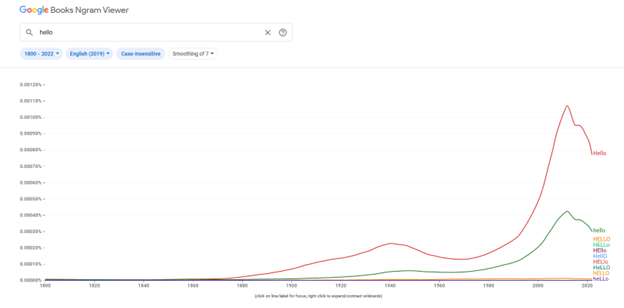
I recently discovered the Google Books Ngram Viewer, and it appears that the frequency of the word hello peaked around 2012:
Google Books Ngram Viewer results for “hello.”
Is hello getting cancelled? If so, we’re doomed.
I’m going to rebel against this trend and keep saying hello anyway.
That divisive 2024 presidential election cycle was pretty wild, wasn’t it? We went from old man Biden falling behind old man Trump in the polls to younger woman Harris surging past Trump in the polls. Some polls showed Harris ahead in this state and Trump ahead in that state and vice-versa. Women favored Harris and men favored Trump. Duh. Projections from the pundits, pollsters, politicos, and pinheads were for a tight election – not chad checking tight like in the 2000 presidential election, but tight, nonetheless. When the dust settled, we got ourselves another old white man, but also a misogynist, a womanizer, and a convict. Good job, America – you just elected the first Convict-in-Chief.
Was this a “Better the devil you know than the devil you don’t,” vote? Perhaps it was, but we can do so much better than this.
Again, as a solid Libertarian (I voted for Chase Oliver and I encourage you to read about him), I find myself politically homeless. Being a social liberal and fiscal conservative makes me an outlier in today’s corrosive Team Red or Team Blue political duopoly.
Also, there is a misrepresentation of libertarians in that all we want to do is legalize drugs and prostitution. This is the bastardized version of the libertarian party. The libertarian party is about much more than decriminalization of drug use and sex workers. It’s also about personal freedom, minimizing government force and government interference in your life, free markets, sound money policy, etc. I recommend that you read all about it over at lp.org before making any judgment.
The best definition of liberty I ever heard was from Katherine Mangu-Ward, editor in-chief of Reason, the magazine of “free minds and free markets,” which, to paraphrase, was, “Liberty is the total absence of government coercion.” Yes!
I was a double-hater from the beginning for many reasons. Neither candidate had a coherent foreign, domestic, trade, or monetary policy. Both Harris and Trump were floating out off-the-cuff ideas here and there (most of them terrible) I think mostly to see what might stick in the news-cycle, but there was zero substance in my opinion. No tax on tips was the best idea they could agree on. Wow. Talk about weak sauce. Instead, how an adult conversation about a simple flat minimum tax rate coupled with a value added tax (VAT) plan like what 175 other countries do? Just floating out an idea here. Also, we don’t need a new Department of the Politically Homeless, thank you.
Neither candidate spoke about reigning in the size and scope and power of the government. It was essentially more of the same – more spending, more government jobs programs, more debt. So much debt that tens of trillions of dollars of it doesn’t even move the needle anymore. I think this is because most people just don’t understand that one trillion dollars has twelve zeros (for a visual reference, that is $1,000,000,000,000) and is too big of a number for the average person to comprehend let alone talk about.
No talk about federal government program reform, or departmental or agency audits, like maybe audit the Federal Reserve, Department of Education, Postal Service, Social Security, Medicare, IRS, ad infinitum. Do we really need the Commission of Fine Arts? Probably not. No talk about shrinking the military budget or de-tangling our very messy foreign entanglements. Balancing the budget? Forget about it! Sorry, Senator Rand Paul: Your Six Penny Plan to balance the federal budget in 5-years is a great idea but is also a non-starter because Congress is addicted to pork. What we need here is an intervention.
It has been said that a government big enough to give you everything you want, is a government big enough to take away everything that you have, which is something that we are flirting with. This is why further expansion of any existing or creation of any new government program or “service” needs to be curtailed by any means possible, including some old school filibustering.
Also, the voting bloc of unionized government workers is probably going to vote for the candidate that is not talking about reform or cuts, because reform or cuts may cost them their jobs, so there’s that. Essentially, they vote for job security.
Oddly, neither candidate talked about the ever-increasing tax burden placed on the shoulders of the American people because of the federal government’s spending problem. Instead, Harris supports an unrealized gains tax and Trump supports massive tariffs, both of which are unbelievably bad ideas and would increase the tax burden and the cost of goods for Americans across the board, not just the millionaires and billionaires.
To drive this idea home, I’ll flip the script from talking about income to talking about tax burdens. For example, “I make $100,000 per year,” changes to, “My tax burden is $24,000 per year,” which is an entirely different conversation. This is only a 24% tax rate on gross earnings example, so it’s not a crazy high number that I’m hypothesizing with here. Work with me. In some places in the world, that $24K is a fortune.
Can I get a show of hands from people who like having $2,000 a month stolen from them? Oops! What I meant was, can I get a show of hands from people that like making a “voluntary” $2,000 per month contribution to the IRS? Oh, and if you don’t voluntarily give up your money to the government, it will be taken by force. That force being the confiscation of your cash and assets and possible jail time.
Also, that pesky 6,871-page U.S. tax code (75,000 pages after tax regulations and official tax guidelines from the IRS are included) is just too unwieldy for casual political conversation. Let’s be honest here; the U.S. tax code is a bloated tome of the greatest cradle to grave taxation scheme ever imposed upon the public. I say we burn it and start over with a single page tax return.
The only more that I want from the government is more freedom, more personal liberty, more reform, and more contraction. Anything less is anathema to a free society.
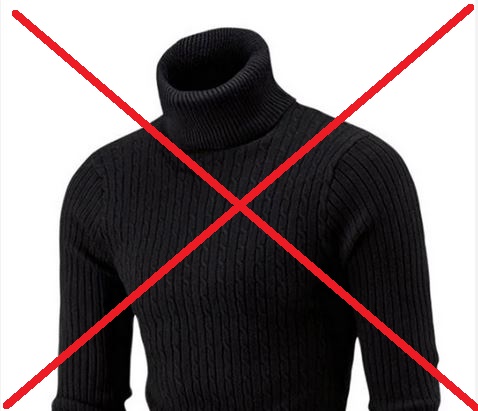
Ahh, fall is in the air and with it comes longer nights and cooler temps and the season of the…turtlenecks. God help us.
Guys, turtlenecks just don’t look cool and are a very dated fashion choice. Seriously. It’s a dreadfully old, dull fashion statement that just won’t die and it’s all your fault.
Do you think turtlenecks make you look taller? They don’t.
Do you think turtlenecks make you look smarter? If you don’t mind being judged as an elitist intellectual type – because this is what turtlenecks say about you – then, yes, you look smarter you little snob.
Do you think a turtleneck makes you look trendy? Depends upon whom you ask, but the correct answer is no.
Nobody really likes them, except for maybe mothers and girlfriends and boyfriends with ulterior motives.
Looking back to days of yore, turtlenecks were only invented to protect the necks of medieval knights to prevent chafing from their chainmail armor way back in the Dark Ages. They were not invented for men to wear while singing folk music, reciting poetry, anchoring the news, playing the bongos, or eating a steak at Morton’s with Guido and Tony.
Are these modern turtleneck wearing men trying to signal to us that they are identifying as a bold, horse riding, sword fighting, mace swinging, lance impaling medieval knight with bad teeth and actually trying to subconsciously intimidate us? Granted, this is a massive stretch. Eh, on second thought, probably not.
What looks worse than an actual turtleneck? A Dickie mock turtleneck, like what cousin Eddie spectacularly wore in Christmas Vacation. I guess if you don’t have the bucks for an actual turtleneck, a Dickie is your discount fashion option, you cheap, out-of-touch bastard. Also, I don’t think a man should wear anything called a dickie because the name itself hints that a certain body part may be smallish.
The worst look of all is a turtleneck with a big, chunky gold or silver chain worn on the outside of the collar. Unless, of course, you are Dwayne “The Rock” Johnson; he’s the only one that can pull that look off. Ahem, hi Dwayne – I love your work!
Do men really wear turtlenecks to fend off a chill to their neck on a cold day? No. It’s only worn as a fashion statement, not as a practical clothing item. So, you gotta man up, dude – wear something hip like a cravat, or a neckerchief, or an ascot, or a buff, or even a keffiyeh, but wearing one of these might piss a few people off.
Or is it that these turtleneck wearing men are channeling an actual turtle in that they can retreat into their shell if frightened by, say, a snarling Pomeranian gnashing its teeth?
Do these men look in the mirror and say to themselves, “Wow, dude – what an absolutely awesome fashion statement!” Or is it, “Mom love’s it when I wear this!” This is wrong either way.
Or is it that you allow your mother or the woman or the man in your life to dress you in a turtleneck? Rage, rage, against the…wearing of the terribly bad fashion choices.
Does your girlfriend or wife or boyfriend or husband tell you that you look handsome in a turtleneck? They are lying to you through an ulterior motive which is to make you look as unattractive as possible to other people, you know, to fend off any potential competition. The same goes for two-faced lying coworkers who tell you that you look great in a turtleneck but are laughing behind your back. You’re actually being subliminally manipulated, and you should be angry about that!
Whatever the reason is that you’re wearing a turtleneck now, it’s categorically wrong. Please, just stop it.
I’ll concede here that I can only see one, ONE, possible reason to wear a turtleneck: To cover up a poorly executed neck tattoo of a red lipstick kiss that you paid $10 for when you were 20 years old and drunk in Mexico. At the time you thought that it looked like a kiss from Angelina Jolie’s sexy lips, but when you sobered up it looked more like a smeared, sloppy, drunken kiss from the lips of Mrs. Doubtfire.
I encourage everyone to dig through their closets and their dressers and grab every single turtleneck or Dickie that can be found, pile them up high in the driveway, pour some gasoline over them, and torch them. Yes, yes, set them ablaze in the ultimate rejection of a fashion style that should have died out during the Renaissance!
And suddenly, I’m getting notices from Amazon that fall turtlenecks are on sale. “We found something you might be interested in…” with a bunch of turtleneck images and links. This can only be because I had researched turtlenecks on the web, not because I was actually shopping for one to purchase. Yeah, that’s it. Apparently, the app was “listening.”
This creepy AI algorithm stuff is going way too far.