Story 41 of 52
By M. Snarky
For the last three months I have been working the overnight shift on a retail store network equipment refresh project for a global shoe brand. Due to contractual obligations, I am not at liberty to disclose the company name, but what I can say is that they’re kind of a big deal and I’m grateful for being part of this project.
However, working the night shift is hard for us humans. It throws our circadian rhythm so far out of whack that what once was perhaps a pleasant samba groove in 4/4 time becomes an offbeat primal sound more like that of a chimpanzee on meth beating on a metal trash can with a crowbar.
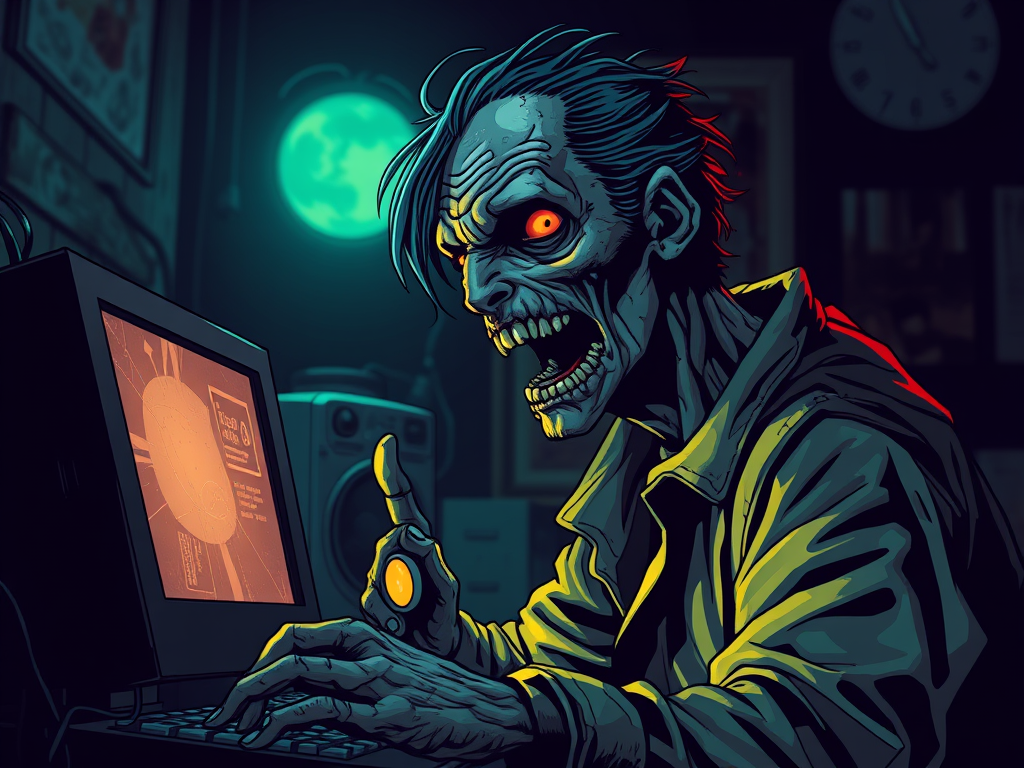
Getting out of the familiar 8 AM to 6 PM daytime rat race schedule and into the 6 PM to 4 AM nocturnal racoon schedule – the wee hours of which, incidentally, are the same as those of the tweakers, serial killers, zombies, vampires, and aging rock stars – is certainly not for everyone. I don’t love it, but it is necessary and mercifully temporary.
Your instincts are that when it gets dark outside, you are supposed to be winding down, not up. By 2:00 AM, you find yourself in an epic mental battle between your mind desperately wanting to sleep and your mind needing to stay wide awake and mentally sharp. You oscillate between these wildly opposite mental states. It’s not easy. It’s an eternal battle between Greek gods Hypnos and Argus Panoptes.
But you find ways to stay awake, like reading a book, listening to upbeat music, or playing a newly discovered online version of Whist, a popular 19th century card game that Dostoevsky mentions in The Brothers Karamazov that I had to Google when I read it. Whist was a predecessor of modern Contract Bridge, which is my dad and stepmom’s favorite card game. Sometimes I find myself doing all of these at once.
I feel oddly guilty about pouring a dram of whiskey at 4:00-AM and getting up at the crack of noon. It feels strange going to sleep for 8-hours and waking up on the same day. And even though I do typically sleep for 8-hours, I still feel tired. But why though? I mean, it’s just a time shift, right? I should feel totally normal, right? Well, not exactly…
In 1972, geologist Michel Siffre, one of the early pioneers of experiments on human circadian rhythms, spent six months in Midnight Cave in southern Texas. Siffre suffered both acute and lasting effects, only partially recovering from the isolation physically, mentally, and emotionally. His internal clock shifted to 48-hours, and he completely lost track of hours, days, weeks, and months. He stayed awake for 36-hours straight and slept for 12-hours at a stretch. His Day 63 inside Midnight Cave was really Day 77 above ground.
Siffre later described the experience as: “A slow slide into madness.” He talked to insects for company. He found comfort in his own voice, but silence always returned, crushing and relentless. After 180 days, Siffre’s team removed him from the cave. To him, only 151 days had passed. 29 days were unaccounted for in his daily diary. Time literally slowed down, stretched out, and slipped away from him.
So, from Siffre’s experiments we can conclude that our circadian rhythm is nothing to trifle with or you just might risk losing your mind a little bit. Duly noted. It’s still May, right?
I have one more week to go. I hope I make it. But if you see me talking to insects, you’ll understand why.
Instagram: @m.snarky
Blog: https://msnarky.com
©2025. All rights reserved.


 msnarky