Story 45 of 52
By M. Snarky
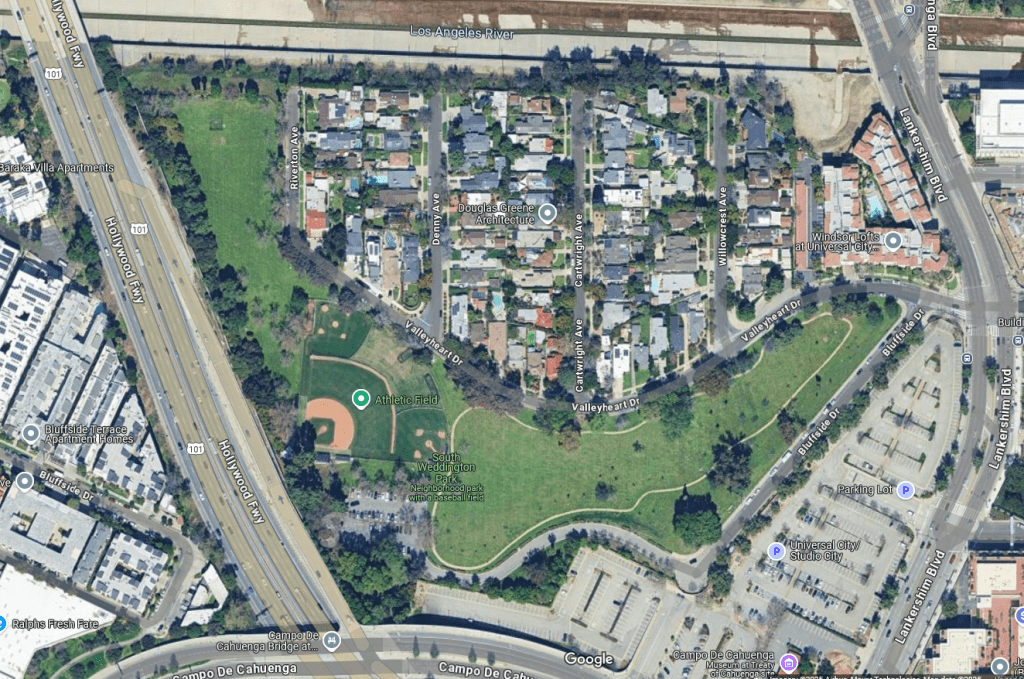
Between 1979 and 1984, Bluffside Park was the unofficial local name for South Weddington Park in Studio City, and it was the “secret” place where all of the hip cool young people from Studio City, North Hollywood, and the Hollywood Hills would meet up to find out the answers to the many important questions of the day:
- Was there any good weed to score?
- Does anyone know where to score some cocaine?
- Where were the weekend house parties?
- Were there any good bands playing at the Starwood, Gazzarri’s, or Phases?
- Does anybody have any clove cigarettes?
Good weed was relatively easy to obtain around Los Angeles most of the time and some strains were vastly better than others—some of which would knock you on your ass—but getting your hands on some decent cocaine required knowing a guy who knew a dealer and trusting that the blow wasn’t cut with too much lactose or mannitol. Ultimately, you just had to trust the system and weren’t going to get ripped off.
The curious thing about cocaine is that while it impresses people as a classy drug used by sophisticated individuals such as artists, musicians, poets, actors, and writers—ergo, sophistication by association—it simultaneously drains your bank account at $100 per gram. That was a lot of money back then, especially for a low roller like me making only $5 per hour as an electricians apprentice. Indeed, a spare Benjamin was hard to come by but all too easy to spend foolishly in an attempt to impress friends and love interests. Although I did enjoy getting high on cocaine, I could only indulge in it occasionally because I needed to make rent on a regular basis, which was unlike some of the young adults in the neighborhood who were still living with their wealthy parents and always seemed to have a vial or two of cocaine in their pocket.
As it was, Bluffside was one of those local impromptu gathering places where sometimes only a handful of people would show up and at other times the small dirt parking lot was completely full of cars and anticipation. There was always a good chance that you would run into someone that you hadn’t seen in a while which would give you the opportunity to catch up on things, exchange phone numbers, and maybe get high together.
Unfortunately, the locals living in the Bluffside enclave hated the sometimes-noisy crowds that occasionally blasted the KROQ soundtrack of the day on the Blaupunkt radio installed in their parents BMW’s or Mercedes-Benz’s. Apparently, music by The Clash, The Dead Kennedys, The Police, the B-52’s, and Iggy Pop violated the collective sensibilities of the well-heeled neighborhood and so they would call the L.A.P.D. regularly.
The cops arrival would disburse the crowd remarkably fast when they rolled up because they were easily spotted due to the park being accessible only by two streets: Bluffside Drive to the east and Valleyheart Drive to the north. The park boundary was wedged between CA 101 to the west and the concrete L.A. River (a.k.a. “the wash”) to the north, and it was easy to ditch the cops along the verge of the 101 or the verge between the wash and the residential houses in the tony little neighborhood.
The unofficial yet generally accepted schedule at Bluffside was to meet on Friday night after work, disseminate and absorb all of the critical information, chose your adventure, and then meet again on Saturday night and repeat the process. By Sunday night, the talk was mostly about the disasters, misadventures, and the highlights of the previous 48-hours. There were also plenty of casual conversations revolving around music and food and books and movies and sometimes a bit of juicy gossip would creep into the conversation about who started dating, who broke up, and who was having sex with whom.
The legendary house parties were absolutely wild. There were many wealthy families living in the area who worked in the automotive, aerospace, music, television, or film industries, and some of them lived in these fabulous hillside houses that had large swimming pools some of which included detached cabanas or pool houses. Often, the parents would go on a lengthy vacation and leave their eighteen-year-old or so offspring at home by themselves because there is nothing more tedious and troublesome than traveling with adult children, the term of which appears to be an oxymoron.
Leaving an unsupervised eighteen-year-old “adult” at home was analogous to leaving an arsonist with a five-gallon jerrycan of gasoline and a match: At some point combustion was going to happen. One phone call to one friend would start a chain-reaction of other phone calls to other friends, and exponentially, the news got around quickly. Soon, hundreds of random people—some known, others being perfect strangers (if there is such a thing)— start showing up on a Saturday night to party their asses off like there was no tomorrow because, frankly, at that age most of us were living in the moment which was all that truly mattered.
The age span between eighteen and twenty-one is like purgatory because you are considered an adult and are of legal age to vote and engage in contracts or join the military or buy a car or borrow money from the bank to buy a house, but you can’t buy alcohol, one of the great privileges and pleasures of true adulthood. When you are stuck in this underage limbo, the only way to get alcohol was to know somebody who was old enough to buy it for you, or you had to resort to “pigeon” for it. To pigeon was to hang out in a liquor store parking lot out of sight of the store clerk and ask someone who was going inside the liquor store to purchase your alcohol for you. At best, the odds were 50/50. Circus Liquor in North Hollywood was my liquor store parking lot of preference because it was close to where I lived. Indeed, the only way to get your fifth of Cuervo Gold or a six-pack of Bud tall boys was by proxy. There were other, more nefarious ways like shoplifting, but I always considered theft one of the lowest forms of human conduct and refrained from engaging in such a lowly act.
This was a pre-GPS era, so unless you had a Thomas Guide in your car and knew the street address of the house party (of at least the general vicinity), you would often pile into the car of a guy who said that he knew where the party was, and along with your plain brown paper bag of beer or tequila, you drove off to parts unknown. We would often get lost and missed out on many house parties with this method. The surest way to find the house party was to convoy with a bunch of other cars that were following the guy in front who did have a Thomas Guide and snake your way up into the narrow streets of the Hollywood Hills.
One of these house parties was near Laurel Canyon Blvd and Mulholland Drive, overlooking Hollywood. The house was stylishly furnished, replete with leather couches, crystal chandeliers, marble, and all manner of artwork. There was a better than average live rock band playing under a cabana on the pool deck. There were several kegs of beer on ice in plastic trash cans that were lined up along the back wall of the house. Drinking Heineken from a keg is not the same as drinking Heineken from a bottle—it was considerably better, and so it flowed endlessly into my bottomless red cup. The house was jam-packed with partygoers and marijuana and clove cigarette smoke permeated the air. People were smashing out their cigarette butts on the hardwood floors and spilling their beers all over the house. Some people were snorting cocaine from the marble countertops in the kitchen.
As I was bumping my way through the crowd toward the band, Tom Armstrong, an old hooligan friend that I hadn’t seen in a while, spotted me from the opposite side of the pool and yelled out my name. We acknowledged each other. He was there with his friend Duke. Tom said something in Duke’s ear, and then they started walking briskly in opposite directions around the pool toward me. This could only mean one thing: They had conspired to throw me into the pool. Not tonight, boys! I spotted some Italian cypress trees at the far edge of the pool deck and decided that I was going to hide behind them. The thick crowd of people slowed them down considerably and I bent down as low as I could while winding my way through the thicket of people toward the trees hoping that Tom and Duke would lose sight of me.
When I got to the edge of the slate pool deck, I briefly glanced back to see Tom and Duke closing in on me. I took a step beyond the deck thinking that it was a planter bed where the Italian cypress trees were located, but it wasn’t…it was the ledge of a concrete retaining wall. I stepped off the ledge and fell down about twelve feet into the darkness and almost landed on a couple who were making out on a bench in the planter below. I hit the dirt hard on my right side. It knocked the wind out of me, and I was sure that I broke my right arm and maybe some ribs. The guy on the bench jumped up and said, “Dude—are you okay?” I couldn’t talk yet because I was still struggling to catch my breath, so I just nodded my head, slowly stood up, and limped away holding my arm and headed back toward my car to drive myself to the emergency room. On the way to my car which was parked way up the road, I ran into my friend Mark Flaata who had just arrived. By then I had recovered considerably in the miraculous way that one recovers quickly when one is young. My arm and ribs were definitely not broken, but my confidence definitely took a major hit. We went back into the party and stayed until the cops showed up around midnight and shut it down.
Meeting back at Bluffside the next night, we heard many other stories about the same wild party. It’s funny how people can be at the same place at the same time yet not run into each other while also having a completely different experience. Drama, comedy, run-ins with law enforcement, breakups, hookups, philosophical conversations, religious conversations, swearing off drinking alcohol or doing drugs, passing out on the front lawn, and musings about the meaning of life were all part of the various storylines that were told. In those moments, we represented our fleeting wasted youth in the truest form possible.
This was all part of an earnest—although ultimately futile—effort to stave off the requirement to get serious about life because no young person wanted to end up like their parents working long hours in jobs that they hated and being stuck with all of those serious adult responsibilities like insurance and mortgages and car payments and the multitudes of problems that seem to accompany them.
No matter our purest intentions, time marches forward mercilessly regardless of how tenaciously we try to hold it back, and most of the once fierce, invincible, carefree teenagers eventually become another cog in a massive, indifferent, mindless system that strips them of their soul and spits out their bones when it is done with them, repeating the infinite cycle of modern society.
Luckily, some of them survive with their souls intact. These are my kind of people.


 msnarky