
By M. Snarky
Story 20 of 52
A mecca for car and motorcycle enthusiasts, Mulholland Drive between Coldwater Canyon Avenue and Laurel Canyon Boulevard was a place to test your driving or motorcycle riding skills. It was also a place where death was always possible at every turn.
I have driven on this section of Mulholland drive more times than I can remember, sometimes as a driver or motorcycle rider, and sometimes as a passenger. It is an infamous 2.25 mile stretch of road for many reasons. It is a road where you might test out the new suspension mods you just installed on your car. It is a road where you might take your significant other to view the city lights from one of the many fantastic lookouts. However, this is an unforgiving stretch of road and if you make a mistake, you may find yourself plunging hundreds of feet down a steep hillside and you are not likely to survive.
Some of the turns even have names, like Deadman’s Turn, Carl’s Curve and Grandstands, all of which have proven to be fatal at one time or another over the decades. This is part of the allure of Mulholland Drive; to push the driving envelope and beat death by hitting every twisting turn as fast as possible. Or not.
At the bottom of the gully at Car’s Curve you can find cars from all of the decades piled up. It is rumored that this part of Mulholland Drive is haunted by the drivers who were killed there. I came close to crashing there a few times myself.
I almost crashed on Alan Flaata’s café style 1973 Yamaha RD350 on Dead Man’s Curve – a nasty, almost 90-degree turn. If you’re coming from Laurel Canyon Boulevard, it turns hard to the left and comes up right after about a one-eighth mile straight section where you can pick up a lot of speed…if you’re willing…and I was. I came into that turn going much too fast and as I was downshifting and braking hard and leaning hard and trying to pull the motorcycle hard to the left, the left side foot peg scraped the asphalt and almost high-sided me right over the edge of the curve and down into the canyon. I barely pulled it off. I also almost soiled my new 501’s.
When I thought I was a great driver in my late teens and early twenties – like all young men that age believe – I was always pushing the envelope on Mulholland Drive in whatever car I was driving, which translates into I was almost always crashing all of the time…but I got lucky and never did actually crash, although I came very close. This is why that road is so dangerous; you build up a false sense of world-class driving skills when you’re driving hard and don’t crash, and so you keep on pushing the limit. It is a vicious circle.
Here’s my list of all the spinout survivor cars that I almost crashed on that stretch of road:
- 1973 BMW 2002 with a 4-speed manual transmission and a heavily modified engine with dual, side draft Weber carburetors, headers, and a lowered suspension kit with anti-sway bars and Koni shocks and springs, and flared fenders with fat Pirelli tires. A true Eurocar experience. This car belonged to Frenchman Robert Gabbay, one of my old European Motor Connection bosses.
- 1978 Fiat X1/9, stock, with a 5-speed manual transmission. A lightweight mid-engine car that handled pretty good and was fun to drive. This was a European Motor Connection customer car that I had for the weekend.
- 1982 Chevy Citation X-11 5-speed coupe, stock. This was mine. It had decent power and handled well, but the front-wheel-drive transverse transaxle drivetrain was a little heavy to steer.
- 1976 Jensen Interceptor III, stock. Another European Motor Connection customer car that I thrashed a few times.
- 1969 Chevy Chevelle Super Sport 396, this was my $400 beater car that I bought from Keith Doran. Primer gray, no heater, no AC, no frills – just a shell of its former self. Somewhere along the line, someone swapped out the 396 for a 350! What a knucklehead.
Out of all of these cars, the Chevelle was the dumbest car to race around on Mulholland Drive because it simply was not built for handling and was notorious for massive understeer and crappy braking. It also only had a 2-speed “Slip ‘n’ Slide” PowerGlide transmission. Ah, youthful exuberance!
Some of these spinouts happened during the day, and some happened at nighttime, which is a very different experience when you’re spinning out; one second you see the rocky face of the road cut, and the next second you see the oncoming traffic, and the next second you see the city lights. With sweaty palms and an adrenaline surge, you drive off as if nothing had happened.
Around the summer of 1979 or so, my crazy friend Mark Flaata, Alan Flaata’s older brother, borrowed his mom’s dark green fake wood paneled 1972 Chrysler Town and Country station wagon one night and picked me up. As we were driving up to Mulholland Drive from Coldwater Canyon, we smoked a little bit of weed and were blasting Led Zeppelin’s Whole Lotta Love on 95.5 KLOS. We were feeling alright, and when Mark turned left onto Mulholland Drive, he apparently started channeling Björn Waldegård, the 1979 World Rally champion, and opened up the 4-barrel carburetor on the 383 cubic inch engine and got that massive station wagon a little bit sideways. Mark drove like a maniac, sliding around the curves, and flooring it every chance he could. We were laughing our asses off as Mark was thrashing his mom’s poor car.
Up ahead, Mark saw a hitchhiker and decided to stop and give him a ride. I was thinking that picking up a hitchhiker on Mulholland Drive at night might be a really bad idea, but the guy from Reno turned out to be pretty cool and was trying to get to Hollywood and Vine. Mark said, “No problem; I’ll drive you there!” Then Mark drove off like a nut job, spinning his wheels in the dirt and speeding off and sliding around more turns. I looked back at the guy from Reno, and he looked like he wanted to barf or maybe jump out of the car. Well, as Mark sped into one of the unnamed right-hand curves near Laurel Pass Avenue, he lost control, and we slid sideways left off of the pavement and into the slightly bermed dirt hillside – almost rolling that gigantic mass of Detroit steel in the process – as it stalled and came to rest on top of a huge hard-packed mound of dirt.
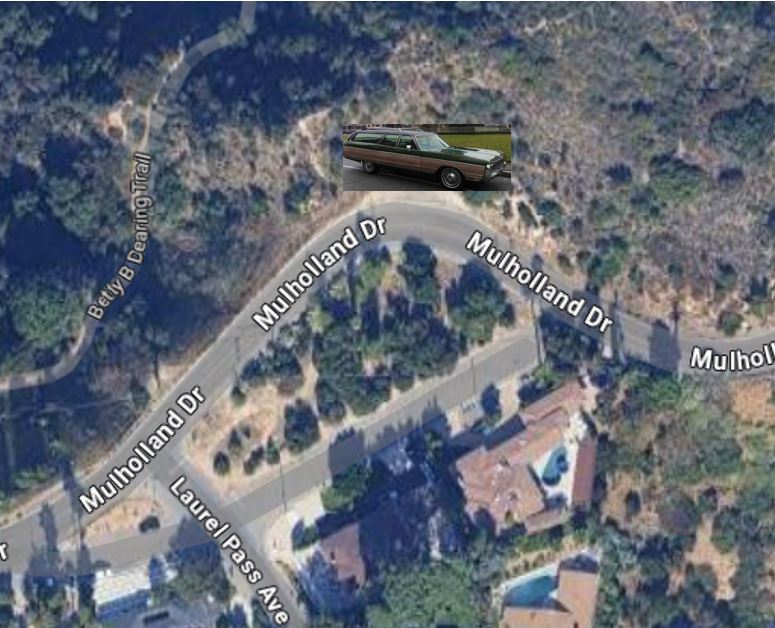
This is when the guy from Reno said, “Hey man, thanks for the ride, but I think I’ll walk the rest of the way.” Mark replied, “Don’t worry, dude, I’ll get you to Hollywood!” as he quickly restarted the Chrysler and tried to drive it off the mound of dirt that it found itself sitting on, but all that happened was spinning wheels – the massive, 4,735 lb., 121-inch-long wheelbase station wagon was stuck, looking something like a beached mechanical whale. We got out of the car to assess the situation. The frame of the station wagon was sitting on the crest of the hard-packed dirt mound and was practically teetering. We knew our only option was to bumper jack it up from the front until the back wheels were firmly touching the ground for traction, and then reverse it out as the car would, theoretically anyway, gracefully roll backwards off of the jack.
This is when we noticed that the man from Reno was gone; he had pulled off a proper Irish Goodbye and we never saw him again. Hopefully he got to Hollywood in one piece. I’m 100% sure Mark left an impression.
Being that the car was on a slight slope, it took a few attempts to get the bumper jack to stabilize using some strategically placed rocks, but it actually worked on the fist attempt. By the time we were done, we were covered in dust, dirt and sweat but remarkably, aside from the layer of dust and dirt also on the station wagon, it was unscathed: no dents, no scratches, no flat tires, no cracked windshield, proving once again that the car was pretty much invincible. In retrospect, it could have been a massively worse crash and we were lucky that we didn’t get hurt or killed.
There are many spots along that stretch of Mulholland Drive that you can pull off and park and watch the motorcycle riders and car enthusiasts – even the boneheaded ones that borrowed their mothers station wagon, ahem – test their mettle. On any given weekend, you’d see early and late model European cars like BMW, Mercedes-Benz, Jaguar, Alpha-Romeo, and my personal favorite, Porsche. Most of these cars looked original, but many of them were modified for road racing. Occasionally you would witness a spinout or someone driving off the asphalt and onto the soft dirt shoulder kicking up a huge cloud of dust.
Less crazy Alan Flaata had a heavily modified 1972 Ford Capri that he raced around on Mulholland Drive too, but Alan definitely had much better driving skills than Mark. I know this because I was a passenger in that car when he drove through Griffith Park as fast as he could on Mt Hollywood Drive, colloquially known as Trash Truck Hill. Alan spent many weekends wrenching on his beloved Capri road racer, and I think he spent most of the money he earned from working at Oroweat Bakery on aftermarket parts. Alan was an early adopter of the “Built not bought” movement. His friend Mauricio Zotto followed suit, but “Zotto” built a badass 1970 Boss 302 Mustang that he could pull a slight wheelie with that he raced on Van Nuys Boulevard in the heyday of Wednesday night cruising. But that’s another story.
Instagram: @m.snarky
©2025. All rights reserved.
 msnarky