As a general rule, I walk at lunch, unless, of course, the weather sucks. Movement is good and it gives me a chance to reset and clear my head.
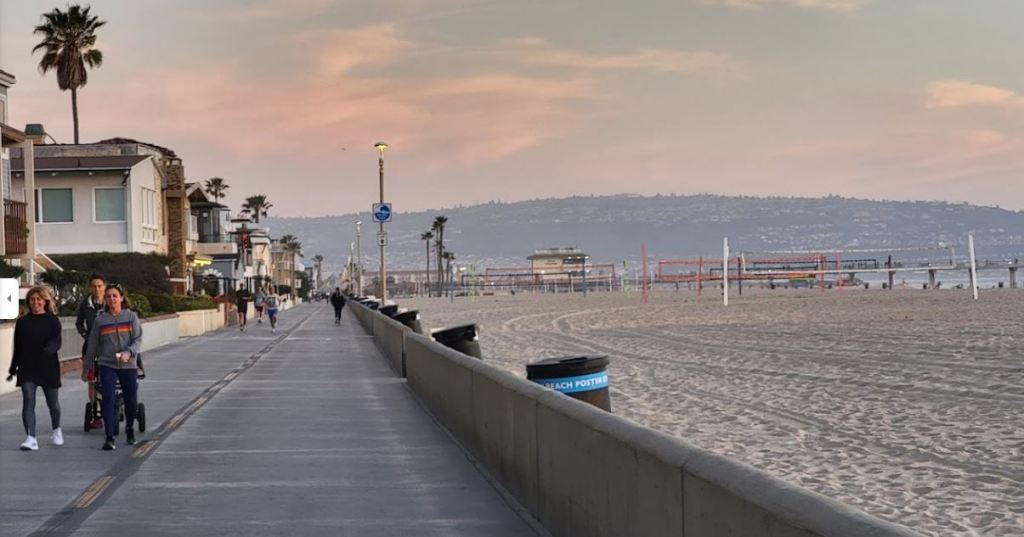
I’m currently working in Manhattan Beach, CA, and there’s a path a half mile away in Hermosa Beach that goes right between the multi-story, multi-million-dollar homes and the beach that the locals call “The Strand.” It’s nice. It’s a beautiful place. Sometimes it is so clear that I can see the west end of Santa Catalina island. It’s great for people watching. I see the beautiful people on a regular basis. I also see the locals and tourists, has-beens and wannabes, beauty, beasts, homeboys with their pit bulls, and burnouts. I’m sure I’ve seen a couple of drug deals go down. It’s an interesting dichotomy of the people that live in Southern California.
Some of them are day drinking a bottle or a can of something from a brown paper bag as they sit along the low wall between the sand and the path or as they cruise along the path on a beater bicycle. Some of them are smoking weed with the warm smell of colitas rising up through the air. Hotel California reference aside, I often wonder what the people living in those beachside houses do for a living. They certainly are not flipping burgers. These are the often-derided Coastal Elites: Educated, wealthy, influential, and meddling.
There’s also a regular mix of walkers, runners, cyclists, skateboarders, and roller-bladers on The Strand. Occasionally, I see a wipeout when someone hits the loose sand that is often on the concrete path. Most of them get right back up, dust themselves off, and go on about their activity. Others act as if they are waiting for an ambulance and Larry H. Parker to show up.
I’ve recently come to the realization that not every stroller has a small child sitting in it enjoying the fresh air and sunshine or taking a nap as you would expect. Indeed, many of the strollers I see actually have a small dog (or two) and sometimes even an occasional cat. Cats and strollers seem like a recipe for, well, a catastrophe. I can barely get my cat Cheeto into his cat carrier to get him to the veterinarian and the thought of getting him into a stroller “voluntarily” for a lovely walk down The Strand would turn into a bloody mess. My blood, not Cheeto’s. It might actually work out if Cheeto is inside the cat carrier first and the cat carrier is loaded and strapped onto the stroller, but I’m not willing to get shredded to find out. You can read more about Cheeto in an earlier post here.
Now, as I walk down The Strand, I play a game inside of my head called People and Strollers: Pet or Child? I haven’t really been keeping score, but I am often surprised, especially when it is a young woman or a young couple pushing a stroller with animals inside instead of the expected little human being.
Ironically, the animals are often much cuter than the children.
I live in a subdivision of the San Fernando Valley that was built in 1952 by a contractor named Ponticopoulos, Inc. The homes here are mostly modest post-war houses ranging from 1,100 to 1,400 square feet and are typically 3-bedroom, 1-¾ bathroom, with a fireplace and an attached or a detached 2-car garage. Some have swimming pools. They were built without central heating or air conditioning. There are only about four original floor plans and as is typical of a subdivision, the floor plans are reversed (or “flipped”) to add some variety to what were ostensibly cookie-cutter tract homes. Compared to new subdivisions, the lots here are generous in size. Our 1,246 square foot house sits on a 9,298 square foot lot. We purchased the house in 1999 from the original owners who hadn’t done any improvements, but it was in great overall condition.
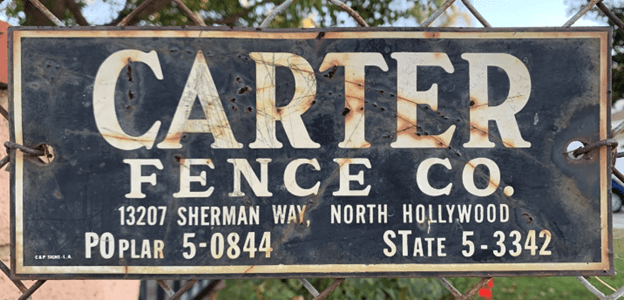
On Amestoy Avenue near Stagg Street, there’s an old original Carter Fence Co. sign on a neighbors old chain link fence with the even older seven-digit phone numbers on it:
Carter Fence Co.
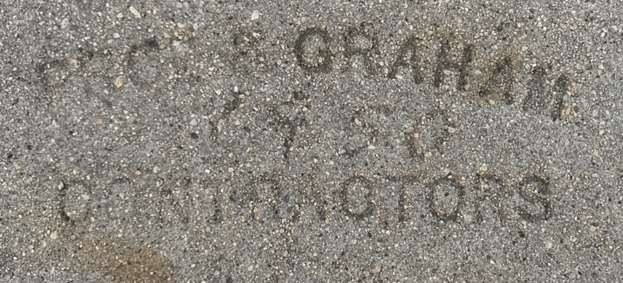
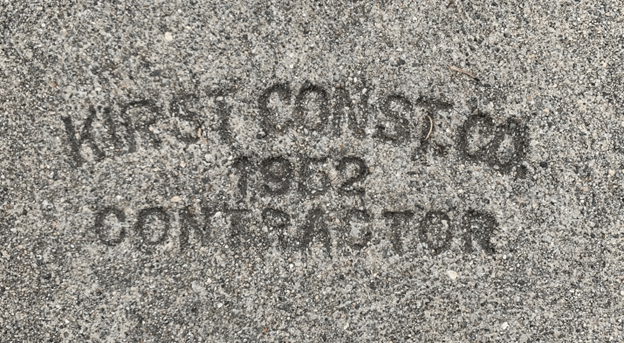
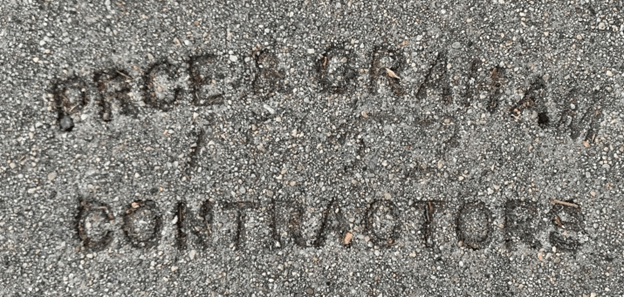
There are concrete stamps in the sidewalks with the contractor’s names and the year the concrete was poured. I’ve identified the following stamps around the neighborhood:
1950 – PRCE & Graham Contractors. This is the earliest stamp I have found. The hand etched 1950 numbers are a little hard to see in this image.1951 – Malcolm Paving Co.1952 – Kirst Construction Co.1952 – PRCE & Graham Contractors. Again, the hand etched 1952 is not easy to see.1953 – Kirst Construction Co.1954 – Kirst Construction Co.
Judging by the quantity of the stamps, Kirst Construction Co. built the most sidewalks, curbs, and gutters here implying that they had close ties to the general contractor / builder Ponticopoulos, Inc. I think the stamps are cool looking and a semi-permanent memoir to the contractors that poured the mid-century cement. I’m planning on finding out more about these contractors at a later date for an exercise in Los Angeles urban development history. The 1952 stamps in the sidewalk around the corner indicate that our house was built during the third of five phases.
Only about 50% of the sidewalks in the neighborhood are still flat-ish. Between the mature trees and their roots pulling everything up and the many earthquakes over the decades, there are countless parts of the sidewalks that are buckled, tilted, cracked, or totally shattered.
Over the years, many of the homes in the neighborhood have been remodeled or built an addition, for example, a fourth bedroom. The trend now is building mostly 2-story ADU’s (accessory dwelling units). Some ADU designs are definitely better than others as far as style goes; some look like basic boxy utilitarian housing, while others were given far more architectural thought and are more pleasing to the eye. Many of the garage conversions look like they were done by a DIY-er and a maybe a couple of friends on a 12-pack Saturday and most likely without a permit. There are also other perpetual construction projects at various stages throughout the neighborhood.
I regularly walk around my neighborhood 4-5 days per week to get my (mostly) daily 10,000 steps. I have set 3 and 4-mile routes that I know like the back of my hand, and so I pass the same houses along those routes all of the time. Some houses are just more noticeable than others for various reasons. My observation is that the houses generally fall into the following categories:
Bright
Faded
50/50
Derelict
Hoarder
Squatter
Cat Lady
Bright
These are the homes that are well maintained and visually appealing. They are in tip-top shape and don’t need any improvements. The roofs are in excellent condition. The paint looks fresh. The front landscaping is well manicured. There is a late model car or two in the driveway. They often have seasonal greeting flags and some big box DIY store yard decorations that came all the way from China. There is pride of ownership at work here and it shows. You would not be afraid to ask this neighbor for a cup of sugar and they would probably ask you what kind of sugar you needed; white, brown, coconut, jaggery, or piloncillo.
Faded
These are the homes that need some love. The roofs are showing signs that they are approaching their 25-year lifespan. The paint is peeling and chipping all around the exterior of the house especially on the areas with southern exposure. There is a lack of landscaping. Untrimmed trees, bushy shrubs, and overgrown hedges take up the sidewalk. Tall weeds, and mostly dead grass occupy much of the front yard because the sprinklers don’t work anymore. There are older cars in the driveway. These are either rental homes that the landlord doesn’t care to maintain, or the homeowners gambled their retirement money away playing the lotto or playing the slots at the local tribal casino or in Las Vegas. You normally would not ask this neighbor for a cup of sugar, but you would do so in a pinch.
50/50
These homes fall in between the bright and the faded. It wouldn’t take much to get them into the bright category, but if they continue to let it go it will definitely fall into the faded category. A little paint here, some trimming there, a working sprinkler system and some fertilizer would work wonders while increasing the curb appeal – and the value – of the home. This is really DIY stuff here, so they don’t necessarily need to hire an expensive contractor to do the work. There is always the option of picking up some questionable day laborers at the local DIY big box store too. Questionable, meaning that if you go up to a group of these men and ask for someone who knows plumbing, they will all raise their hands. Same goes for electrical, carpentry, drywall, and even dentist – these guys miraculously seem to know everything. This is what they do.
It is difficult to tell whether these homes are slowly ascending to bright status or slowly descending into faded status. Only time will tell.
Derelict
You know these homes. They look like something from a slasher movie. They also look like they need to be condemned. There might even be a dead body somewhere on the premises. There are old cars or boats or trailers or RV’s (or a combination thereof) at various levels of decay that haven’t run or moved in years that are parked in the driveway, or on the front yard, and in front of the house. There might be one beater car that actually runs. You almost never see any of the occupants. The heavily weathered formerly white picket fence is falling over onto the sidewalk. Trick-or-Treaters don’t even dare to ring the doorbell or knock on the door for some free candy. You would definitely never ask this neighbor for a cup of sugar because you might get a cup of rat poison instead. Or maybe some crystal meth.
Hoarder
A hoarder house looks a lot like a derelict house but with additional, apparently important “stuff” that takes up most of the outside space of the property. It’s difficult to differentiate between hoarder and collector, but you’ll see places like these on American Pickers on a regular basis. The stuff is generally anything; old signage, broken coolers, wheelbarrows, car parts, strollers, rusty bicycles, long dead appliances, stockpiles of bricks and plumbing parts and scrap lumber that might come in handy one day. The cars on the front yard look like they’ve been abandoned. God only knows what the inside of the house looks like, but if the yard is any indication, there is probably barely enough room to walk in. But if you needed, say, an intake valve for a 1932 Ford V-8 flathead engine, they probably have it AND know exactly where it is in their, um, vast filing system kept between their ears. I would on no occasion ask them for a cup of sugar in fear of finding it infested with dead insects.
Squatter
You’ve seen these houses scattered around the city. They are a mash up of the derelict and hoarder house but with a dozen or more people living in them. The residents are mostly drug using and/or drug dealing bachelors. People come and go all hours of the day and night. Their collective of barely running (likely stolen) cars are parked in the driveway and on the front lawn and spill out onto the surrounding street along with their trash that they never bother to pick up. These men simply find a vacant house, break into it, and move in. If there’s no electricity, they will tap an extension cord onto the unfused live overhead utility wires and bring it into the house through a window. Talk about the real danger of a fire…or possible electrocution! But hey; it’s free rent and they need a place to charge their electronics.
My understanding is that it is a hellish process to get squatters evicted and it can take a year or more and cost tens of thousands of dollars. There’s actually one of these houses a few blocks down the street from our house. One day I counted 13-cars on the property, all of which were at various levels of drivability – or not. A cup of sugar from that house would probably include a free sample of whatever highly addictive drug they’re selling so you’ll come back for more later on. No thanks. I’ll just go to 7-11 on the corner instead and pay the exorbitant amount of $10 for a pound of sugar.
Cat Lady
We have one in the neighborhood. She lives a couple of cul-de-sacs over. The godawful smell from that house is overwhelming and it assaults you 3-doors down as you walk by. There used to be this wooden multi-level cat condo structure in the driveway that housed dozens of feral cats. The city finally made her take it down after the neighbors complained about it for months. We still see the feral cats all over the neighborhood. The front yard and the curb in front of this house are everchanging. There’s an ongoing furniture thing that’s happening on the unkempt front yard. One day, you’ll walk by and see a coffee table. On another day, it’s a dresser. Sometimes it’s an old, clawed up couch or loveseat. Sometimes it is several pieces of furniture at once, as if someone is moving in or out. But it is always changing. I have no idea where the furniture comes from or where it goes. Maybe she’s just airing them out to freshen them up. Maybe she’s a furniture afficionado who knows the value of secondhand furniture and makes a living buying and selling on the Internet.
At the curb, the trash bins are always full of smelly, empty cans of cat food and empty dry cat food bags and empty cat litter bags. They always wreak of dead fish and ammonia-tinged cat litter. There are also various and sundry cat related items at the curb like partially deconstructed catnip filled toys, and heavily shredded scratching posts and perches.
Every now and then I’ll see her SUV parked in the driveway with the liftgate open. The cargo area is always full of bags of cat litter, dry cat food, and cases of canned cat food that she picked up from Costco. Seems to me that she likely let all of the feral cats move into the house when the city condemned the cat condo.
The upside of our neighborhood is that most of the neighbors take care of their houses and are friendly and reasonably quiet, and they dutifully pick up the dog poop that their favorite pooch deposits on the front lawn.
The feral cats, however, deposit their poop in my front planter on a regular basis leaving the telltale signs of little piles of dirt and mulch in the center of their scratch marks.
The cat lady owes me an apology and a regular weekly clean up.





 msnarky