Story 13 of 52
By M. Snarky
I’ve mentioned in a previous post (https://msnarky.com/2024/08/30/walking-in-my-neighborhood/) that I do my best to get my ten-thousand daily steps. It’s good for me. It gets me away from my screens for an hour or so. It gets my heart rate up a little bit. I also benefit from the sunshine and fresh air and the endorphins especially after getting chased by a dog for half a block. I do most of my walking around my neighborhood and I’ve become familiar with the streets and the houses and the other regular walkers.
I’ve gotten myself into the habit of saying hello to everyone that I pass. Not an over-the-top, phony “HELLO!” like what the salesman at the car dealership says as if they know me, it’s just a regular, friendly, low-key “Hello,” which to me is a simple greeting and an acknowledgment of someone’s presence. Oddly, my hello back ratio is lacking, like maybe I get a one out of five response, or 20%. On a good day, maybe one out of four, or 25%. My ratio is 100% because I always say hello back.
There is a semi-regular walker in my neighborhood that I call Bigfoot. He is a thinnish sixty-something year old mustachioed man with a ruddy complexion and thinning hair and he’s maybe five-feet-nine-inches tall. He wears Ray-Ban Aviator sunglasses…even at night. He walks with duck feet (out-toeing) at such an unbelievable angle with shoes so large that it reminds me of Bigfoot, hence the nickname. He walks with his head at a downward angle as if he is avoiding making eye contact with anyone. His body language tells me that he is walking reluctantly – as if he’s only doing it because of doctor’s orders.
I have said hello to this man at least dozen times. He has never, ever, said hello back. My first inclination was that he was tuned out with earbuds (which, unfortunately, is often the case) and maybe blasting Liberace’s Greatest Hits and simply didn’t hear me, but there was nothing jammed into his ears. My second inclination was that he had a hearing deficit and simply couldn’t hear me. But then I saw him having a conversation with someone in the neighborhood which ruled this out. So, if he can hear me, there must be another reason. Maybe he’s just a shy person. Maybe he’s just going through the motions of life and not really engaging in it, which is sad, really. Perhaps he is in a witness protection program and is suspicious of everyone, which pretty much borders on paranoia. Or maybe he’s just an anti-social crank that hates the world. I’m leaning toward that last one.
So, this got me thinking about the actual word, hello, where it came from, what it means, etc., and down the world-wide-web rabbit hole I went…
According to Merriam-Webster, the etymology of the word hello is that it is an alteration of the word hollo (14th century) which was originally used as an exclamation or to attract attention. The Oxford English Dictionary notes the earliest known use of the word hello is in the 1820s. Okay, so the word has been in use for a couple of centuries so it’s not like it’s a new word that hasn’t caught on.
According to NPR, Thomas Edison is credited for popularizing the word hello by suggesting that this is how you should answer your newfangled telephone in the late 19th century. His rival, Alexander Graham Bell, however, thought the better word was “ahoy.” I can’t imagine answering my phone with, “Ahoy!” instead of, “Hello!” unless, of course, I was a pirate.
Anyway, I’m not exactly sure why there is a hello back deficit and I do have some theories about this. But first, some definitions (that I made up):
- Hello-er [he-loh-er] – the person who says hello first.
- Hello-ee [he-loh-ee] – the person who is the recipient of the hello.
Theory 1 – People are Generally Unfriendly
For whatever reason (or reasons), people, in general, are just not that friendly. By default, they are wary of a random stranger talking to them. Maybe they think replying with a hello back will open up an opportunity for a life insurance sales pitch. Or maybe this is just an L.A. thing.
Theory 2 – Avoiding Conversation
People might think that if they respond with a hello back, it will open up the floodgates of a potentially awkward conversation with the unknown hello-er, so they avoid replying back because they don’t want to get pulled into a discussion about politics or religion or veganism.
Theory 3 – Cultural
Unless you have been introduced to a person by a friend or a family member of a member of the clergy, you just don’t talk to strangers unless you want to get flogged. This is probably more applicable to women than men because it is mostly men that make up the rules that incorporate flogging.
Theory 4 – Stranger Danger
Similar to Theory 3 but without the flogging part, Stranger Danger mandates that by default you don’t talk to any stranger for any reason or under any circumstances because they might be a slasher or a rapist or a politician. Don’t even make eye contact. Be a ghost. Indeed, we teach our children to be paranoid and anti-social at an early age here in the USA.
The response of some hello-ee’s is sometimes that of a happy surprise, as if they didn’t expect you to acknowledge them at all, and when you did, they smile and say hello back. These are my favorite people – they are spontaneous and genuine.
For example, there is a family in my neighborhood that has a special needs daughter in her late teens or early twenties. She is non-verbal and the parents have this special three-wheeled wheelchair contraption for her that straps her feet onto pedals and her hands onto handlebars that are articulated to encourage motion in her withered limbs. It is both heartbreaking and beautiful to see parents that are so devoted to their daughter that they regularly walk her around the local elementary school.
The first time we walked by them we were walking in opposite direction around the school, so we saw them face-to-face. I said hello, not only out of being social, but also to convey to them that I see them and that I acknowledge them. They probably didn’t sense that I silently understood the 24/7 anguish they must be experiencing. The response from the parents was as if they had become so accustomed to being invisible that they didn’t think anybody cared to say anything to them, especially a perfect stranger, and I think that I caught them off guard. My hello evoked from them a quick smile and a friendly hello back. It appeared to me that this family had grown accustomed to people walking silently past them. They were used to people ignoring them, not particularly out of callousness or indifference, but because people don’t naturally know how to act or what to say to someone that is clearly living day-to-day with such hardship.
I strongly recommend that people say hello to the passersby that are less fortunate – you might just make their day.
I’ve also noticed that there are vast differences between the hello back response rates of men versus women. In my experience, the man-to-man hello back rate is probably close to one in two, or 50% while the man-to-woman hello back rate is much lower, like maybe one in five, or about 20%.
Not being a woman, I have no idea what the woman-to-woman or woman-to-man hello back ratio is, but I imagine that it is not exactly the inverse. What I mean is that perhaps the woman-to-woman is on par with the man-to-man ratio but the woman-to-man hello back percentage is probably much higher because most men are, frankly, a bunch of horndogs. I also wonder what the national average is between the hello-er and hello-ee ratios between the sexes.
I recently discovered the Google Books Ngram Viewer, and it appears that the frequency of the word hello peaked around 2012:
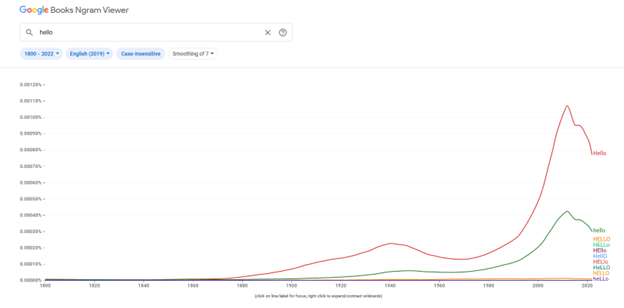
Is hello getting cancelled? If so, we’re doomed.
I’m going to rebel against this trend and keep saying hello anyway.
Instagram: @m.snarky
© 2024. All rights reserved.
Supporting Links
Hollo – https://www.merriam-webster.com/dictionary/hollo
Hello – https://www.merriam-webster.com/dictionary/hello, https://www.oed.com/dictionary/hello_int?tab=factsheet#1691340
NPR – https://www.npr.org/sections/krulwich/2011/02/17/133785829/a-shockingly-short-history-of-hello
Google Books Ngram Viewer for hello https://books.google.com/ngrams/graph?content=hello&year_start=1800&year_end=2022&corpus=en-2019&smoothing=7&case_insensitive=true


Hello back rate is much higher
LikeLike