We wake at dawn, often begrudgingly, and load up the bikes, and the necessary gear, and drive the road, barely awake, to the edge of land, to the edge of the sea, where the two collide, is where we congregate, to set out, on our weekly ritual.
We ride, we ride.
With skinny tires, and spoke and wheel, and chain and gears, we hop on our saddles, and grab our handlebars, and we ride the weathered, asphalt ribbon, that strings along the, Pacific Ocean, and crisscrosses, the coastal mountains, that are dotted with, century old oak trees, that are covered with lichen, and black walnut trees, with resident squirrels, and holes in the ground, with other resident squirrels, that often scurry, frantically, without apparent reason, out across the road, directly in front of us, making us flinch, and miraculously, with nowhere to hide, they somehow avoid getting run over, at the very last second.
We ride, we ride.
With hawks, crows, and condors, soaring overhead, and sometimes, a turkey buzzard or three, on the road ahead, dining a creature, that was formerly living, this is what they do, we also spy mule deer, and an occasional coyote, out in the periphery, of the living canvas, and we see, the tumbleweeds, waiting for the wind, to set them free, and we see the purple sage, and the green wild fennel, an invasive species, that is hard to eradicate, and the orange poppies, and the purple lupine, and the yellow coreopsis, the rainbow of colors, and the richness of textures, is pleasant to the eyes, as we roll by, side by side, and keenly observe.
We ride, we ride.
Looking out across, the shimmering azure sea, changing hues by the moment, we see the dark kelp beds, just beneath the surface, that protect the little fishes, from the big fishes, who want to eat them, and we see sailboats, and fishing boats, and we see whales, and dolphins, and sea lions, surfing and playing, in the briny blue, and they smile at us, and we smile back, acknowledging each other, in the fleeting moment, as we glide down the road.
We ride, we ride.
We ride in the fresh salt air, and in the warm sunshine, and in the biting cold, and in the pouring rain, and in the gusty wind, that nobody really likes, and we fix flat tires, regardless of weather conditions, because we must, and we talk and laugh, about all sorts of things, sometimes serious, sometimes humorous, but always engaging, and sometimes we cuss, to emphasize a point, and sometimes we deride, the ones that are deserving, of our scorn.
We ride, we ride.
We ride along, through the open space, between heaven and earth, past the verdant fields, and up and over the hills, and across the valleys, and through the mountain passes, and down the canyons, sometimes too fast, and through the tunnels, and over and under the bridges, and sometimes through water, that’s a little too deep, that gets your shoes and feet wet, making them cold and squishy, and year after year, we meet and we ride, for endless miles, with the people that we love.
We ride, we ride.
This is how we meditate, and naturally medicate, and how we heal, and how we make sense of, our complicated lives, until the fateful day comes, when circumstances conspire, to weaken and wither our bodies, and we can ride no more, then we’ll dream, the wonderful dream, the golden dream, the infinite dream, of the adventures past, and the stories told, and the laughter, and the comradery, where time stands perfectly still.
Recently, my old wireless keyboard had some stubborn, sticky keys, so I had to replace it. Mind you, the keys were not sticky with foodstuffs like strawberry jam, orange blossom honey, or gooey perfumy hand lotion like my mother-in-law’s keyboard (true story); they were sticky as in I had to mash them down to get them to work. This mashing of the keys has the potential to trigger carpal tunnel syndrome, so the keyboard had to go to the great computer in the sky. Farewell, my QWERTY friend.
Subsequently, I had to purchase a replacement keyboard and mouse set. The set came with what can best be described as a warning booklet in a 1-millimeter font which required a magnifying glass to read. There were battery warnings, laser warnings, FCC warnings, plus product use guidelines. You’d think that I just bought a nuclear detonating device, not a keyboard and mouse. The only thing missing, I think, was language about the keyboard not being intended to be used a weapon. This booklet seemed like hyper legal overkill to cover any potential product liability. All of this for a keyboard? I’m pretty sure that my dad’s old mechanical Smith-Corona typewriter had no such label. I’m also pretty sure that his generation would have torn any such label off anyway.
Naturally, now I’ve been noticing that there are warning labels on everything. EVERYTHING! It is as if we have collectively lost all common sense and are somehow no longer responsible or accountable for not knowing that a knife may be sharp, or that a fire is hot. This is beyond ridiculous – this is insanity.
Is it not common sense (or common knowledge, which, apparently, is not so anymore) that:
A stovetop may be hot.
A hot cup of coffee may be hotter.
An electric appliance may shock you.
An electric chainsaw may shock you and also cut you.
You might fall off of a ladder.
A lawnmower may be dangerous if you stick your hands or feet underneath the cutting blade shroud.
That sunscreen may not protect you from actually getting skin cancer.
An inflatable flamingo is not a life saving device and you may drown.
Gasoline is flammable.
Rat poison is poisonous.
You might crash your bicycle.
You might cut yourself with a pair of scissors.
If society is going to go through slapping warning labels on all of the allegedly dangerous things, may I also suggest warning labels for people? Simple labels like:
Does not get along well with others.
Do not allow to consume alcohol.
Volatile.
Agitated.
Bigot.
Democrat.
Republican.
Dangerous while driving.
Dangerous while talking.
Narrow-minded.
Intolerant.
Indifferent.
Hater.
Extremely selfish.
Hypocrite.
Liar.
Pathological liar (there is a difference).
Blowhard.
Unmotivated.
Manipulator.
I think this would help avoid a whole lot of conflicts because you simply would avoid these types of people, right? On second thought, it would leave you with the uncomfortable knowledge that there are so many of them running around possibly having children.
I would argue that warning labels are interfering with the natural order of things like Darwin’s theory of evolution by natural selection, for example. Think about that for a minute. If we don’t allow Darwinism to do its natural selection thing, are we not allowing for the perpetuation of DNA that perhaps should have discontinued?
I don’t believe that we want the guy who shocked himself while trimming his tree by cutting into a utility wire with an electric chain saw and fell off his ladder into a gasoline fueled firepit to have any children. Prove me wrong.
But there is always a lawyer somewhere that would ask, “Was there a visible warning label on the utility wire?”
Politicians. They’re just built different. From what I can gather, their (he/him/his, she/her/hers) “job” consists of the following:
Convincing the people that they should be elected mostly because of some sort of affinity for something that the people care about (based on polling, of course): a strong military, American jobs, the economy, entitlements like Social Security, Medicare, etc.
Convincing the people that they need to be protected from some bogeyman du jour, often made up out of thin air, but generally some evil foreign entity.
Convincing the people that the opposing political party is to blame for everything bad that is happening while also engaging in bad things themselves.
Convincing the people that raising taxes (i.e., taking even more of your money) is a patriotic thing to do because it helps out our country, our sick, disabled, poor, and elderly in one form or another.
Convincing the people that they are getting the biggest slice of the tax dollar pie as possible (i.e., government handouts).
Being that most politicians started out as lawyers, they are highly skilled at this convincing business. Maybe there is some truthiness to some of this convincing, but the jury is still out regarding actual truth. In reality, much of it are noble lies.
What politicians avoid talking about is their cut, er, I mean the cost of running the government, whom, apparently by design, have made themselves the ultimate middlemen because nothing happens unless they get their cut first.
You work. The government takes some (too much, actually) of your money in the form of taxation. The government divvies up the tax money amongst the various departments. In the meantime, throughout this entire divvying process, they always get their cut, and they always take their cut.
Now I’m going to use some very simple math here to prove my point because I’m fairly good at simple math. I also like to use infographics to support a topic, so here we go…
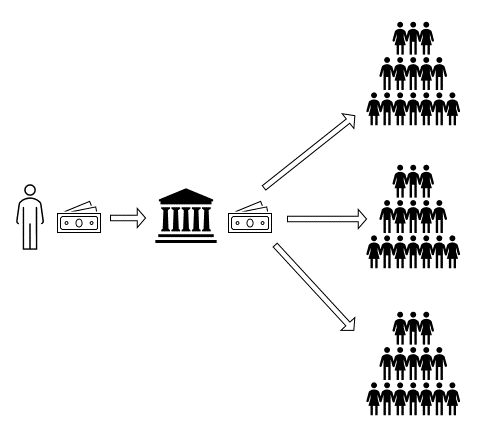
I think this is how most people think the government works:
The tax dollars flow in and are distributed to the various programs. The various programs assure that the recipients get their money.
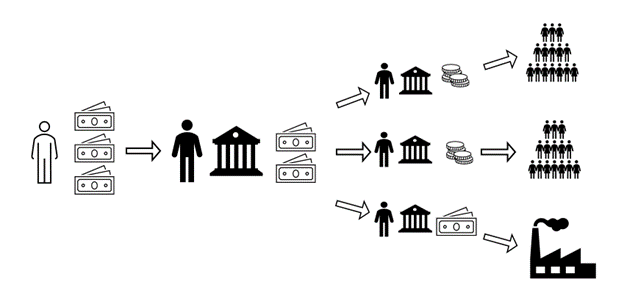
But this is how the government actually works:
You see, the tax dollars flow in and are distributed to the various departments who then distribute it to the various programs, with each level of government taking their cut along the way before the money finally gets to the recipient who, by the way, is not always a sick, disabled, poor, or elderly person as you have been led to believe. Recipients also include multi-million dollar incorporated farms and billion-dollar industries, like Big Ag, Big Pharma, Big Oil, the automotive industry, the aerospace industry, and various military industrial complex companies to name a few. I abhor this last point because I cannot stand the thought of my tax dollars going into the coffers and pockets of wealthy businessmen.
The politicians will tell you that those companies need the tax money to keep Americans working, stay competitive, and “create jobs,” as the popular political speech goes. This also happens to go directly against free-market principles and the government should not be meddling in this space – let the market (i.e., the people) figure out who the winners and losers should be – not the politicians receiving massive donations from these large corporations. But they do, and this meddling skews basic economics so much so that a rocket scientist can’t even figure out the math.
Many (too many, in my opinion) of your tax dollars get consumed by the black hole of bureaucracy itself and, to me, it appears to be an inverted Ponzi scheme. Or maybe an organized crime syndicate.
The actual percentage of the government cut are hard to track because the black hole of bureaucracy is also really good at obfuscating this kind of information, but it appears to be somewhere “estimated at about 5%,” according to the Cato Institute. I know what you’re thinking, “Shut the hell up, Snarky, it’s only 5%!” To which my reply is, 5% of the annual U.S. government budget of $6.75T (that’s trillion, with a “T”) is $337.5B, some of which, by the way, has to be borrowed because the government has a spending problem – oops – I meant to say because of budget deficits. Hmm, the last time I was in a budget deficit I ended up in bankruptcy court.
So, $337.5B divided by the 2025 U.S. population of 348M (rounding up) is $970 (rounding up again) for every man, woman, and child in this country. Okay, so I’ll just write out a $970 check for everyone in my household to the IRS and I’m done for the year, right? Not so fast, Snarky: this math is much, much too simple – you’ll need to use the official U.S. government math to get it right or you risk having your assets seized and going to prison. You see, you’ll have to apply the 6,871-page U.S. tax code (75,000 pages after the U.S. Treasury’s official interpretation of the tax code) to figure out who actually pays what, plus file your annual tax return. This is absolutely ridiculous and borders on insanity. This is all in an attempt to make sure that you pay your ever increasing “fair share” of taxes which never actually feels fair at all.
In the meantime, city, county, state, and federal politicians are all perpetually scheming on how to take even more of your money for more government jobs programs which will also cost more money in and of themselves. Stuff like increased or new sewer taxes, refuse taxes, energy taxes, toilet taxes, storm water runoff taxes (yes, Los Angeles taxes us for rainwater), ad infinitum. Us taxpayers are perpetually under attack and will die a death of a thousand taxes. Keep in mind that these are also the same people that can vote to give themselves raises. Try to do that that at your job.
In reality, it is glaringly apparent that we can’t afford ourselves anymore, so maybe it’s time to apply some basic economic principles to the government, like cutting a lot of unnecessary expenses, for example. But we will get convinced that this can’t be done because government math is obviously different than all other mathematics combined – including rocket science.
One last point here is who do you think those millions of city, county, state, and federal government workers are going to vote for; the politician talking about cutting the size, scope, expense, and power of government, or the politician championing government jobs and how they must be protected and even expanded? Unfortunately, it’s the latter, not the former. Obviously.
Don’t get me started on government employee labor unions and collective bargaining agreements where the taxpayer is virtually powerless. This, however, is simple math: They demand a raise and/or more benefits or threaten to go on strike, the politicians capitulate, and in the end, you’re going to pay more taxes.
If “Taxation without representation is tyranny,” how is representation with ever increasing taxation not outright theft/coercion? How about some representation with less taxation? Just asking questions.
Maybe the politicians should just be called Ultimate Meddlemen?
I was recently reflecting on how many jobs that I’ve had over the years and decided to write them all down for posterity, you know, in case anyone was wondering. Also, the electrical trade had its ups and downs and in between the slowdowns, I worked odd jobs. As you’ll see in 1979-1981, I jumped around quite a bit between a bunch of jobs because I was:
Between electrical jobs due to economic slowdowns.
Chasing better paying jobs
I simply got bored with them.
In 1978 I had moved in with my dad in Sacramento after getting released from Fire Camp #7 – Camp William V. Mendenhall, a juvenile detention facility in Lake Hughes, CA. Yes, I was a juvenile delinquent at one point in my life and I absolutely paid my dues for it. It’s a long story. I recently wrote a memoir about my juvenile delinquency and am currently seeking a literary agent – stay tuned. Anyway, after working in the kitchen at Mendenhall, I decided that the culinary arts was going to be my career path and that is how I ended up working as a prep cook in a Japanese restaurant.
1975-1976 – Gopher at Errol Sign Company, North Hollywood, CA. The summer of ‘75 was the first part-time job that I had. My best friend Mark Flaata got me the job, and the pay was a whopping $2.10 per hour – big bucks for a 14-year-old. With In-n-Out just down the street on Lankershim Blvd, this is where much of my money was spent. The owner Errol Biggs was a mustachioed character that drove around in a 1969 Chevy El Camino. He had dirt bikes that he let Mark and I borrow and eventually destroy.
1977 – Part-time machinist apprentice at Jack Drees Grinding, North Hollywood, CA for $3 per hour. Another job that Mark landed for me. Precision grinding for all sorts of military parts. Surface grinders, double-disk grinders, Blanchard grinders. I was pretty good at learning this and was running my own Blanchard grinder within a few months. Not bad for a 16-year-old.
1978 – Part-time prep cook at a Japanese restaurant in Sacramento, CA, $3.25 per hour. Among other duties like chopping, cutting, slicing, julienne, etc., all sorts of foods, this is where I learned how to break down and debone a whole chicken lickety-split.
1979 – Pumping gas at the Union 76 gas station at the corner of Whitsett Ave. and Vanowen Blvd., North Hollywood, CA, $3.50 per hour. My brother Scott got this job for me. For the Vietnam veteran owner George Christie, the gas station was a side hustle as he was a full-time engineer for the Southern Pacific Railroad. I quit after a few months.
1979 – Floyd Floor Mats, North Hollywood, CA, $3.75 per hour. This job consisted of cutting out carpet shapes and sewing on edges and silk-screening logos on floor mats. I didn’t particularly care for this filler job, and it lasted only a couple of months before I left for a better paying gig.
1979 – Part-time machinist apprentice at a machine shop on Hinds St., North Hollywood, CA, $4 per hour. I forgot the name of this company, but this is where I learned to run an analog Bridgeport milling machine. I left this job to go back to Drees grinding for more money.
1979 – Machinist at Jack Drees Grinding, North Hollywood, CA, working the swing shift as assistant foreman for $4.50 per hour at 18-years-old. Mark Flaata was working the same shift at Lockheed, so we would meet when our shifts were over and go off-roading and drink beer and smoke weed and listen to music, sometimes until sunrise.
1980 – Electrician – apprentice, G.G. Electric, North Hollywood, CA. $5 per hour! I got this job through my friend Jerry Podlevsky. I quickly learned the basics of reading blueprints, layout, and wiring. I was pretty good at this too and was a quick study.
1980 – European Motor Connection, North Hollywood, CA, $5 per hour. Low level mechanic and gopher for my brother-in-law, Armand Azran, a French Moroccan national. A shitty filler job. By 1993, Armand began engaging in criminal activity and had to leave the country before Guido and Tony caught up with him. He convinced my sister and mom to go, which was the dumbest thing for them to do. Armand eventually went to prison in Morocco.
1980 – Electrician – apprentice, Sheffield Electric, Reseda, CA, $6 per hour, through Jerry Podlevsky. This company had the notoriety of writing bad checks to its employees, so it was always a race to the bank on Friday.
1981 – Morris Richman Auto Sales, Studio City, CA, $5 per hour. Gopher, car washer, and porter. Another shitty filler job, but at least it was close to where I was living. This was the first time I took a reduction in my hourly wage.
1981-1984 – Electrician – apprentice to journeyman, J. J. Master Electric, Los Angeles, CA, $7 up to $12 per hour. Joe Masterson was the cigar chomping owner of this A-list electrical contractor. Landmark locations like Chasen’s and the Hotel Bel Aire plus various film, TV, radio and sports personalities and old L.A. money families like the Doheny’s and the Keck’s. Meeting and working with Vin Scully was a highlight.
1984-1990 – Electrician – journeyman, White Glove Electric, Santa Monica, CA, $13 up to $20 per hour. This company was started by Woody Miles and Rudy Martinez, two veteran electricians from J. J. Master who recruited me for more money. I left White Glove after a falling out with management. Promotional promises were made but not kept.
1990-1992 – Electrician – journeyman, Kamashian Electric, Van Nuys, CA, $21 up to $22 per hour. Joe Kamashian was great to work for and very professional. Lots of industrial control system work that I geeked out over, and I was really good at it There was a major slowdown and I got laid off.
1992-1994 – Electrician – journeyman, Shamma Electric, Granada Hills, CA, $22 up to $23 per hour. On December 26, 1994, I was electrocuted and almost killed on the job. It took me seven months to recover. This also set me up for a better career path 5-years later due to the California Vocational Rehabilitation law at the time. Long story.
1995-1998 – Electrician – journeyman, Kamashian Electric, Van Nuys, CA, $24 up to $26 per hour. It was good to work with Joe again. This was my last job working in the electrical trade.
1999 – obtained my Microsoft Certified Systems Engineer (MCSE) certification. This was a major career game changer.
1999-2005 – Systems Engineer for Center Automotive Group, Sherman Oaks, CA. The timing couldn’t be more perfect. The owner David Farguson had decided to update their dealer management system (DMS) from the green screen terminal-based mainframe Reynolds and Reynolds system at BMW, and ADP system at Chrysler/Jeep to a centralized Windows based system called Carman. I was moonlighting for them doing some electrical work on the BMW parts department remodel. They had a meeting where Mr. Farguson announced the decision to move to Carman and asked if anyone knew someone that knew Windows systems. My brother Scott was at that meeting, and he knew that I was taking the MCSE certification courses going to night school and floated my name out. David invited me to a meeting and offered me a salaried position starting at $80K. I was only making about $60K in the trade at the time. You bet your ass that I took the job. I happened to be at the right place at the right time and it changed my life.
2005 – Started my own IT consultancy, Business Technology Services & Management, LLC, Van Nuys, CA. Also certified on an IP based telephony system called Fonality. I had sold and installed a handful of these systems and got a call from the people that I knew at Fonality to help out one of their partners, Cbeyond Communications (a CLEC out of Atlanta), who was opening an office in Gardena, CA. The story was that Cbeyond had hired a cabling contractor to do a temporary cabling job on one of the floors of a building while another contractor was building out the suite a few floors above. The cabling contractor had disappeared, and Cbeyond was left in the lurch with plans to occupy the space within a week. I had been working with a cabling company named Streamline Communications which was owned by Sam Mazzola, one of my instructors for one of my MCSE certification courses. I got Sam and the Cbeyond team to together and Streamline delivered the project in five days! This set me up for something unexpected.
2007-2015 – Landed a major Field Services contract with Cbeyond Communications for the Los Angeles and San Diego markets. After helping Cbeyond with their cabling fiasco, their field services manager John Favors invited me to a meeting and asked if I was interested in doing field services for them as a preferred field services provider (FSP). Even though I was not fully prepared, I said yes because I knew I would figure it out as I went along. At the peak of the contract, I had ten employees in various positions working for my company. Total billing for this contract was $4.24 million over 8-years. After Birch Communications bought them out in 2014, they slowly bled out the FSP’s by bringing the field services in-house. I had to let go of everyone that was working for me.
2015-2018 – Field Nation platform for IT field services. Various tech related field service projects for hospitality, retail, food and beverage, and health care.
2018-2023 – Remote IT Systems and Network Consultant to TransformITive, Inc., Berkeley CA, $80k up to $90k.
2021 – Obtained my Cisco Certified Network Associate (CCNA) certification. I had wanted to get this certification for years, and during COVID-19, I buckled down and did it. This certification is difficult – the global pass rate for the exam is under 50%, and the average pass rate is 2.5 attempts.
2023-present – Sr. Network Engineer consultant for a global retail network refresh project for a major shoe brand. Due to contractual restraints, I am not allowed to disclose the finances of this project. All I can say is that it pays well.
Twenty-four jobs in total – wowzah – I never tallied it up before! Setting the odd jobs aside, I mostly worked in two major but vastly different careers: the electrical trade (18-years) and in IT (25-years).
And now I am attempting to be a writer too, so maybe the count is three major careers?
At this precise moment, if you are reading this, you are a human being, and you are alive. You should celebrate this with every fiber of your being. Why? Because the odds of you being born are astronomically low – like 1 in 400 trillion – so you really need to consider yourself as more than extremely fortunate.
You are also on an ancient planet called Earth that is spinning at 1,000 miles per hour that is in a swirling galaxy named the Milky Way that is traveling through endless space at 1.3 million miles per hour. Is it not also wondrous that your body is made out of the same elements that are found in this galaxy? You are stardust.
By being alive, you have also found yourself on the ride of your life. There are many twists and turns and ups and downs on this ride that oftentimes leaves you feeling completely disoriented and out of control. This is actually good. Why? It is good because you feel something. You are alive.
This ride is both terrifying and exhilarating and will leave you breathless and bewildered and brokenhearted at times, but you can’t slow it down. In fact, it goes faster as you get older. Don’t fear it: hang on and embrace it. Enjoy it.
There is only one true way off of this ride and death will come soon enough, so don’t throw it away or rush it or force it or waste it or complain about it. Feel it. Fight for it. Live it. Feel the sunshine on your face. Watch a sunrise. Listen to the birds. Smell the flowers. Drink the wine. Eat the food. Immerse yourself in the wonder of it all. Love the living things. Love people. Love yourself. Amor fati.
In the summer of 1971, my dad took my younger brother Scott and I fishing on the shore of the Sacramento river…at night. I was 10 and Scott was 8. This, we were soon to find out, was going to be an unexpected adventure.
My dad loaded up our fishing gear and folding camp chairs and a metal Coleman cooler full of 12-ounce cans of Budweiser and Shasta cola then drove us to the “secret fishing spot” in his stock, white top with Glenwood Green body, 1964 Chevy C10 long-bed pickup. At first, we were driving along a 2-lane highway and then turned onto a narrow 2-lane county road that generally paralleled the curves of the great river to the farmland far beyond the city lights of Sacramento. Then he turned onto a rutty single lane dirt road and drove for a half-mile or so to a small, flat clearing amongst the oak trees that dotted the muddy banks of the ancient river.
There was a large bonfire, and there were about a half-dozen other men with pickups and a few more boys who happened to be running around the bonfire. So much for the secret fishing spot! My dad barely had the truck parked when Scott and I gleefully hopped out of the pickup and into the arms of the warm, firelit summer night.
We quickly introduced ourselves to the other boys and immediately engaged in the ongoing activities which basically consisted of running around the bonfire while throwing more wood into it…or anything else that we thought would burn.
Meanwhile, my dad met up with his buddies, and in the illumination of a Coleman lantern, they began to get themselves set up to fish for the largest fish in the Sacramento river – green sturgeon! They had thick fishing rods with large Penn reels and heavy line that they rigged up with big lead weights and huge fishing hooks. For bait, they impaled chicken leg or chicken thigh meat onto the fishhook and wrapped it up tight with panty hose. Yes, these men traveled around with panty hose in their tackle boxes. I’m sure their wives understood.
After rigging everything up, they cast out the lines with a back-and-forth swinging motion of the fishing rod to build up enough momentum to get the bait as close to the deep middle part of the river as they could, and after a big splash, the waiting game between man and fish began. Or was it a drinking game that began between man and man? They also smoked cigars and joked around quite a bit. Apparently, there was a lot of downtime fishing for sturgeon.
As my dad explained it to us, a sturgeon doesn’t strike like other freshwater fish. A bluegill, trout, or largemouth bass, for example, will take the bait and quickly swim off with it and this is easily detectable by the action on the fishing rod at which time you set the hook with a pulling action. A sturgeon, however, is pretty much a gigantic prehistoric suckerfish, and they will instead gently pull on the bait as they try to suck the chicken meat off of the hook. The only way to detect it is by “feeling” the fishing rod for successive tugs, and when you think you have one on the line, yank the rod back hard to set the hook. Hooking a sturgeon is one thing, but landing a sturgeon was described as, “reeling in a pickup truck.” We witnessed one of the men working for what seemed like an hour before he landed a massive sturgeon on the riverbank.
In the meantime, Scott, and I, on our Shasta cola caffeine and sugar high, were fishing our brains out for catfish with our light tackle setup using nightcrawler worms for bait. We caught tons of them and threw all of them back into the river after convincing ourselves that a bigger one was out there lurking, worthy of us to keep on fishing for “the big one.”
It was getting late, and Scott and I decided to take a break and go sit down on a log that was against a tree near the bank of the river. We sat down with a collective sigh. One moment later, the “log” violently convulsed, sending the two of us running off in full, screaming-boy panic mode. After a few seconds of sheer terror passed, we stopped to collect ourselves. We looked back and reasoned that since a log is not a living thing it is impossible for one to move like that, so it had to be something else. We slowly walked back to investigate. As we got closer, we could see more detail. Funny thing: in the dark, a sturgeon looks a lot like a log. Now that we positively identified what we were actually looking at, which was, in fact, not a log, we moved in for a closer look. It was a fascinating creature that looked as if it came from another time…or another planet! It convulsed again, and we jumped back in unison, this time laughing a little bit at ourselves. We found out it was a sturgeon that was caught earlier in the night.
That last thing I remembered about that night was that I crawled into the cab of the truck and fell asleep. But my dad, who got skunked fishing, brought home a dozen or so thick sturgeon steaks that were given to him by one of his fishing buddies.
At home, my dad previously converted an old Kenmore refrigerator into a cold smoker that sat outside on the patio. He cold smoked all of those lovely sturgeon steaks into absolute smoked fish nirvana! I think he thought that he was going to have smoked fish for weeks to enjoy with his ice-cold Bud, but it was not meant to be…because us kids found his stash in the garage refrigerator, and we wiped it out in a matter of days!
5. White lie. A harmless or trivial lie, like, “The dog ate my homework,” or, “No, I didn’t eat all of the cookies.”
4. Bald-faced lie. A lie that is told obvious, shameless, and without any attempt to conceal the deception. For example, “No, officer – this is not my dime bag of weed,” while holding said dime bag of weed.
3. Big fat lie. Generally reserved for couples. “No, I didn’t go out with the guys last night: I was at a PTA meeting.”
2. Lying to yourself. There’s too much to unpack here, but I’m pretty sure you can come up with a couple.
1. Government lies. Next level professional lying that can do more damage than all of the other lies combined.
Depending upon the context, the politicians that perpetrate these lies will either look dead serious or smile for the news camera as they tell them. Also, many politicians started out as lawyers, so there’s that.
The list of government lies is far too long for this post, so I’ll highlight a few recent ones:
Donald Trump – Blaming Ukraine for starting the war on Ukraine. Source, CNN.
Joseph Robinette Biden II – On promising not to pardon his son, Hunter. Source, BBC.
Barack Obama – Falsely Claiming that Obamacare Was “Absolutely Not A Tax Increase.” Source, ABC News.
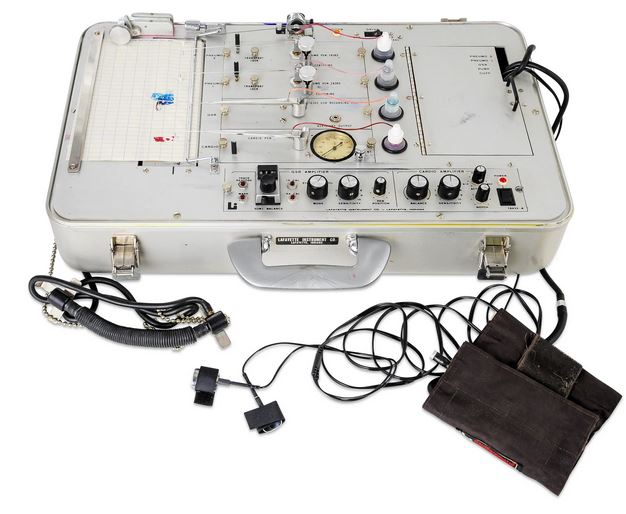
Before talking to the press, maybe the politicians need to be hooked up to a modified polygraph machine that shocks them when they tell a lie? Nah, that’s a terrible, stupid, inhumane idea – they would all electrocute themselves in public!
On the other hand, it would be top notch entertainment.
I heard a commercial on the radio this morning about financing corrective eye surgery which got my attention – not because I was in the market for the procedure – but because it seemed to me that if you can finance your eyeballs, you can probably finance anything, right? This got me to thinking about this current trend of financing all of the things all of the time in today’s instant gratification society here in the good ol’ US of A.
The euphemism for this is “buy now, pay later” (BNPL) which is dominated by fintech companies like Affirm, Afterpay, Klarna, Sezzle, and Zip. Each of these companies has their own flavor of terms, but you should probably read the fine print carefully and choose wisely or that $25 box of Best Cat Toys Ever will end up costing you like $1,000 and the money will get sucked out of your bank account faster than a politician denying sexual misconduct allegations.
Financing traditional big-ticket items like cars, trucks, RV’s, and boats makes perfect sense because most people don’t have the $60-$100K (or more!) of loose money lying around to buy them outright. But, if you’re going to finance something, you better pay attention to your FICO score, or you’ll get nailed with a significantly higher interest rate. This is where the salesperson will ask you, “What do you want your monthly payment to be?” This is also how they bury you with 120 payments at 15% interest and now that $100K RV will actually cost you $193,601.95 over ten years, but you got the RV of your dreams, right?
But nowadays you can finance small-ticket items too like appliances, tires, teeth, computers, smartphones, cosmetic surgery, weight loss surgery, shoes, clothing, jewelry, camping gear, guitars, hardscape, office equipment, and pretty much anything else you can get on Amazon. Apparently, most people don’t even have a few thousand bucks lying around to pay for what they need…or what they want. Therein, I think, is the underlying problem.
The thing about financing all of the things all of the time is that if you fall on hard times and miss a payment or ten, the finance company will dispatch repo-men who will descend upon you like green bottle flies on fresh dog poop to repossess what technically (legally, anyway) belongs to them, of which you obviously can no longer afford, like the car, boat, diamond ring, eyeballs, teeth…stuff like that.
And now you are forever labeled as a deadbeat and your FICO score will drop faster than the value of a memecoin.
I can do math when I need to, but it was never my strongest subject in school. I liked my English, history, and music classes much more than mathematics. Who needs to actually know algebra in their daily adult life anyway? However, I’ll concede here that basic math is important to know and is actually a life skill. Also, electronic calculators are your friend!
Math takes on an entirely new level of difficulty when you’re tired, especially if you are running a marathon and trying to calculate something like your pace, or when you need to eat or drink, or how long it may take you to get to the 26.2-mile finish line. I call this, “The Mis-Calculus of Marathon Runners.” Please allow me to explain…
In a nutshell, you have several primary variables to consider:
Pace
Speed
Distance
Fuel (food)
Hydration (water, sports drink)
ET’s
Pace is calculated in terms of minutes per mile, for example, a 10-minute mile. In the simplest math possible, this means that you’ll finish the marathon in 4.4 hours (rounding up). BUT keeping a steady pace like this is next to impossible during the race and your pace will actually fluctuate wildly. Sometimes your pace will be faster than you expected, but my experience is that my pace is mostly slower…and slower…and slower…and now we walk.
Speed is calculated in miles-per-hour. Taking the 10-minute mile pace from above, your speed is going to be 6-miles per hour, or about twice as fast as the average walking speed, or infinity times faster than a couch potato.
Distance calculations are based on a couple of factors: miles completed, and miles to go, but a marathon runner is mostly concerned with miles to go. Oddly, the further you go in a marathon, the longer the miles get.
Fueling up and hydration are critical parts of the marathon runner’s calculus and although there are food and water stations along the route, you need to bring your own for backup. Typically, you are eating or drinking something about every 10-15 minutes depending upon what your fuel and hydration needs are in caloric terms. In a marathon, you are always in a calorie deficit, so you better stay on top of your food intake! Oh, and you may barf too, or worse…like crapping in your running shorts because you tried a new fuel on race day. Professional coaching tip on this: NOTHING NEW ON RACE DAY!
ET’s (or splits) are basically the time differences between a mile or a block of miles and will generally give you an idea of how you are sustaining, or progressing, or regressing which is generally the case for me being the rank amateur runner that I am. Rank is the keyword in that last sentence.
Secondary variables to consider are:
Sleep deprivation
Injuries (either before or during the race)
“The Wall”
Sleep deprivation – I hate you. In my personal experience, I never get a good night’s sleep the night before a marathon due to a phenomenon called pre-race anxiety. It happens. So, you are essentially going into an intense endurance race totally unrested. It sucks, and it can also turn into a huge negative mental challenge that can be difficult to overcome the further you get into the miles. You’ll start feeling loopy around mid-race and wonder if that dog you just passed really had two heads.
Injuries are relatively common with marathon runners, and it can be anything from a nagging sports injury to some other physical trauma that you had to recover from and endure, like tripping over a tree root while on a training run and injuring your shoulder or ankle or knee. At times like these, I remember the Japanese proverb “Nana korobi, ya oki” which translates to “Fall down seven times, stand up eight.”
“The Wall” is not a reference to the fantastic 1979 Pink Floyd album, rather, it is something that you “hit” at around mile 19. For some, the wall hits a little sooner, for others, the wall hits a little later, but hit it, you will. This is the point at which any lack of proper fuel and hydration intake will come to bite you hard. This is the place where the physical exhaustion and calorie deficit conspire to take you out of the race…if you let them. This is also the critical time to stop crying and collect yourself and rally for the last 7.2 miles, even if you have to do run/walk intervals. This is also where doing math is extremely difficult and it will never add up no matter how hard you try.
You might, might, be able to do some simple addition and subtraction to figure out your pace, or when you’ll finish your race, and you’ll do a lot of rounding up and down as you’re dragging your slow, tired ass toward the finish line, but multiplication and division take on entirely new dimensions of difficulty. Don’t. Even. Try. While in this state of mind, 26.2 minus 19 could be 5 or 6.6 or pi or the hypotenuse of an equilateral triangle or whether you need to find the next portable toilet. But then again, a runner’s watch will magically do all the math for you! I highly recommend one, but you will still find yourself second guessing what the watch is telling you.
At this point in the race, all you really need to concern yourself with is getting to the finish line and snagging that shiny finisher’s medal before the race officials start closing down the marathon course.
But that feeling of finishing a marathon – the runners high – makes all of this worthwhile, even when you think 2+2= less than 12 parsecs.







 msnarky